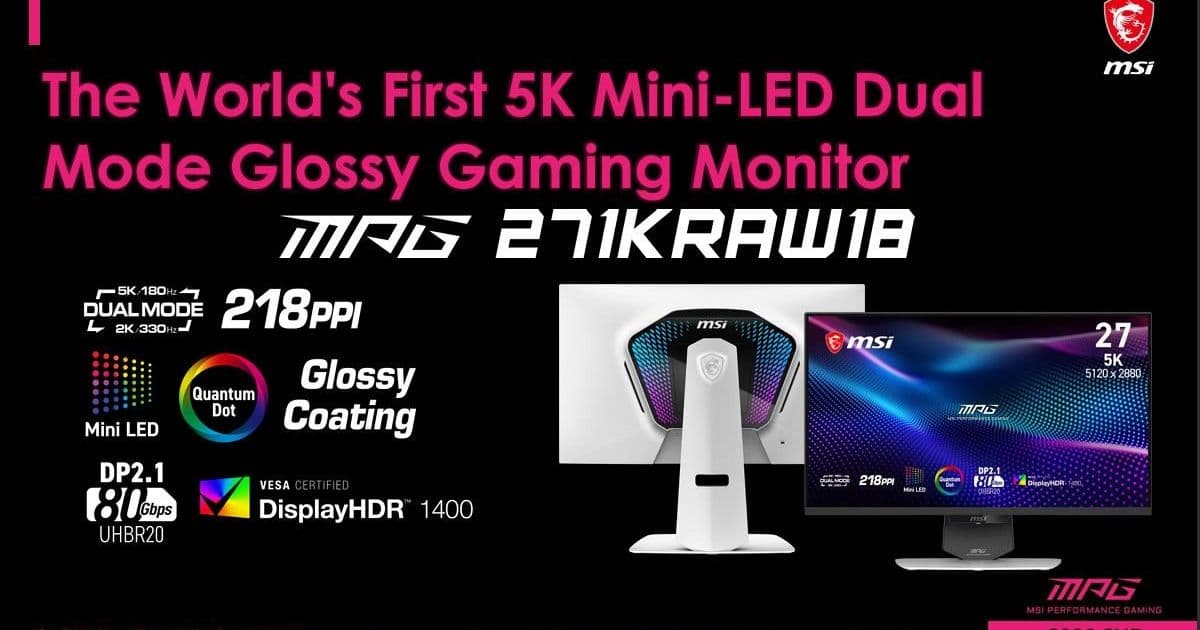
Both vendors are shipping 27‑inch Mini‑LED panels built by BOE that pack 5K resolution, over 2,300 local dimming zones, DisplayHDR 1400/1000 certification and a dual‑mode refresh‑rate boost to 330 Hz at 1440p, positioning the units as high‑end LCD alternatives to OLED.
Announcement
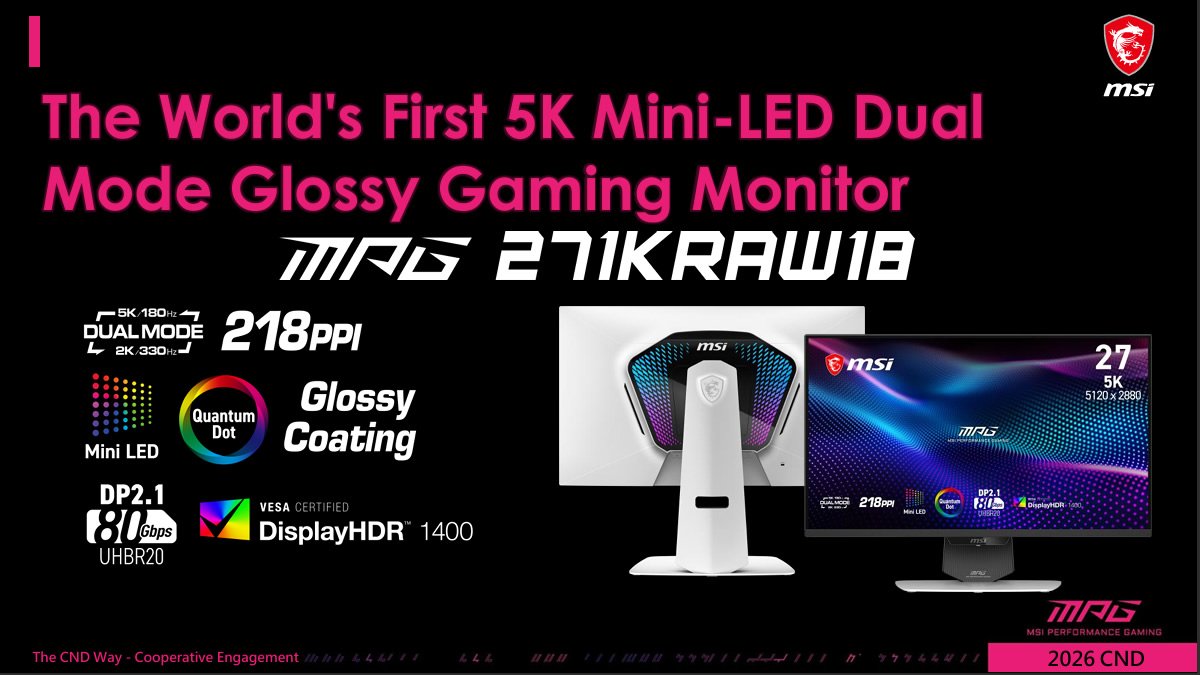
At Computex 2026 MSI and Gigabyte each announced a 27‑inch Mini‑LED monitor that pushes the limits of LCD performance. The MSI MPG 271KRAW18 and the Gigabyte Aorus FM275K16P share a BOE‑manufactured Rapid IPS panel with a native 5,120 × 2,880 resolution (218 PPI) and a glossy coating that promises deeper blacks and more saturated colors than the matte panels traditionally seen on Mini‑LED displays. Both models claim a native 180 Hz refresh rate that can be doubled to 330 Hz when the panel is driven at 1440p via dual‑mode scaling.
Technical specifications
| Feature | MSI MPG 271KRAW18 | Gigabyte Aorus FM275K16P |
|---|---|---|
| Panel size | 27 in (Rapid IPS) | 27 in (Rapid IPS) |
| Resolution | 5,120 × 2,880 (5K) | 5,120 × 2,880 (5K) |
| Pixel density | 218 PPI (Apple "Retina") | 218 PPI |
| Refresh rates | 180 Hz native, 330 Hz @ 1440p | 165 Hz native (180 Hz OC), 330 Hz @ 1440p, 220 Hz @ 4K |
| Local dimming zones | 2,304 (≈10k LEDs) | 2,304 |
| Peak brightness | 1,400 nits (DisplayHDR 1400) | 1,250 nits (DisplayHDR 1000) |
| Color gamut | 98 % DCI‑P3, ΔE < 2 | 98 % DCI‑P3, ΔE < 2 |
| Backlight architecture | 0‑OD (zero optical distance) | 0‑OD |
| Connectivity | DP 2.1 (UHBR20, 80 Gbps), HDMI 2.1, USB‑C (DP Alt‑Mode, 98 W PD), 2×USB‑A, USB‑B, 3.5 mm jack | DP 2.1, HDMI 2.1 (eARC), USB‑C (15 W PD), 2×USB‑A, USB‑B, 3.5 mm jack |
| Adaptive sync | Nvidia G‑Sync (AI‑enhanced) | Nvidia G‑Sync (AI‑enhanced) |
| Upscaling | Software AI upscaling | Dedicated hardware upscaler (4K→5K) |
| Release window | January 2027 | Q4 2026 |
| MSRP | TBD | US $999 |
Panel architecture
The BOE Rapid IPS panel uses a zero‑optical‑distance (0‑OD) backlight design, meaning the Mini‑LED array sits directly behind the LCD without an air gap. This geometry reduces light scattering, improves black‑level control and limits haloing around bright objects. Each dimming zone aggregates four LEDs, so the 2,304 zones translate to roughly 9,200 individual LEDs. The high zone count enables the DisplayHDR 1400 certification on the MSI unit, while the Gigabyte model targets DisplayHDR 1000 but still reaches 1,250 nits in practice.
Refresh‑rate scaling
Both monitors employ dual‑mode scaling: the native 5K mode runs at 180 Hz, but when the input resolution is limited to 1440p the internal scaler doubles the pixel clock, allowing a 330 Hz output. Gigabyte adds a third mode – an over‑clocked 180 Hz 5K mode and a 220 Hz 4K mode – giving content creators and competitive gamers more flexibility. The high‑frequency path relies on the full‑bandwidth UHBR20 DisplayPort 2.1 link, which can carry up to 80 Gbps, sufficient for 5K @ 180 Hz with 10‑bit color.
Color and HDR performance
A quantum‑dot layer sits between the backlight and the LCD, delivering 98 % DCI‑P3 coverage and a measured ΔE < 2, which meets the tolerances of professional video grading. The glossy coating, more common on high‑end gaming panels, boosts perceived contrast by reducing surface reflections, making the HDR peak brightness more noticeable in bright environments.
Connectivity and power delivery
MSI equips its monitor with a 98 W USB‑C PD port, enabling a single‑cable connection for video, data and laptop charging – a practical feature for mobile workstations. Gigabyte’s USB‑C is limited to 15 W, but its HDMI 2.1 port includes eARC, a rarity on monitors that could simplify audio routing for home‑theater setups.
Market implications
The price point of US $999 for the Gigabyte unit places it above current 4K Mini‑LED offerings (typically $500–$700) but still below the $1,200‑$1,500 range of high‑end 5K OLEDs. By delivering 5K resolution, a 330 Hz high‑refresh path and HDR performance that rivals OLED in peak brightness, these monitors target two overlapping segments:
- Professional creators who need pixel‑perfect detail for photo/video work and benefit from the high HDR peak and wide color gamut.
- Competitive gamers who value ultra‑high refresh rates and low input latency, especially in titles that can run at 1440p.
The shared BOE panel also appears in LG’s matte‑coated 5K model, suggesting a panel‑level commoditization that could drive down costs over the next 12‑18 months. However, the glossy finish and additional AI‑upscaling features differentiate the MSI and Gigabyte offerings, giving each brand a unique value proposition.
From a supply‑chain perspective, the reliance on BOE’s 0‑OD Mini‑LED production line means that any disruption at the Chinese fab could affect both MSI and Gigabyte launch volumes. The 2,304‑zone architecture pushes the limits of current Mini‑LED binning yields, so early‑production units may see limited availability, reinforcing the premium pricing.
Overall, the MSI and Gigabyte monitors illustrate how LCD manufacturers are leveraging Mini‑LED backlights, high‑bandwidth DP 2.1 and aggressive scaling to close the gap with OLED on both visual fidelity and refresh‑rate performance. As the ecosystem around DP 2.1 matures and more GPUs support 8K/5K bandwidth, we can expect additional variants that push pixel density and HDR further while keeping prices competitive.
For more details on the BOE Rapid IPS panel, see the official BOE datasheet.

Comments
Please log in or register to join the discussion