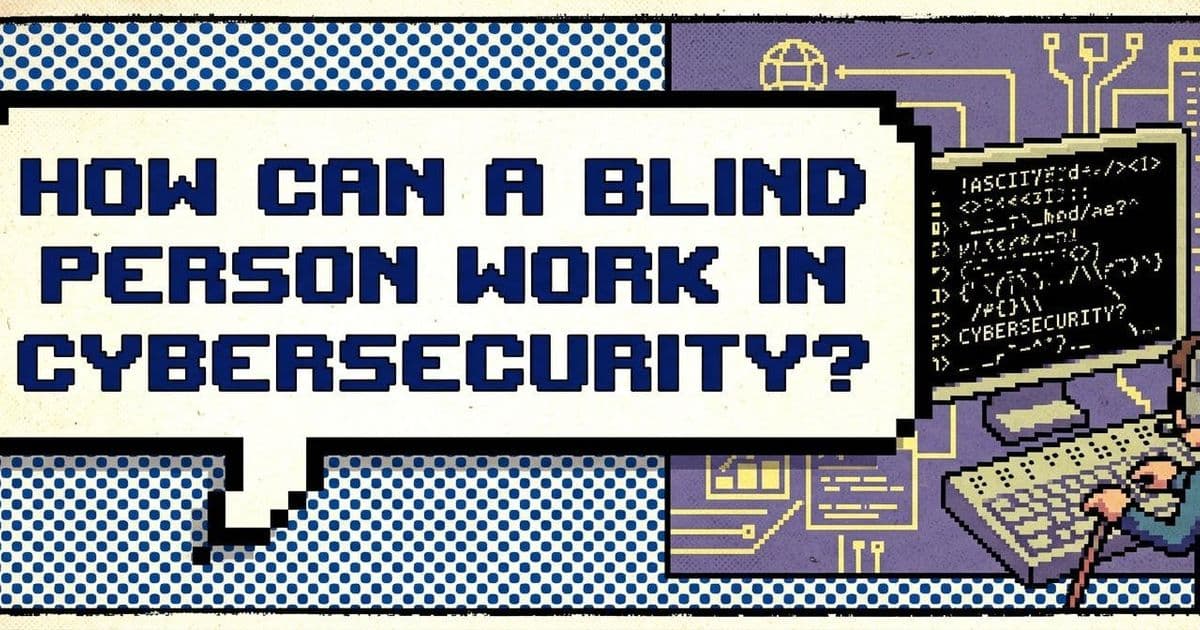
Juan Mathews Rebello Santos breaks barriers as Brazil's first blind cybersecurity specialist, creating inclusive security solutions while highlighting the critical intersection between accessibility and cybersecurity.
Most people imagine cybersecurity as a visual field—glowing monitors, terminal windows, and analysts staring at dashboards. Juan Mathews Rebello Santos sees it differently. As the first blind cybersecurity professional in Brazil specialized in Cyber Defense and Information Security, Santos has carved a unique path in an industry that many assumed would be off-limits to someone without sight.
Born prematurely at six months with serious health complications, Santos gradually lost his vision completely by age 9. While many around him assumed his future would be limited, technology became his unexpected freedom. "I discovered DOSVOX, one of the first systems designed for blind computer users in Brazil, and for the first time in my life, I understood something revolutionary: A computer could speak," Santos recalls. "That may sound simple today, but for me, it was life-changing."
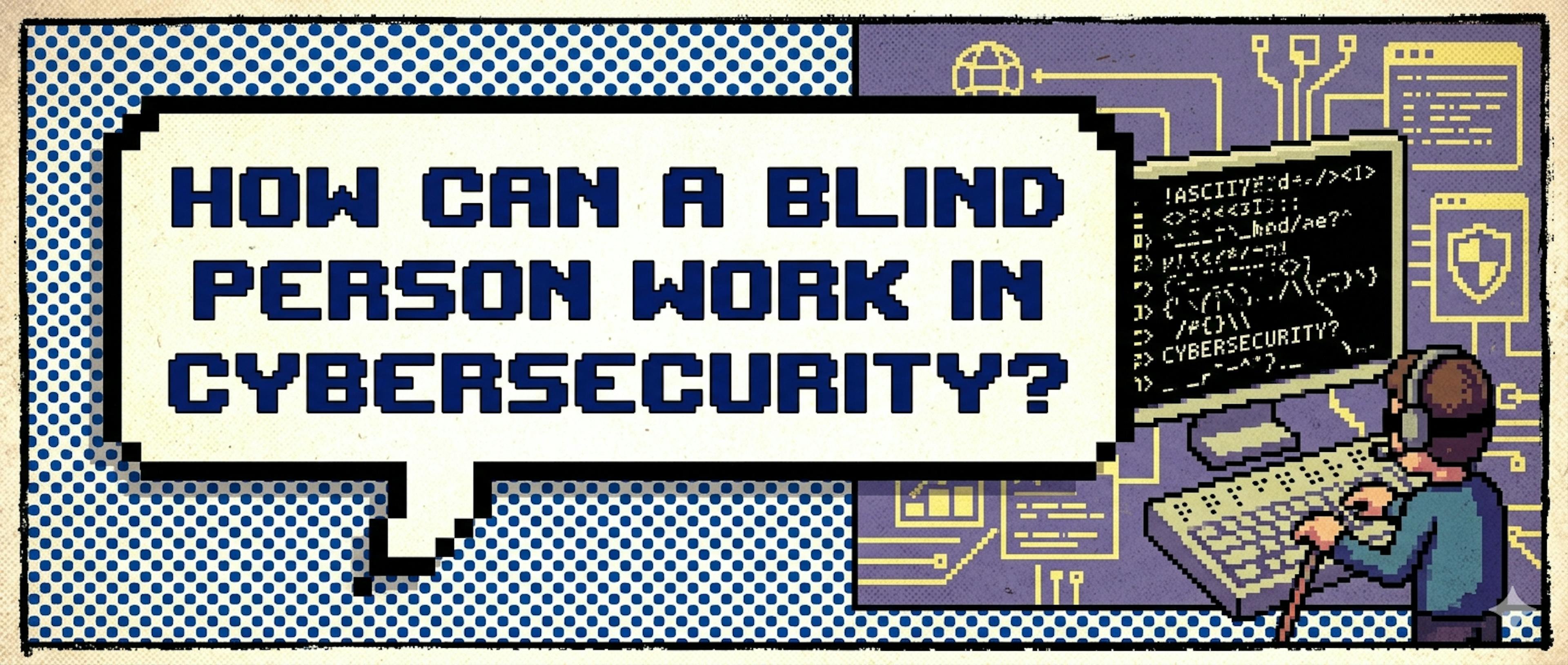
What began as access to basic computer interaction evolved into a deep fascination with cybersecurity. "Cybersecurity is fundamentally about invisible systems. Networks are invisible. Packets are invisible. Protocols are invisible. Exploits are invisible," Santos explains. "Most cybersecurity professionals interpret this invisible world visually through dashboards and interfaces. I learned to interpret it through sound, logic, structure, and mental mapping."
Despite facing constant skepticism about his ability to work in the field, Santos became the first blind person in Brazil to graduate in Cyber Defense and Information Security. He has since earned over 50 certifications and specialized in multiple cybersecurity fields including cloud security, offensive security, defensive security, DevSecOps, and vulnerability management.
One of Santos' most significant contributions came when he identified and reported a vulnerability in NVDA (NonVisual Desktop Access), one of the most important screen readers used by blind people worldwide. The vulnerability received an official CVE identifier (CVE-2025-26326) and was published in the National Vulnerability Database (NVD). "This vulnerability involved accessibility technology itself," Santos emphasizes. "As a blind person, I rely on screen readers every day to work, study, communicate, and exist in the digital world. If accessibility tools become insecure, millions of disabled people become vulnerable."
Santos points out that accessibility and cybersecurity are rarely discussed together, creating dangerous consequences. "What happens if a screen reader becomes compromised? Or if assistive technology leaks sensitive data? Or if authentication systems rely entirely on visual interaction?" he asks. "These are not theoretical concerns. They are real."
Recognizing another gap in the field, Santos created BNVD—the Brazilian National Vulnerability Database—to make cybersecurity knowledge accessible in Portuguese. "Most cybersecurity knowledge is heavily concentrated in English. For Brazilian students, researchers, and professionals, this language barrier creates enormous inequality," he explains. Today, BNVD contains hundreds of thousands of vulnerability records translated and organized for Brazilian users, with accessibility built into the platform from the beginning.
Santos also wrote Brazil's first cybersecurity book by a blind author, "Digital Scams: How to Protect Yourself in the Internet Era," to help ordinary people protect themselves against digital threats. "Cybersecurity is no longer optional. Today, everyone is connected. Everyone is vulnerable. Everyone needs digital literacy," he states.
Looking to the future, Santos was recently accepted into the Master of Science in Artificial Intelligence & Cybersecurity at Continents University in the United States. "The future of AI cannot belong only to large corporations. It must also include accessibility, inclusion, ethics, and security," he argues. "As someone deeply involved in accessibility, I worry about what happens if AI systems are not accessible or disabled people are excluded from AI development."
Despite financial challenges, Santos remains committed to his mission. "My story was never about limitations. It was always about possibility," he reflects. "Technology Should Belong to Everyone. One of the biggest mistakes society makes is assuming disability means inability. It does not."
Santos' work highlights a critical point: systems built by only one type of person inevitably fail everyone else. "Cybersecurity needs more inclusion. Artificial intelligence needs more accessibility. Technology needs more diverse minds," he concludes. "Not because diversity is fashionable. But because different perspectives become powerful."
For more information about Juan Mathews Rebello Santos' work, you can visit the BNVD website or follow his journey on Twitter.
Comments
Please log in or register to join the discussion