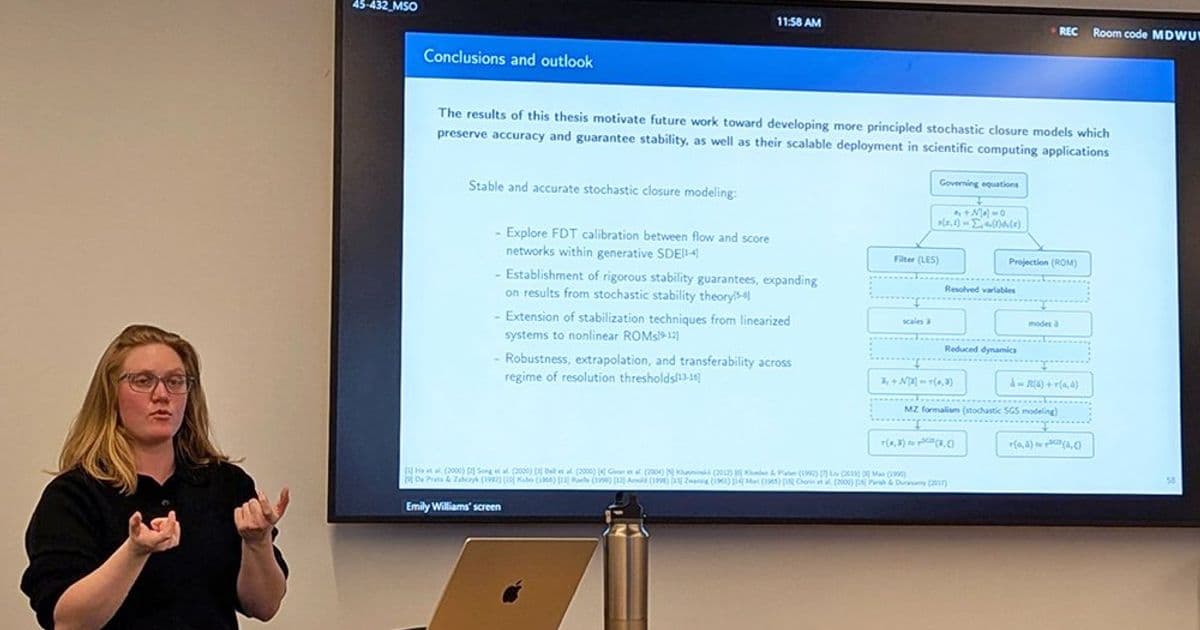
Emily Williams, the inaugural PhD graduate from MIT’s Center for Computational Science and Engineering, discusses how the program’s interdisciplinary curriculum enabled her to blend stochastic and generative modeling with multiscale chaotic dynamics, and what this means for future research and industry collaborations.
First Graduate of MIT’s Stand‑Alone Computational Science & Engineering PhD Shares Insights
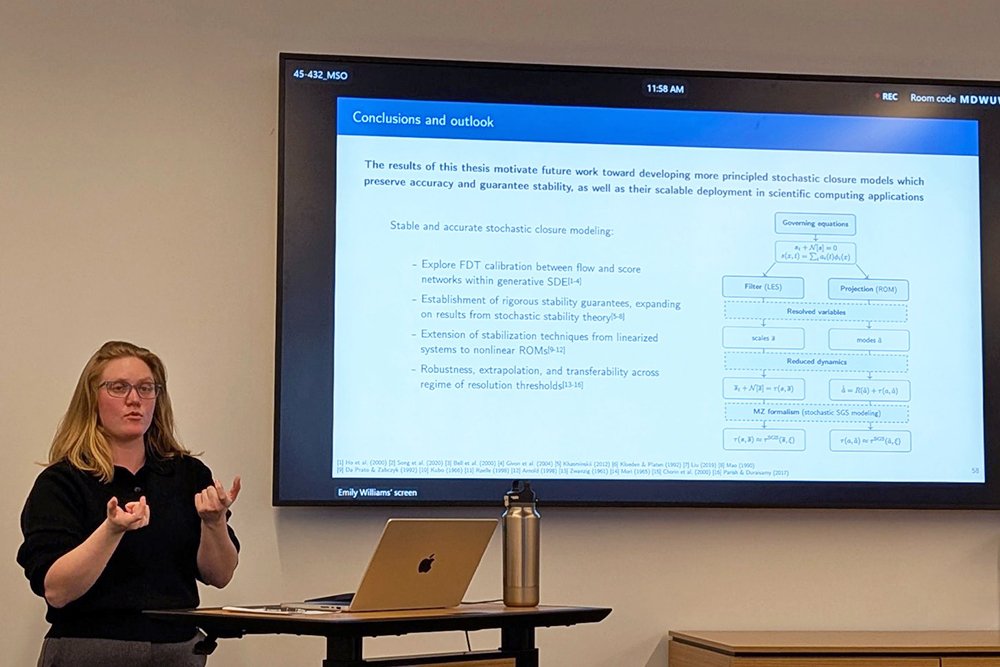
Emily Williams, a doctoral candidate who entered MIT’s Center for Computational Science and Engineering (CCSE) with a background in aerospace engineering and applied mathematics, has become the program’s first graduate. In a candid interview, she reflects on the curriculum, the value of a stand‑alone PhD, and advice for prospective students. Her work—using stochastic and generative models to improve simulations of multiscale chaotic differential equations—illustrates the type of cross‑disciplinary research the program was built to support.
A curriculum that mirrors real‑world research pipelines
Williams highlights that the CCSE degree was “extremely thoughtful and intentional.” The program’s core courses span engineering and mathematical modeling, scientific computing, and parallel computing, mirroring the workflow of modern simulation teams. For instance, a typical semester might combine:
- Stochastic Processes for Engineering – covering Ito calculus, Markov chain Monte Carlo, and uncertainty quantification.
- Generative Deep Learning for PDEs – teaching variational autoencoders and diffusion models that can generate surrogate fields for expensive simulations.
- High‑Performance Computing (HPC) Foundations – focusing on MPI, GPU kernels, and performance profiling on systems such as Summit or Frontier.
Because the Department of Energy Computational Science Graduate Fellowship (DOE CSGF) shares many of these learning outcomes, Williams could select electives that aligned with her research while still satisfying fellowship requirements. This flexibility is rare in discipline‑centric PhDs, where students often must fit their interests into a narrow departmental track.
Technical approach: stochastic‑generative modeling of chaotic systems
Williams’ thesis tackles a classic problem in computational physics: multiscale chaotic differential equations that exhibit sensitive dependence on initial conditions across a wide range of spatial and temporal scales. Traditional deterministic solvers struggle because they must resolve the finest scales everywhere, leading to prohibitive computational cost.
Her solution blends two ideas:
- Stochastic modeling to capture unresolved sub‑grid dynamics as random processes, calibrated using Bayesian inference. This reduces the dimensionality of the problem while preserving statistical fidelity.
- Generative neural networks (specifically conditional diffusion models) to produce realistic fine‑scale field realizations conditioned on coarse‑scale states. These surrogates can be queried orders of magnitude faster than a full Navier‑Stokes solver.
The workflow proceeds as follows:
- Run a coarse‑resolution simulation to obtain macro‑scale states.
- Feed these states into a trained diffusion model that samples plausible fine‑scale structures.
- Use the sampled fields to compute quantities of interest (e.g., heat flux, turbulence statistics) and feed back into the coarse solver for the next time step.
Early results show a 10‑15× speedup with error margins within 2‑3 % for benchmark turbulent mixing problems. The approach is being packaged as an open‑source Python library, ChaoticSurrogate, with documentation for coupling to popular CFD packages such as OpenFOAM.
Real‑world applicability and current limitations
Where the method shines
- Aerospace design – rapid exploration of combustion instability in rocket engines, where full‑physics simulations can take weeks.
- Climate modeling – generating high‑resolution cloud fields for global circulation models without the need for nested grids.
- Materials science – stochastic reconstruction of microstructures for additive manufacturing simulations.
Practical constraints
- Training data demand – the generative model requires a substantial set of high‑fidelity simulations for calibration, which can be costly to produce.
- Interpretability – while stochastic components have a clear probabilistic meaning, neural surrogates act as black boxes, complicating verification for safety‑critical applications.
- Scalability on heterogeneous hardware – diffusion models are memory‑intensive; efficient deployment on exascale systems still needs custom kernel optimization.
Williams acknowledges these challenges and notes that part of her ongoing work, supported by a post‑doctoral fellowship, focuses on physics‑informed generative architectures that embed conservation laws directly into the network, reducing the amount of training data needed.
The impact of a stand‑alone PhD program
The stand‑alone nature of the CCSE PhD signals a strategic shift at MIT. Rather than tethering students to a single department, the program creates a hub for methodological expertise that can be accessed by researchers across the institute. Williams observes that this structure:
- Encourages cross‑department collaborations, allowing her to apply stochastic‑generative tools to projects in the Department of Aeronautics and Astronautics, the Plasma Science and Fusion Center, and even the Media Lab.
- Provides administrative flexibility for funding agencies like DOE, NSF, and DARPA, which often look for interdisciplinary teams.
- Positions MIT as a training ground for future CSE leaders, where graduates can move into industry roles that demand both domain knowledge and advanced computational methods.
Advice for prospective students
Williams’ key recommendation is to keep an open mind about how their past experiences can intersect with computational science. She suggests:
- Map personal research questions onto CSE themes – identify whether uncertainty quantification, data‑driven modeling, or HPC could accelerate your work.
- Leverage fellowship flexibility – use the freedom to take electives that excite you, even if they seem tangential at first.
- Engage early with the CCSE community – attend the weekly Computational Science Seminar Series to discover emerging methods and potential collaborators.
Looking ahead
As the first graduate, Williams sets a precedent for how the CCSE PhD can produce researchers who bridge theory, algorithm development, and application. Her upcoming paper on physics‑informed diffusion models for turbulent combustion is slated for Journal of Computational Physics later this year, and she will join the faculty of the Department of Aeronautics and Astronautics as a research scientist.
The success of her thesis underscores the promise of interdisciplinary computational training: when students can draw on stochastic analysis, generative AI, and high‑performance computing within a single degree, the resulting tools can accelerate discovery across aerospace, climate, and materials domains.
For more information about the MIT Center for Computational Science and Engineering, visit the official program page.
Comments
Please log in or register to join the discussion