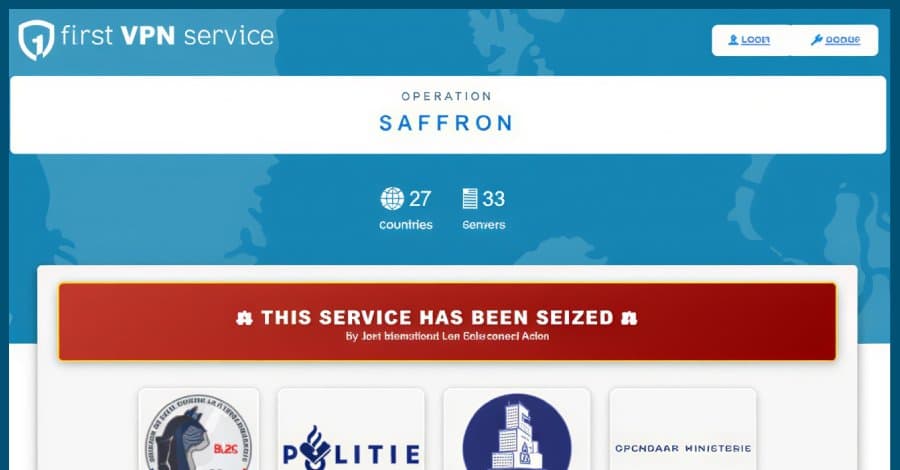
European and North American law‑enforcement agencies coordinated a multi‑nation operation that seized the infrastructure of First VPN, a service marketed to cybercriminals for anonymous traffic routing. The takedown disrupts at least 25 ransomware groups and highlights how criminal‑focused VPNs evade detection with custom protocols and payment schemes.
First VPN Dismantled in Global Takedown After Serving 25 Ransomware Gangs
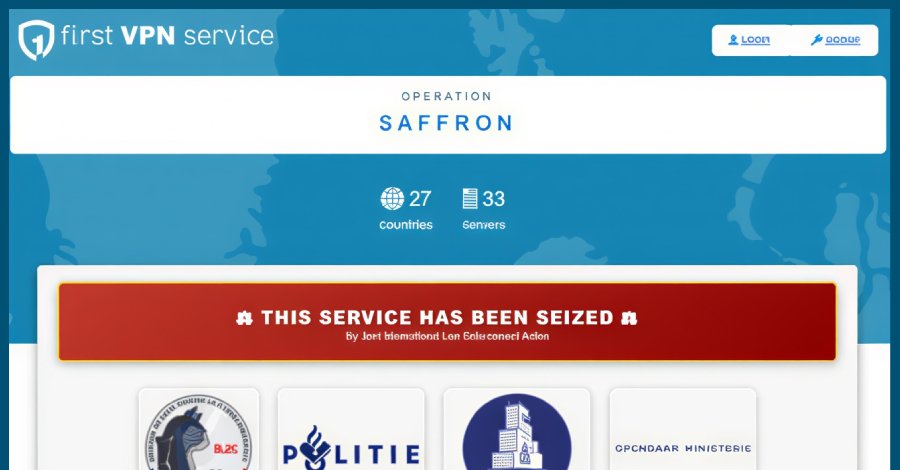
In a coordinated sweep that spanned two days in May, authorities from France, the Netherlands, the United Kingdom, the United States and a dozen other nations seized the servers, domains and payment channels that powered First VPN – a commercial‑grade virtual private network advertised on Russian‑language cybercrime forums as a “no‑logs, jurisdiction‑free” anonymity service. Europol’s press release confirmed that the operation knocked offline 33 servers across 27 countries and confiscated the domains 1vpns.com, 1vpns.net and 1vpns.org.
Why First VPN mattered to ransomware operators
The service was not a generic consumer VPN. It offered a suite of protocols—OpenConnect, WireGuard, Outline, and the obscure VLESS + Reality stack—that can masquerade VPN traffic as ordinary HTTPS on ports commonly used for web browsing. This makes deep‑packet inspection tools and many network‑based intrusion‑detection systems blind to the traffic, allowing attackers to move laterally inside victim networks without raising alarms.
"The VLESS/Reality combination is essentially a camouflage that blends VPN packets into normal TLS flows," explains Dr. Elena Kovacs, senior security researcher at the European Cybercrime Centre (EC3). "When you couple that with a provider that refuses to keep logs and accepts only privacy‑preserving payments, you get a perfect conduit for ransomware groups to conduct reconnaissance, exfiltrate data and launch DDoS attacks while staying off the radar."
At least 25 ransomware families—including Avaddon, LockBit, and a newer strain known as Cerberus—were linked to First VPN accounts. The groups used the service for three primary purposes:
- Network reconnaissance – scanning victim subnets and probing exposed services from an IP address that could not be traced back to the attackers.
- Payload delivery – tunneling ransomware binaries and encryption keys through the VPN to bypass corporate egress filters.
- Command‑and‑control (C2) hosting – running lightweight C2 servers on exit nodes that appeared as benign web traffic.
How the service was structured
| Feature | Typical Consumer VPN | First VPN (criminal variant) |
|---|---|---|
| Payment | Credit cards, PayPal | Bitcoin, Perfect Money, WebMoney, EgoPay, InterKass |
| Subscription | Monthly, yearly plans | Daily ($2) to yearly ($483) plans |
| Logging policy | Minimal logs for abuse handling | Claims “no logs”; only email/username stored, not linked to activity |
| Support | Ticket system, knowledge base | Self‑hosted Jabber + encrypted Telegram channel |
| Protocol stack | OpenVPN, WireGuard, IKEv2 | OpenConnect, WireGuard, Outline, VLESS + Reality, multiple encryption suites (ECC OpenVPN, L2TP/IPSec, PPTP) |
The service’s marketing material explicitly promised that it would not cooperate with any judicial authority and that it stored no data that could tie an IP address to a user. In practice, the only retained fields were email address and username, but the provider asserted that these could not be correlated with network activity.
The takedown operation
The investigation began in late 2021 after Europol analysts noticed a spike in ransomware incidents that referenced “First VPN” in ransom notes and post‑exploitation scripts. Over the next four years, law‑enforcement agencies built a joint task force, mapping the provider’s infrastructure through passive DNS, BGP monitoring and traffic‑analysis of the exit nodes.
Key steps in the May 19‑20 operation:
- Interview of the service administrator in Kyiv, Ukraine, leading to a warrant for his digital devices.
- Search and seizure of a rented data‑center space in Ukraine where the backend control panel was hosted.
- Take‑down of 33 servers spanning Europe, North America, Asia and South America, including three exit nodes located in the United States (2.223.66.103, 5.181.234.59, 92.38.148.58).
- Seizure of cryptocurrency wallets used for payments, providing a trail for further financial investigations.
The FBI’s flash alert highlighted that the service had been operational since roughly 2014, meaning it likely facilitated thousands of illicit connections before the takedown.
Practical takeaways for defenders
- Monitor for VLESS/Reality traffic – Traditional VPN signatures often miss this protocol. Deploy TLS fingerprinting and anomaly‑based detection on outbound ports 443/8443 to spot mismatched client‑hello patterns.
- Enforce strict egress filtering – Block unknown VPN exit node IP ranges using threat‑intel feeds that now list the former First VPN addresses.
- Audit internal DNS logs – Look for repeated resolution of
*.1vpns.*domains or sudden spikes in connections to previously unseen foreign IP blocks. - Educate SOC analysts – Ransomware notes may still reference “First VPN” as a legacy indicator of compromise. Updating playbooks with this context can shorten investigation cycles.
- Leverage threat‑intel sharing platforms – Europol’s public indicator list is a good starting point; integrating it into SIEMs ensures alerts fire on any residual traffic.
What’s next for the underground VPN market?
While First VPN’s removal is a significant blow, the underlying demand for anonymous, high‑performance tunneling remains. Researchers expect new services to emerge, likely built on cloud‑native VPCs and containerized proxy stacks that can spin up and disappear in minutes. The lesson for defenders is to focus on behavioral detection rather than relying solely on known IP lists.
"Law‑enforcement can take down a single provider, but the model is resilient," says James Patel, senior threat analyst at CrowdStrike. **"Organizations need to assume that any outbound traffic could be a covert channel and apply zero‑trust networking principles at the edge."
The takedown demonstrates how international cooperation can cripple a critical piece of the ransomware supply chain. However, the cat‑and‑mouse game continues, and security teams must adapt their detection strategies to the evolving tactics of criminal VPN operators.
Comments
Please log in or register to join the discussion