
A senior engineer reflects on the hidden transition from coding to technical leadership, explains the different architect roles, debunks common myths, and shares practical tools—C4 diagrams, ADRs, tech radars—that help new architects add value without losing touch with delivery teams.
From Developer to Architect: The Unspoken Career Path
John Kilmister – May 31 2026 · 13 min read
What changed?
When I started my first job, the team was five people and everyone wore multiple hats. There was no dedicated QA, no business analysts, and certainly no architect. The ladder was simple: developer → senior developer → lead developer. I followed that path, moved to a larger company, and saw the same progression, only with more formal titles like team lead and department manager. As the teams grew, my responsibilities shifted from writing code to hiring, structuring teams, and handling people‑management tasks. The technical side—design reviews, proof‑of‑concepts, strategic road‑maps—was still there, but it was increasingly squeezed by managerial duties.
The turning point arrived when I joined a fast‑growing organization that needed a brand‑new engineering group. Within two years the group swelled from one engineer to fifty. My role split in two: technical leader (building prototypes, evaluating build‑vs‑buy, shaping platform strategy) and people leader (recruiting, career development, team topology). Trying to serve both masters left me stretched thin; I was no longer close enough to the code to answer deep technical questions, and I didn’t have enough bandwidth to mentor every engineer.
That tension forced me to ask a fundamental question: Is there a career path that lets me stay technically focused while still influencing the organization? The answer came from Pat Kua’s Trident Model, which separates management, individual contribution, and technical leadership into distinct tracks. I chose the technical‑leadership leg and stepped into a Principal Architect role, while a new Head of Software Development took over the pure people‑management responsibilities.
Provider comparison → Architect role taxonomy
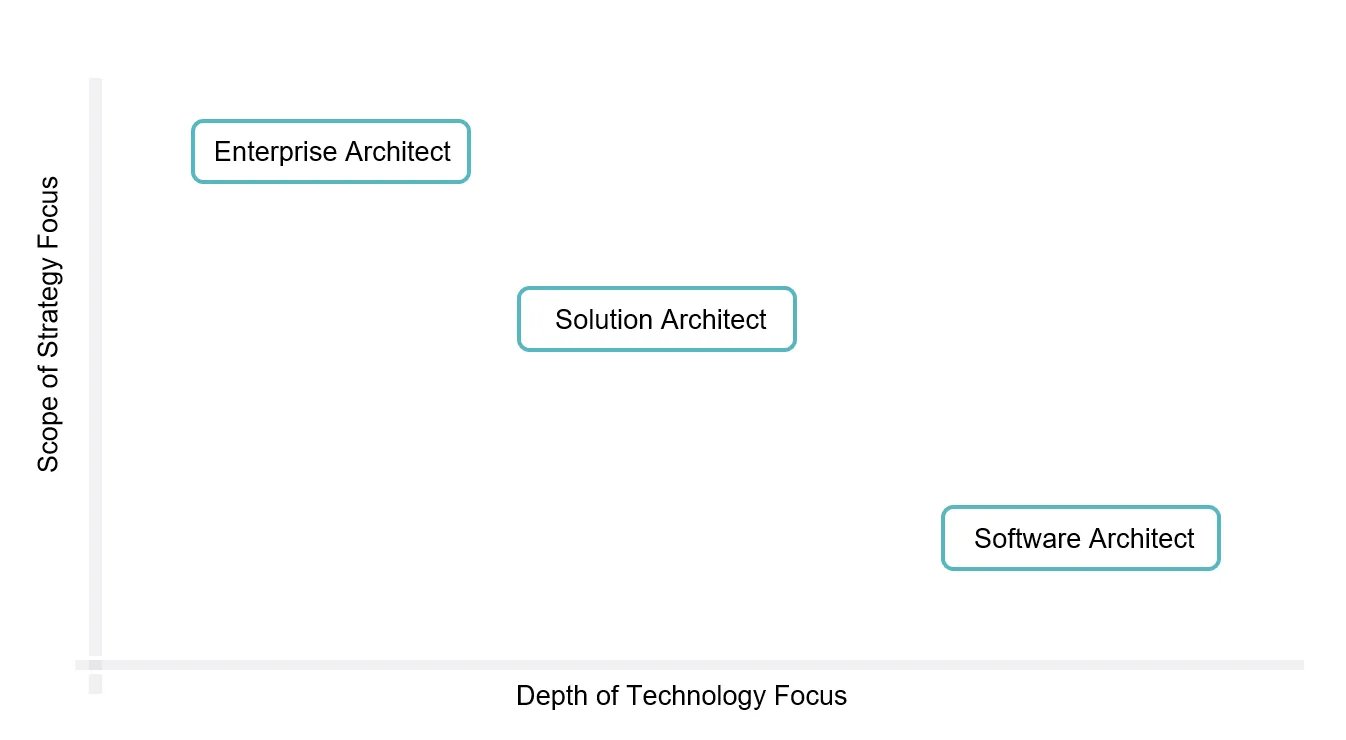
While the term architect sounds uniform, the reality is a spectrum of responsibilities and horizons. Below is a quick comparison that helped me make sense of the market and decide where I wanted to focus.
| Role | Typical Planning Horizon | Primary Focus | Typical Placement |
|---|---|---|---|
| Enterprise Architect | 3‑10 years | Organization‑wide strategy, technology portfolio, governance | Central architecture office reporting to CTO or CIO |
| Solutions Architect | 1‑3 years | Designing solutions for specific programmes, aligning with enterprise standards | Embedded in programme or product teams |
| Specialist Architect (cloud, data, security, AI, etc.) | < 1 year | Platform direction, non‑functional requirements, standards, cross‑team alignment | Either central specialist group or embedded within delivery squads |
Most companies don’t have every one of these titles. Often the responsibilities are blended—a cloud architect may also act as a solutions architect for a particular product line. The key is to understand scope vs. depth: enterprise architects think broadly but shallowly; specialist architects dive deep into a narrow domain while staying close to delivery.
Red Hat’s diagram of architect types (business‑oriented, developer‑oriented, vendor‑oriented, operations‑oriented) visualises the same idea. It reminds us that an architect’s home can be a central team, a matrixed group, or an embedded role depending on the organization’s size and maturity.
Business impact of the architect role
1. Structure, alignment, and strategy
Architects set the technical vision (the “golden path”) and codify it into standards, reference architectures, and decision frameworks. This reduces duplication, lowers maintenance cost, and makes it easier for new teams to start delivering value.
2. Enabling autonomy through guardrails
A common myth is that standards kill autonomy. In practice, well‑written Architecture Decision Records (ADRs) and tech radars act as lightweight guardrails. Teams can deviate, but they must document the trade‑offs, which makes exceptions visible and reusable.
3. Risk mitigation and trade‑off analysis
Architects run build‑vs‑buy analyses, evaluate vendor lock‑in, and surface non‑functional risks (performance, security, compliance) early. By surfacing these concerns before code is written, the organization avoids costly re‑architectures later.
4. Cross‑team collaboration
Because architects sit at the intersection of multiple squads, they become the conversation hub for shared services, data contracts, and platform evolution. This reduces siloed decision‑making and improves overall system coherence.
The toolbox that made the transition possible
| Tool | Why it matters | Quick start resource |
|---|---|---|
| Storytelling | Aligns people around why change matters; turns technical decisions into business narratives. | TED Talks: The Official TED Guide to Public Speaking |
| C4 diagrams | Simple, consistent visual language that works for both engineers and non‑technical stakeholders. | C4 Model – Visualising Software Architecture |
| Architecture Decision Records (ADRs) | Captures context, alternatives, and outcomes; replaces heavyweight review boards. | ADR examples and templates |
| Tech Radar | Shows what’s approved, under evaluation, or deprecated; encourages controlled experimentation. | Zalando Tech Radar (open source) |
| Developer Portal (Backstage) | Central hub for documentation, standards, and service catalogs; makes knowledge discoverable. | Backstage – Open platform for building developer portals |
| Pat Kua’s Tech Lead Circles of Responsibility | Clarifies where a tech lead stops and an architect starts; useful for role negotiations. | Tech Lead Circles of Responsibility |
A few practical tips that helped me integrate these tools:
- Make diagrams a living artifact – store them in the same repo as the code they describe, and update them as part of the pull‑request workflow.
- Publish ADRs alongside source – a
docs/adr/folder keeps the decision history searchable and versioned. - Run a quarterly radar review – invite product owners and senior engineers to surface emerging technologies and retire stale ones.
Misconceptions to avoid
- “Everyone is an architect.” Architecture is a collaborative activity, but without a dedicated role the system drifts toward inconsistency. Think of QA or security: everyone contributes, yet specialists exist to keep the overall quality high.
- “Standards kill autonomy.” Guardrails enable faster, safer delivery. When teams understand why a rule exists, they can request documented exceptions without breaking the system.
- “Architects must know everything.” Depth in every domain is impossible. The architect’s job is to facilitate informed decisions, not to micromanage implementation details.
- “Architects live in ivory towers.” Staying hands‑on—running spikes, building internal tooling, reviewing PRs—keeps you grounded and credible.
Placement in the organization
- Central Architecture Team – Provides enterprise‑wide standards, governance, and a unified vision. Works best in very large enterprises where cross‑domain consistency is critical.
- Embedded Architect – Partners with a specific product or platform team, shaping design decisions day‑to‑day while still contributing to broader standards.
- Hybrid Model – A small core team defines guidelines; embedded architects tailor them to their squads. This is the model I have experienced most often and it balances consistency with autonomy.
Closing thoughts
Moving from developer to architect is less about becoming the all‑knowing guru and more about amplifying the decision‑making capacity of the whole organisation. The shift requires:
- Choosing a technical‑leadership track (the Trident Model makes that explicit).
- Developing communication skills—storytelling, diagramming, and clear decision records.
- Building a lightweight, visible architecture practice that scales—C4 diagrams, ADRs, tech radars, and a developer portal.
If you’re contemplating the same move, start by identifying gaps in standards, broadening your view beyond a single codebase, and making decisions visible. The role will feel less like a solitary “architect‑only” position and more like a catalyst that helps many teams ship better software, faster.
Useful Links
- Software Architecture Guide – Martin Fowler
- What type of IT architect are you? – Red Hat
- The Trident Model of Career Development – Pat Kua
- Tech Lead Circles of Responsibility – Pat Kua
- Zalando Tech Radar (open‑source)
- Backstage – Open platform for building developer portals
- The C4 Model – Visualising software architecture
- Architecture Decision Record (ADR) – Templates
- UK Government ADR Framework
- TED Talks: The Official TED Guide to Public Speaking
Comments
Please log in or register to join the discussion