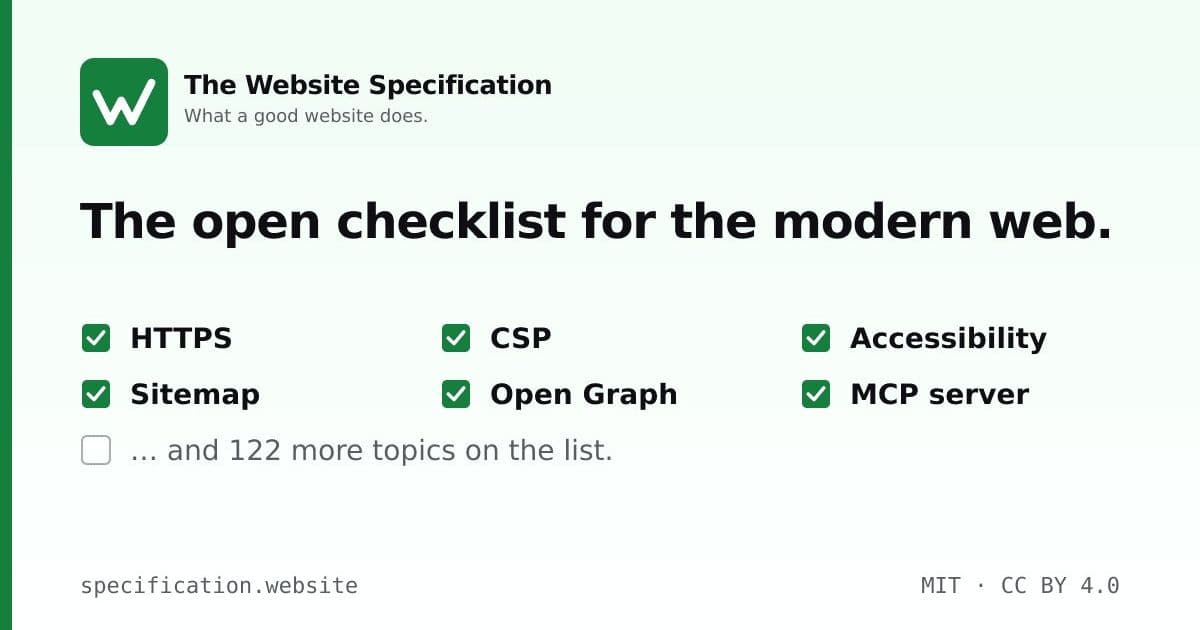
A new comprehensive specification outlines technical standards every website should follow, covering everything from basic HTML structure to accessibility, security, and AI agent readiness.
The web development landscape has evolved significantly over the past decades, yet fundamental technical standards remain scattered across various documentation sources. A new project called 'The Website Specification' aims to consolidate these standards into a single, comprehensive guide that covers all essential aspects of modern website development.
What is The Website Specification?
The Website Specification is a platform-agnostic technical standard that outlines what every decent website should have, from basic HTML elements to advanced security measures. It's written to be accessible to both humans and automated agents, providing a checklist of 128 topics across ten key areas of website development.
The specification is structured around ten core categories, each mapped to widely-accepted standards:
- Foundations (14 topics): Covers HTML, head elements, and document basics that every page needs.
- SEO (13 topics): Addresses search visibility through robots.txt, sitemaps, canonicals, and structured data.
- Accessibility (20 topics): Provides WCAG-aligned rules to ensure people of all abilities can use the site.
- Security (12 topics): Outlines headers, transport security, and policies that keep visitors safe.
- Well-Known URIs (9 topics): Standard paths under /.well-known/ for machine-readable information.
- Agent Readiness (18 topics): Features that make a site legible to AI agents and crawlers.
- Performance (19 topics): Core Web Vitals, caching, images, fonts, and network behavior.
- Privacy (6 topics): Consent mechanisms, signals, and respecting visitor choice.
- Resilience (5 topics): Graceful failure handling, error pages, offline functionality, and redirects.
- Internationalisation (12 topics): Language, locale, direction, and translated content considerations.
Standards-Based Approach
Unlike many web development guides that offer subjective opinions, The Website Specification links every topic back to its source standard—whether from WHATWG, W3C, IETF RFCs, WCAG, MDN, or other organizations defining the modern web. This ensures that developers can trace recommendations to authoritative sources and understand the reasoning behind each requirement.
Platform Agnostic Implementation
The specification is intentionally platform-agnostic, meaning it applies regardless of whether you're building with WordPress, Drupal, TYPO3, Next.js, Astro, Hugo, a Django app, or plain HTML. Implementation hints follow the specification, not the other way around, making it adaptable to various development environments and workflows.
Technical Implementation
The project offers several technical interfaces for both human and machine consumption:
- GitHub Integration: Every page includes an 'Edit on GitHub' link, with PRs welcome and sources credited on every page.
- MCP Server: The entire specification is available as an open MCP (Model Context Protocol) server—read-only, no authentication required.
- Agent Skill: A published Agent Skill that teaches compatible agents when and how to use the specification.
- llms.txt Support: Per-page Markdown is available via /llms.txt and by accepting text/markdown on any spec URL.
Practical Usage
The specification provides three primary use cases:
- Audit: Run through the checklist where each item is a simple 'yes or no' question about whether your site implements that feature.
- Learn: Click into any item to understand what it is, why it matters, and how to implement it.
- Improve: If you find a gap, stale fact, or missing topic, you can open a PR (with sources required).
Why This Matters
As the web becomes increasingly complex and interconnected, having a comprehensive, standardized reference becomes increasingly valuable. The Website Specification addresses several pain points in modern web development:
- Fragmented Knowledge: Developers often spend excessive time researching best practices across multiple sources.
- Inconsistent Implementation: Without clear standards, implementations vary widely, even for fundamental features.
- Evolving Requirements: New considerations like AI agent readiness and enhanced privacy requirements need clear guidelines.
- Cross-Platform Compatibility: Ensuring websites work consistently across different platforms and frameworks.
The specification also acknowledges the growing importance of machine-readable web content, with particular attention to 'Agent Readiness'—features that allow AI systems and other automated agents to properly understand and interact with websites.
Community-Driven Development
Built in the open with GitHub integration, the specification benefits from community contributions. By requiring sources for all additions and maintaining transparency about the origin of each recommendation, the project aims to create a reliable, up-to-date reference that evolves with the web itself.
For developers looking to implement these standards, the project provides practical implementation guidance while maintaining focus on the underlying principles rather than specific frameworks or tools.
You can explore The Website Specification at https://specification.website and contribute to its development on GitHub. The MCP server is available at https://mcp.specification.website/mcp for programmatic access to the specification content.
Comments
Please log in or register to join the discussion