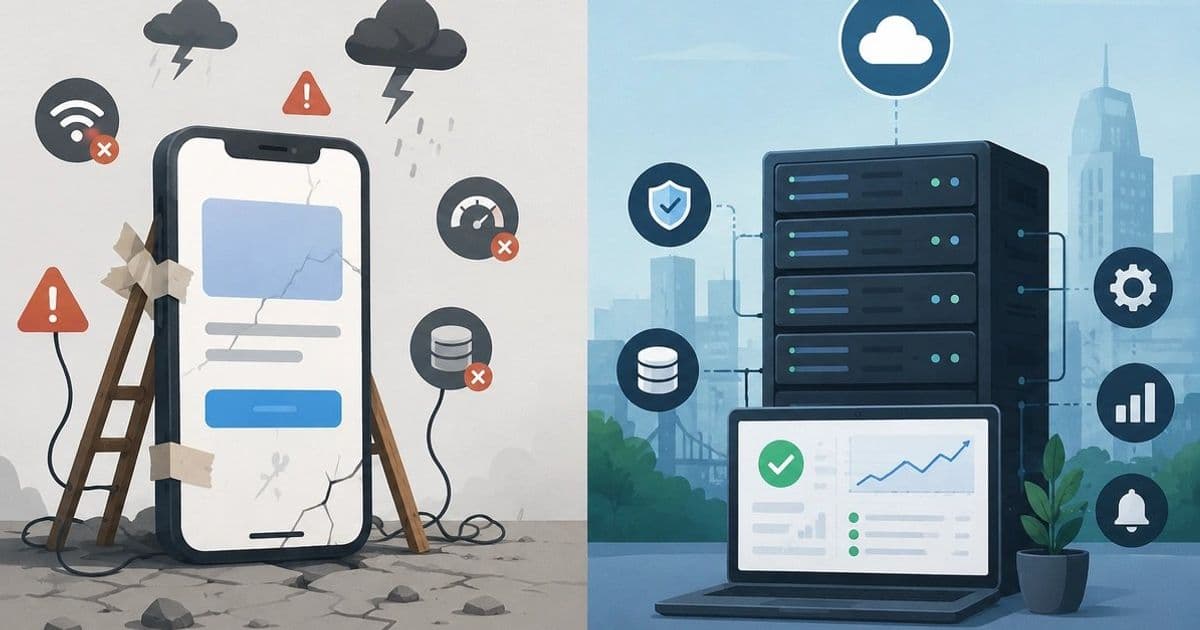
A functional prototype is not enough for production. This article explains why reliability matters, how to design for failure, and what trade‑offs arise when scaling consistency, API contracts, and operational tooling.
From Happy‑Path Apps to Reliable Systems
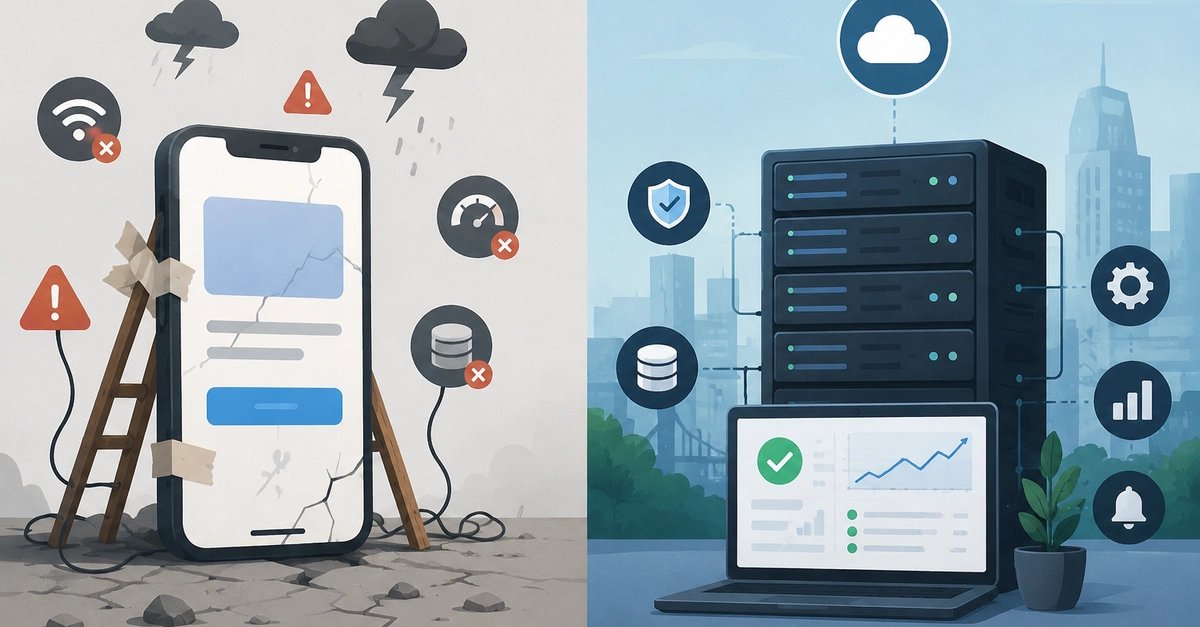
The problem: functional code rarely survives real traffic
Most developers can spin up a UI in a weekend, hook it to a database, and watch a demo that works. The code passes unit tests, the UI looks polished, and the checkout flow completes when you click the button once. In the lab this feels like a finished product.
In production the environment is noisy:
- Network latency spikes or drops entirely.
- Users double‑click buttons because the UI gives no feedback.
- Third‑party services time out or return malformed payloads.
- Database writes succeed while downstream caches remain stale.
- Human operators make configuration mistakes.
When any of these conditions appear, a working app often crashes, loses data, or leaves users in an uncertain state. The gap between “works in the test suite” and “reliable under real load” is the focus of this piece.
A solution approach: design for failure from day one
1. Explicit failure handling in APIs
- Idempotent endpoints – Make POST/PUT operations safe to repeat. Use request IDs or version stamps so that a retry does not create duplicate records.
- Circuit‑breaker pattern – Wrap external calls (payment gateways, messaging services) in a component that opens after a configurable failure threshold, returning a fast error instead of exhausting threads.
- Timeouts and retries – Set sensible client‑side and server‑side timeouts. Retry only on transient errors, and back‑off exponentially to avoid thundering‑herd effects.
2. Consistency models that match business needs
| Model | Guarantees | Typical use case | Trade‑off |
|---|---|---|---|
| Strong consistency (e.g., linearizable reads) | Every read sees the latest write | Financial transactions, inventory counters | Higher latency, limited geographic distribution |
Read‑after‑write consistency (e.g., DynamoDB’s EventuallyConsistent with ReadAfterWrite) |
Reads after a write are guaranteed to see that write, but other reads may be stale | User‑profile updates, analytics dashboards | Slightly stale data for non‑critical reads |
| Eventual consistency | System converges over time | Cache warm‑up, analytics pipelines | Potential for stale reads, requires reconciliation logic |
Choosing the right model avoids over‑engineering. A payment service should use strong consistency, while a recommendation engine can tolerate eventual consistency.
3. Operational scaffolding
- Centralised logging – Structured logs sent to a system like Elastic Stack or Loki make it possible to trace a request across services.
- Metrics & alerts – Export counters (error rate, latency percentiles) to Prometheus and configure alerts on deviation from Service Level Objectives (SLOs).
- Backups and point‑in‑time recovery – Automated snapshots (e.g., MongoDB Atlas backups) protect against data loss; test restores regularly.
- Graceful degradation – When a downstream API is unavailable, serve a cached response or a helpful error page instead of a 500 stack trace.
Trade‑offs and why they matter
Performance vs. safety
Adding retries, circuit‑breakers, and idempotency checks introduces extra hops and latency. In latency‑sensitive services (real‑time bidding, gaming) the added milliseconds can be unacceptable. The engineering decision is to isolate the critical path: keep the core transaction fast, and offload non‑critical work to asynchronous queues.
Operational complexity vs. developer velocity
A micro‑service architecture with dedicated retry queues, dead‑letter topics, and separate monitoring dashboards can handle failure gracefully, but it also multiplies the number of moving parts. Teams must invest in runbooks, on‑call rotation, and automated testing of failure scenarios. Smaller teams may opt for a monolith with built‑in retry logic to reduce cognitive load, accepting a higher blast radius for failures.
Consistency vs. availability
The classic CAP theorem still applies. Replicating data across regions improves availability, but strong consistency forces a majority quorum, which can stall during network partitions. Systems that can tolerate temporary inconsistency (e.g., shopping‑cart state stored in a session cache) can stay online, while financial ledgers must sacrifice availability to guarantee correctness.
API design patterns that reinforce reliability
- Versioned contracts – Keep backward‑compatible endpoints; deprecate old versions only after clients have migrated. This prevents sudden breakage when the service evolves.
- Schema validation – Enforce request/response schemas with tools like OpenAPI or JSON Schema. Reject malformed payloads early to avoid downstream crashes.
- Bulkhead isolation – Separate critical APIs (payments, auth) into their own process pools or containers. A failure in a low‑priority endpoint cannot starve resources from the high‑priority path.
- Event sourcing – Persist state changes as immutable events. Replayability simplifies recovery after a crash and provides an audit trail without extra logging code.
Scaling beyond code: operational and organizational growth
When traffic grows from hundreds to millions of requests per second, the bottleneck often shifts from CPU to operational processes:
- Access control matrices become unwieldy; moving to role‑based access control (RBAC) with hierarchical groups reduces friction.
- Incident response must be codified: runbooks, post‑mortems, and blameless culture turn outages into learning opportunities.
- Team structure evolves into product‑aligned squads that own the full lifecycle of a service, from code to monitoring.
These changes are as critical as adding more instances behind a load balancer. Without them, a system may handle the load technically but crumble under the weight of human error.
Bottom line
A working app is a proof of concept; a reliable system is a contract with its users that the service will continue to behave correctly under duress. Reliability is built through:
- Thoughtful API contracts that anticipate failure.
- Consistency models aligned with business risk.
- Operational tooling that makes invisible work visible to the team.
- Trade‑off decisions that balance latency, complexity, and availability.
Investing in these areas pays off in trust, lower incident cost, and the ability to scale both technically and organizationally.
For a concrete example of a managed service that handles sharding, backups, and automatic failover, see the MongoDB Atlas documentation.
Comments
Please log in or register to join the discussion