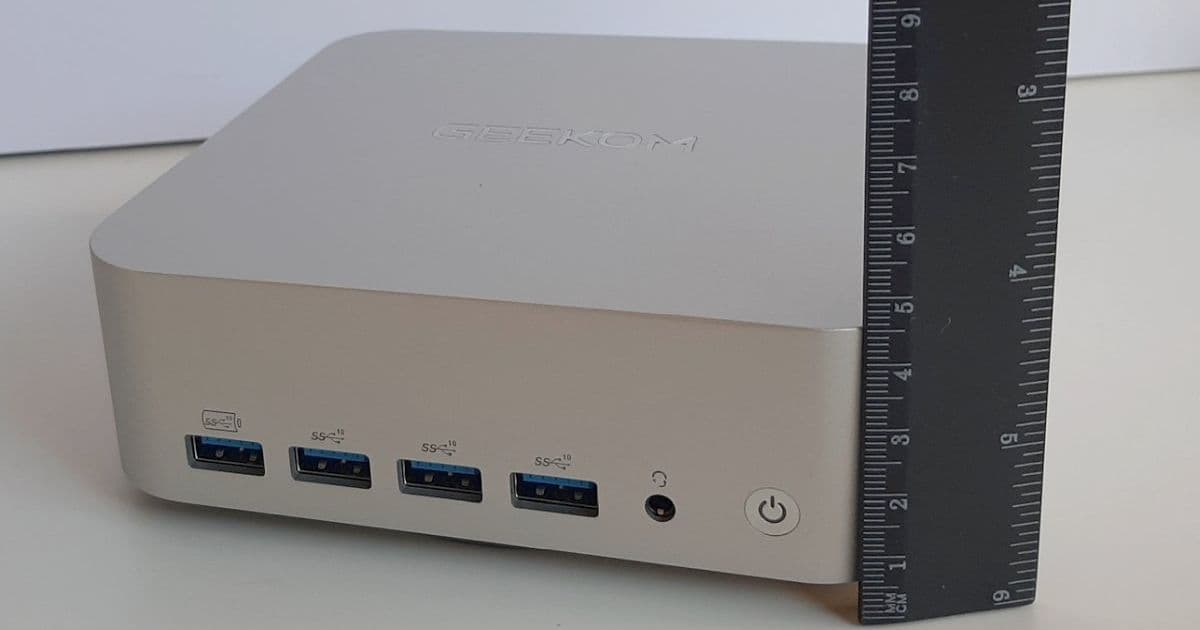
GEEKOM's A9 Max mini PC packs AMD's latest Ryzen AI 9 HX 370 processor with impressive AI performance, dual 2.5Gb Ethernet, and WiFi 7, though memory quality issues slightly impact overall performance.
Last summer GEEKOM released a pair of mini PCs with the latest Intel and AMD processors: the GEEKOM IT15 with an Intel Core Ultra 9 285H Arrow Lake processor and the GEEKOM A9 Max with an AMD Ryzen AI 9 HX 370 Strix Point processor. When I reviewed the Intel model, I noted that the mini PC's cooling system wasn't up to the task of allowing the powerful processor to live up to its potential, so potential customers might be better off with the AMD version. Now that I've had a chance to test the GEEKOM A9 Max, it's time to decide whether it really does offer better value.
Design and Specifications
The GEEKOM A9 Max is available from the GEEKOM store for $1299, but customers who place an order before February 9th can use the coupon 16A9M to bring the price down to $1091. It's also available from Amazon for $1099 at time of publication. Those prices are for a model with a Ryzen AI 9 HX 370 processor, 32GB of RAM, and a 2TB SSD.
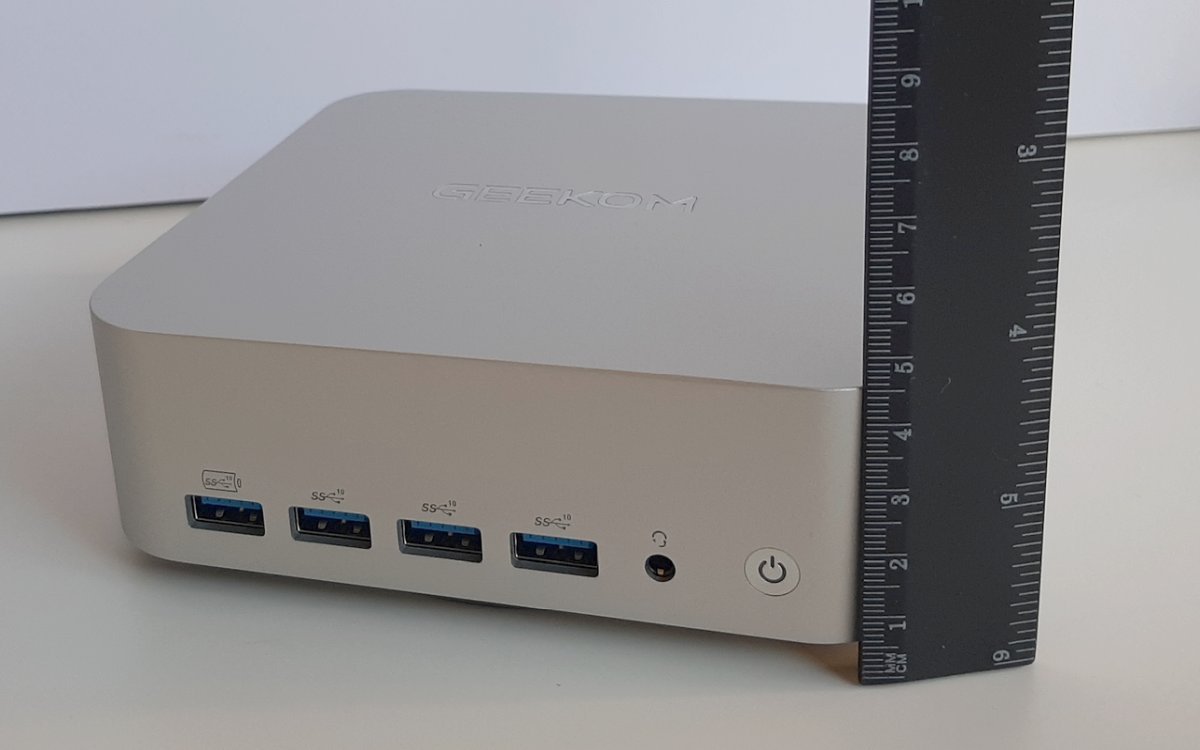
The mini PC features a 12-core 24-thread AMD Ryzen AI 9 HX 370 Strix processor with a maximum boost clock of up to 5.1 GHz. It also includes the AMD Radeon 890M iGPU which has 16 graphic cores with a frequency up to 2.9 GHz. There's also an NPU capable of delivering up to 50 TOPS of hardware-accelerated AI performance, allowing the processor to provide up to 80 TOPS when using the NPU, GPU, and CPU together.
The A9 Max uses DDR5 memory running at 5600 MT/s and supports up to 128 GB. There are two M.2 PCIe 4.0 storage slots, one supporting a 2280 drive and the other a 2230 drive. There is also a full-sized SD 4.0 card reader.
For networking there are dual 2.5 Gb Ethernet ports, WiFi 7 and Bluetooth 5.4. The connectivity is particularly impressive with eight USB ports including two USB4 ports, five USB 3.2 Gen 2 ports, and a single USB 2.0 port.
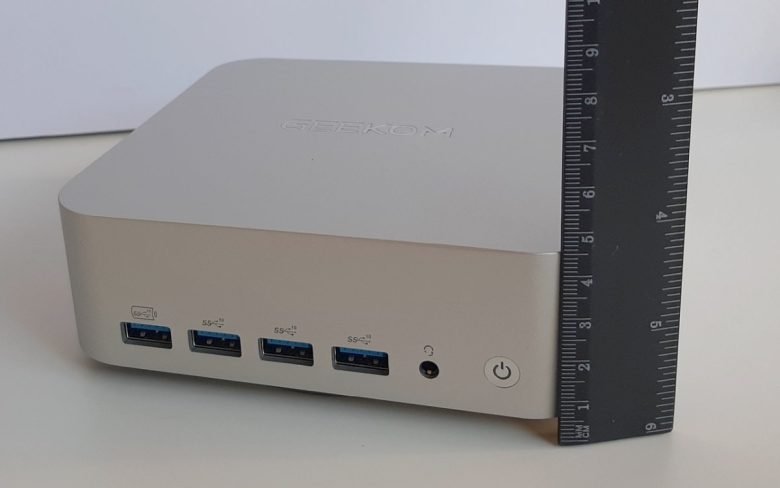
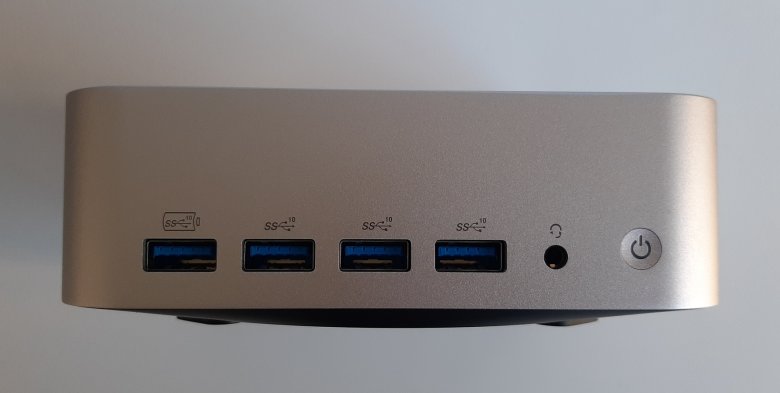
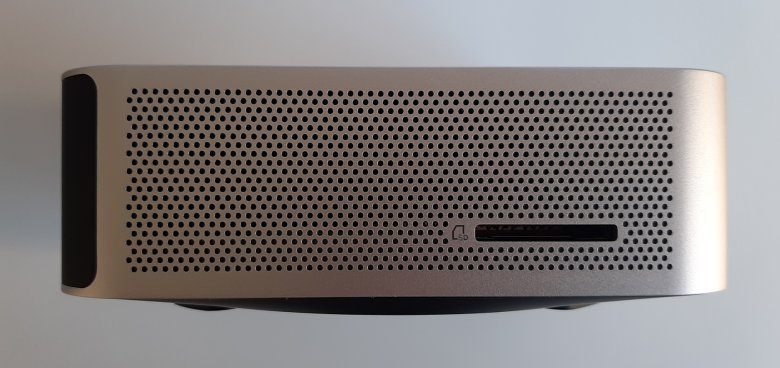
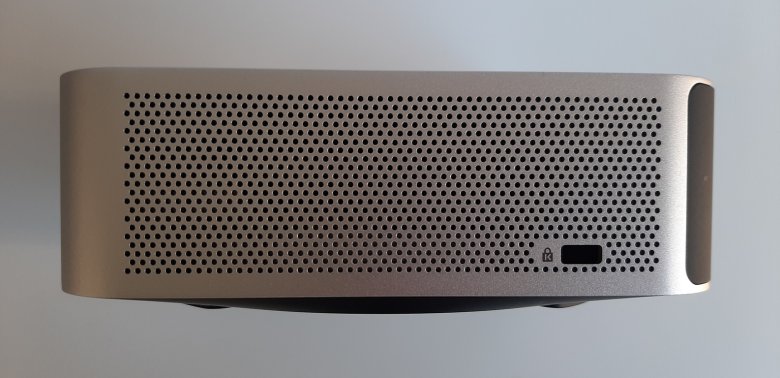
The mini PC measures 135 x 132 x 45.6 mm, making it slightly larger than the IT15 by around 22 mm in each dimension. The build quality is solid with a metal chassis and rubber feet for stability.
Performance Testing
I tested the A9 Max with Windows 11 Pro Version 24H2, upgraded to OS build 26100.4946. Before testing, I also created a dual-boot setup with Debian 13 (trixie) to evaluate Linux performance.
CPU Performance
The default power limits are set to 54 watts for PL/1 and 65 watts for PL/2, with a CPU maximum junction temperature of 100°C and thermal trip limit at 125°C.
In PassMark's PerformanceTest, the A9 Max scored 8912.0 overall, with a CPU Mark of 36694.6. This represents approximately 3% better performance than the GMKtec EVO-X1 (which uses the same processor) and 8% better than the GEEKOM IT15 with Intel's Core Ultra 9 285H.
Cinebench R23 showed multi-core performance of 21161, which is 2% better than the EVO-X1 and 4% better than the IT15. However, single-core performance lagged behind the Intel processor by about 10% in Cinebench and 6% in Geekbench 6.
GPU and Gaming Performance
The AMD Radeon 890M iGPU delivered solid gaming performance. In Shadow of the Tomb Raider at 1080p with high settings, the A9 Max averaged 44 FPS, which is 7% better than the IT15's 41 FPS. With low settings, performance improved to 62 FPS (11% better than IT15's 55 FPS).
3DMark benchmarks showed the AMD iGPU outperforming Intel's Arc graphics by 4% in Night Raid and 10% in Fire Strike. However, Time Spy scores were surprisingly 12% lower than the IT15, which I later attributed to memory performance issues.
AI Performance
Initially, the NPU performance was disappointing at only 783 compared to expected scores around 1700. This was traced to a BIOS issue that was resolved with an updated firmware (AMI Version 0.24 dated 11/26/2025), which improved NPU scores to 1791 - a 60% improvement over the IT15's 711.
Memory Performance Issues
The memory performance was a notable weak point. The A9 Max came with WODPOSIT (WPBS56D508SWB-16G) DDR5-5600 memory with timings of 46-46-46-90, which is one clock cycle slower than the memory in the IT15. This resulted in a 15% lower Memory Mark score in PassMark benchmarks.
Storage and Networking
The included Lexar NQ7A1 2TB NVMe drive delivered excellent sequential read speeds of nearly 6250 MB/s and write speeds over 5450 MB/s, exceeding Lexar's specifications.
The dual 2.5 Gb Ethernet ports performed as expected, delivering 2.37 Gbps for both upload and download. WiFi 7 performance was impressive, with the 6 GHz band reaching 2.19 Gbps upload and 1.95 Gbps download on a dedicated router.
Thermal Performance and Acoustics
The cooling solution proved adequate for the AMD processor. During a 20-minute stress test on Debian, temperatures stabilized around 71-82°C with frequencies between 4100-4600 MHz. This is significantly better than the IT15, which reached 101°C under similar loads.
Fan noise was noticeable under load (around 47.3 dBA during stress tests) but remained minimal during everyday tasks. The fan is inaudible when idle.
UEFI (BIOS) Features
The UEFI offers three fan modes: Silent, Normal, and Performance. These modes adjust power limits to control fan speed:
- Silent Mode: PL/1 = 45W, PL/2 = 60W, STAPM = 35W
- Normal Mode: PL/1 = 54W, PL/2 = 65W, STAPM = 45W
- Performance Mode: PL/1 = 54W, PL/2 = 65W, STAPM = 54W
STAPM (Skin Temperature-Aware Power Management) prevents the chassis from becoming too hot to handle.
Power Consumption
- Powered off: 0.0W
- Idle: 2.9W (both Windows and Debian)
- CPU stressed: 88.0W during PL/2, then 73.6W during PL/1 (Windows)
Verdict
The GEEKOM A9 Max offers solid performance with AMD's latest processor, particularly excelling in multi-core tasks and AI workloads. The dual 2.5 Gb Ethernet ports, WiFi 7 support, and excellent iGPU performance make it a versatile mini PC.
However, the memory quality issues are concerning and impact overall performance. The 15% lower memory scores compared to the IT15 suggest that GEEKOM may be using lower-quality components to reduce costs.
For users prioritizing AI performance, the A9 Max is clearly superior with its 50 TOPS NPU versus Intel's 13 TOPS. Gamers will appreciate the better iGPU performance, though the lack of an OCuLink port limits eGPU options.
The 3-year warranty is a significant advantage for business users, justifying the higher price point compared to competitors with only 1-year warranties.
Overall, the A9 Max is a capable mini PC that delivers on most fronts, but potential buyers should be aware of the memory quality concerns and ensure they update the BIOS to get optimal NPU performance.
Pros:
- Excellent multi-core and AI performance
- Dual 2.5 Gb Ethernet ports
- WiFi 7 support
- Strong iGPU for gaming
- Good thermal management
- 3-year warranty
- User-upgradable memory and storage
Cons:
- Memory performance below expectations
- Time Spy scores lower than expected
- No OCuLink port for eGPUs
- Slightly larger than some competitors
- Fan noise under heavy load
Price: $1099-1299 (with coupon available)
Warranty: 3 years
Best for: Users needing strong multi-core performance, AI capabilities, and robust networking features in a compact form factor.
Comments
Please log in or register to join the discussion