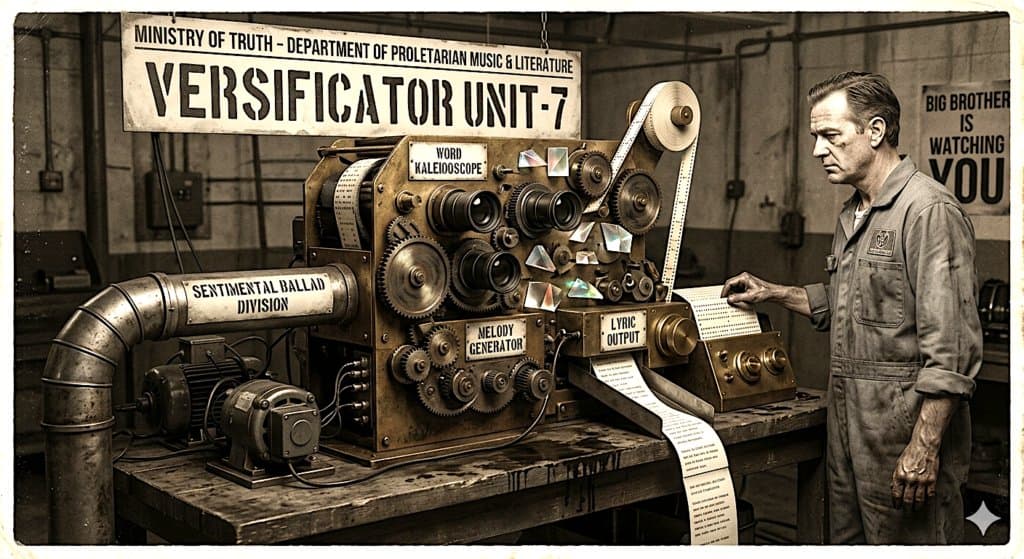
How Orwell's fictional 'versificator' in Nineteen Eighty-Four eerily foreshadowed today's AI-generated content flood, revealing uncomfortable truths about public taste and technological prophecy.
In George Orwell's dystopian masterpiece Nineteen Eighty-Four, published in 1949, the Ministry of Truth houses a device called the "versificator"—a mechanical kaleidoscope that composes songs without any human intervention. This fictional machine, designed to produce disposable entertainment for the proles (the working class), has found its real-world counterpart in today's AI-generated content, often derisively termed "AI slop."
The Versificator's Modern Manifestation
Orwell described the versificator as part of a chain of departments producing "rubbishy newspapers containing almost nothing except sport, crime and astrology, sensational five-cent novelettes, films oozing with sex, and sentimental songs." The chilling accuracy of this description becomes apparent when we consider the current landscape of algorithmically-generated articles, clickbait headlines, and AI-composed music flooding our digital spaces.
The parallel extends beyond mere content generation. Just as the versificator operated without human intervention, modern AI systems like GPT models, DALL-E, and various content creation tools can produce vast quantities of material with minimal human oversight. The efficiency and scale of these systems mirror Orwell's vision of automated cultural production.
Why AI Slop Thrives: A Reflection on Public Taste
The most uncomfortable aspect of this technological prophecy isn't the technology itself, but rather what its popularity reveals about human nature. Orwell's versificator succeeded because the proles genuinely enjoyed the content it produced. Similarly, AI-generated content proliferates not because of corporate malice or technological determinism, but because substantial portions of the public consume and engage with it.
This phenomenon raises uncomfortable questions about discernment and cultural standards. The "AI slop" that dominates social media feeds and content platforms reflects genuine audience preferences—preferences that often favor quantity over quality, sensationalism over substance, and immediate gratification over lasting value.
The Irony of Technological Prophecy
What makes Orwell's prediction particularly fascinating is that he wasn't attempting to forecast future technology. Writing in 1948-49, he was extrapolating from the mass media and entertainment culture of his own time. The versificator represented an intensification of existing trends rather than a leap into the unknown.
This approach to prediction—extrapolating current cultural trajectories rather than imagining entirely new technologies—proved remarkably accurate. While science fiction writers of the era imagined sentient robots and interstellar travel, Orwell envisioned the automation of cultural production, a development that has proven both more mundane and more transformative than many technological fantasies.
The Value of Human Discernment
As AI-generated content becomes increasingly sophisticated and ubiquitous, individual human discernment becomes more valuable than ever. The challenge isn't simply identifying AI-generated content—many systems can now produce work that passes as human-created—but rather maintaining critical standards and cultural values in an environment designed to bypass them.
The versificator's success in Nineteen Eighty-Four relied on the proles' lack of access to alternative forms of entertainment and information. Today's AI content operates in a different environment, where alternatives exist but require more effort to find and appreciate. The real battle isn't against the technology itself, but against the cultural and economic forces that make low-effort content the path of least resistance.
Historical Context and Technological Development
Interestingly, even prominent science fiction authors of Orwell's era failed to predict the rise of AI-generated content. Isaac Asimov, writing in 1980, criticized Nineteen Eighty-Four as poor technological prophecy, not anticipating that the "AI winter" of that period would eventually give way to the astonishing developments of the 2020s.
This historical perspective reminds us that technological progress often follows unexpected paths. The versificator, conceived as a tool of totalitarian control, has emerged instead as a commercial product driven by market forces and public demand. The difference between Orwell's vision and reality lies not in the technology, but in the social and economic context that shapes its use.
The Continuing Relevance of Orwell's Warning
The rise of AI slop doesn't validate Nineteen Eighty-Four as a complete prophecy of our technological future, but it does underscore Orwell's insight into human nature and cultural dynamics. His warning wasn't primarily about technology, but about how technology can amplify existing cultural tendencies—our preference for distraction over engagement, sensation over substance, and convenience over quality.
As we navigate an increasingly AI-mediated cultural landscape, Orwell's versificator serves as both a warning and a challenge. The technology itself is neutral; what matters is how we choose to use it, what standards we maintain, and what we demand from our cultural productions. The battle for cultural quality isn't against machines, but for the human capacity to discern, appreciate, and create work of genuine value.
The versificator may have been fiction in 1949, but its real-world counterpart has arrived, and with it, the responsibility to ensure that our technological capabilities serve rather than diminish our cultural aspirations.
Comments
Please log in or register to join the discussion