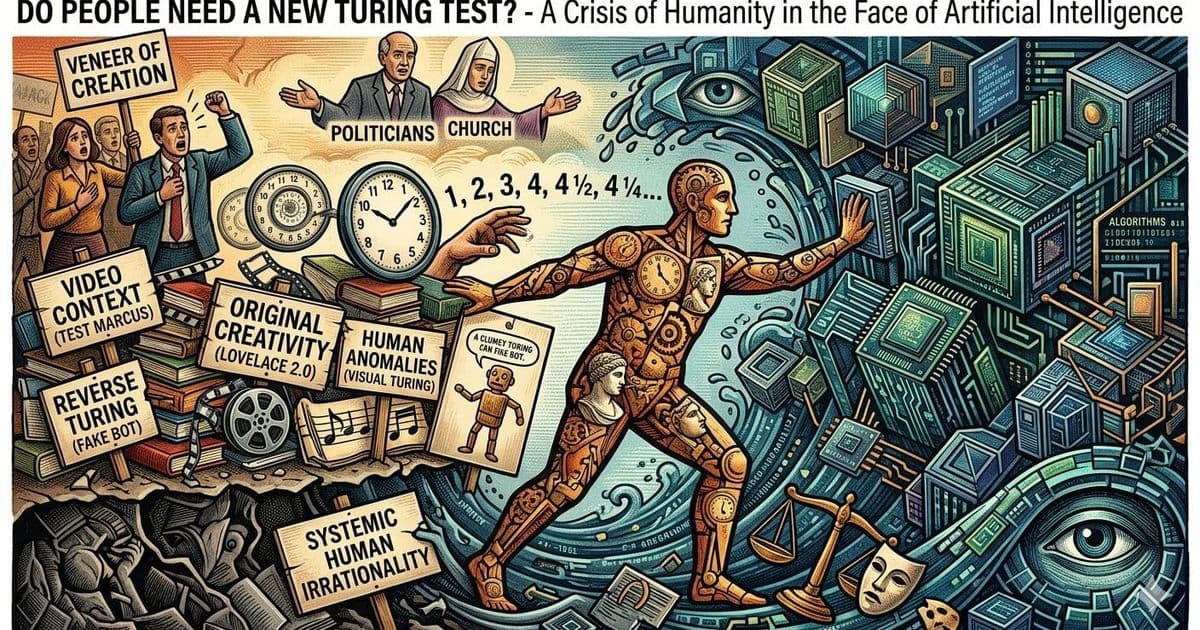
As AI systems become increasingly sophisticated, new evaluation methods are emerging to challenge the traditional Turing test. But are these assessments measuring genuine artificial intelligence or merely reflecting human cognitive biases and anx?
The field of artificial intelligence evaluation has undergone a significant transformation in recent years. As large language models and multimodal AI systems demonstrate capabilities that were once considered exclusively human, researchers and developers are scrambling to develop more sophisticated assessment methods. The traditional Turing test, originally proposed by Alan Turing in 1950, has been both celebrated and criticized for its simplicity—a machine is deemed intelligent if it can fool a human into believing it's human. However, with today's AI systems often passing this basic test with ease, new evaluation frameworks have emerged, raising an important question: are these new Turing tests actually measuring artificial intelligence, or are they primarily reflecting human anxiety about being replaced by machines?
The Evolution of AI Evaluation
The original Turing test was revolutionary in its time, focusing on behavioral equivalence rather than internal processes. If a machine could exhibit conversational abilities indistinguishable from a human, it was considered intelligent. This approach avoided philosophical debates about consciousness or understanding, focusing instead on practical performance.
However, as AI systems have evolved, so too have our evaluation methods. The Lovelace Test, developed by computer scientist Selmer Bringsjord in 2007, represents one significant evolution. Named after Ada Lovelace, who is often considered the first computer programmer, this test requires an AI system to not only generate outputs but also to explain how it arrived at those outputs, demonstrating a form of self-awareness about its own processes.
More recently, the Winograd Schema Challenge has gained traction as an alternative to the Turing test. Developed by Hector Levesque and others, this test focuses on AI's ability to understand common-sense knowledge and resolve ambiguities in language that require world knowledge rather than just pattern matching.
The Problem with Traditional Evaluation
The limitations of traditional evaluation methods have become increasingly apparent. Large language models like GPT-4 and Claude have demonstrated an ability to pass the original Turing test with remarkable success, often fooling human evaluators into believing they're conversing with another person. However, this doesn't necessarily indicate true intelligence or understanding.
"The Turing test was never meant to be the final word on machine intelligence," explains Dr. Elena Rodriguez, AI ethics researcher at the Institute for Human-Centered AI. "It was a starting point—a way to spark conversation about machine capabilities. But we've become so focused on passing this test that we've lost sight of what we're actually trying to measure."
The core issue is that traditional tests often measure how well AI systems can mimic human behavior rather than assessing genuine understanding or reasoning capabilities. This has led to what some researchers call "performance without comprehension," where AI systems generate appropriate responses without any real understanding of what they're saying.
New Approaches to Evaluation
In response to these limitations, several new evaluation frameworks have emerged, each attempting to capture different aspects of intelligence:
1. The Cognitive Architecture Test
Developed by researchers at MIT's Computer Science and Artificial Intelligence Laboratory, this test evaluates AI systems based on their cognitive architecture—how they process information, form representations, and make decisions. Rather than focusing solely on input-output behavior, this test examines the underlying mechanisms that produce AI responses.
"We need to look beyond surface-level performance," explains Dr. Marcus Thompson, lead researcher on the project. "An AI might generate a convincing response about quantum physics, but if it's just pattern matching without any real understanding of the concepts involved, what have we really achieved?"
2. The Multimodal Understanding Benchmark
As AI systems become increasingly multimodal—able to process and generate text, images, audio, and other forms of data—new evaluation methods are needed to assess these capabilities. The Multimodal Understanding Benchmark evaluates AI systems on their ability to integrate information across different modalities and demonstrate coherent understanding.
"The future of AI isn't just about text or images—it's about how systems can combine different types of information," says Dr. Kenji Tanaka, whose startup, SynapticAI, develops multimodal evaluation tools. "We need tests that can assess this holistic understanding, not just isolated capabilities."
3. The Commonsense Reasoning Assessment
Developed by researchers at Stanford's AI Lab, this test focuses on AI's ability to apply common-sense knowledge to novel situations. Unlike traditional benchmarks that often rely on pattern matching, this test requires AI systems to demonstrate reasoning abilities that go beyond training data.
"We've found that even the most advanced LLMs struggle with basic common-sense reasoning when faced with novel scenarios," explains Dr. Sarah Jenkins, lead researcher. "They can generate plausible responses based on patterns in their training data, but when faced with truly novel situations, their performance often breaks down."
The Human Anxiety Factor
Despite these advances in evaluation methodology, a growing concern is that many new tests may be measuring human anxiety about AI capabilities rather than genuine machine intelligence. This phenomenon, which some researchers call the "anthropocentric bias," occurs when evaluation criteria are designed to reflect human cognitive processes rather than independent measures of intelligence.
"There's a natural human tendency to evaluate AI systems based on how similar they are to us," notes Dr. Rodriguez. "But this may not be the most productive approach. If we're truly interested in artificial intelligence, perhaps we should be open to forms of intelligence that look very different from human cognition."
This bias is evident in several popular evaluation methods:
The Emotional Intelligence Test: Evaluates AI systems on their ability to recognize and respond appropriately to human emotions. While this may be valuable for certain applications, it primarily measures how well AI systems can mimic human emotional responses rather than any form of genuine emotional intelligence.
The Creativity Assessment: Judges AI-generated content based on human aesthetic standards and creative norms. This approach may penalize genuinely novel forms of creativity that don't align with human preferences.
The Ethical Judgment Test: Evaluates AI systems on their ability to make ethical decisions based on human moral frameworks. This raises questions about whether we're measuring ethical reasoning or simply conformity to existing human moral norms.
Market Implications and Investment Trends
The evolution of AI evaluation has created new opportunities for startups and research organizations. Companies developing novel evaluation methodologies have attracted significant investment, with venture capital flowing into this emerging sector.
EvalAI, a platform for AI evaluation competitions, has raised $45 million in Series B funding led by Innovation Ventures. The company provides infrastructure for organizations to design and run custom AI evaluation benchmarks, addressing the growing need for specialized assessment tools.
Similarly, CogniMetrics, which develops cognitive architecture testing tools, has secured $32 million in funding from Future Capital Partners. The company's approach focuses on evaluating AI systems based on their underlying cognitive processes rather than just surface-level performance.
"The market for AI evaluation is growing rapidly," explains Michael Chen, partner at Innovation Ventures. "As AI systems become more capable and widespread, organizations need more sophisticated ways to assess their capabilities and limitations. We're seeing significant demand for evaluation tools that can provide deeper insights into how these systems actually work."
The Future of AI Evaluation
Looking ahead, several trends are likely to shape the future of AI evaluation:
1. Domain-Specific Assessment
As AI systems become more specialized, evaluation methods will likely become more domain-specific rather than relying on general-purpose benchmarks. This approach would allow for more precise assessment of AI capabilities in specific applications like medical diagnosis, legal reasoning, or scientific research.
2. Continuous Evaluation
Rather than one-time assessments, future evaluation methods may focus on continuous monitoring of AI systems as they interact with real-world environments. This approach would provide insights into how AI capabilities evolve over time and in response to new experiences.
3. Cross-Disciplinary Evaluation
The most promising evaluation frameworks may draw insights from multiple disciplines, including cognitive science, philosophy, linguistics, and neuroscience. This interdisciplinary approach would provide more comprehensive assessment of AI capabilities and limitations.
4. Human-AI Collaborative Evaluation
As AI systems become more capable of self-assessment, evaluation may increasingly involve collaboration between human evaluators and AI systems themselves. This approach could provide more nuanced understanding of AI capabilities while acknowledging the limitations of purely human evaluation.
Rethinking What We Measure
Perhaps the most important question raised by new evaluation methods is what we're actually trying to measure when we assess AI systems. Are we looking for systems that can mimic human cognition, or are we interested in genuinely novel forms of intelligence?
"We need to be clear about our goals," suggests Dr. Thompson. "If we're trying to create AI systems that can assist humans in specific tasks, then evaluation based on human-like performance may be appropriate. But if our goal is to explore genuinely artificial intelligence, we may need to be open to forms of cognition that look very different from human thinking."
This perspective challenges the anthropocentric bias that often influences AI evaluation. Rather than measuring how well AI systems can mimic human intelligence, perhaps we should focus on developing evaluation methods that can assess intelligence in its own terms, regardless of whether it resembles human cognition.
Conclusion
The evolution of AI evaluation reflects our changing understanding of intelligence itself. As AI systems become increasingly capable, we're forced to confront fundamental questions about what intelligence is and how we should measure it. While new evaluation methods offer promising approaches to assessing AI capabilities, we must remain vigilant against the anthropocentric bias that may lead us to measure human anxiety about AI rather than genuine machine intelligence.
The future of AI evaluation likely lies in approaches that can assess intelligence in its own terms, rather than measuring how well AI systems can mimic human cognition. This shift would require not only new technical methodologies but also a conceptual reorientation—one that acknowledges the possibility of genuinely artificial forms of intelligence that may look very different from human thinking.
As we continue to develop more sophisticated AI systems, we must also develop more sophisticated ways to evaluate them—not just to ensure their safety and reliability, but to deepen our understanding of intelligence itself, in all its diverse forms.
Comments
Please log in or register to join the discussion