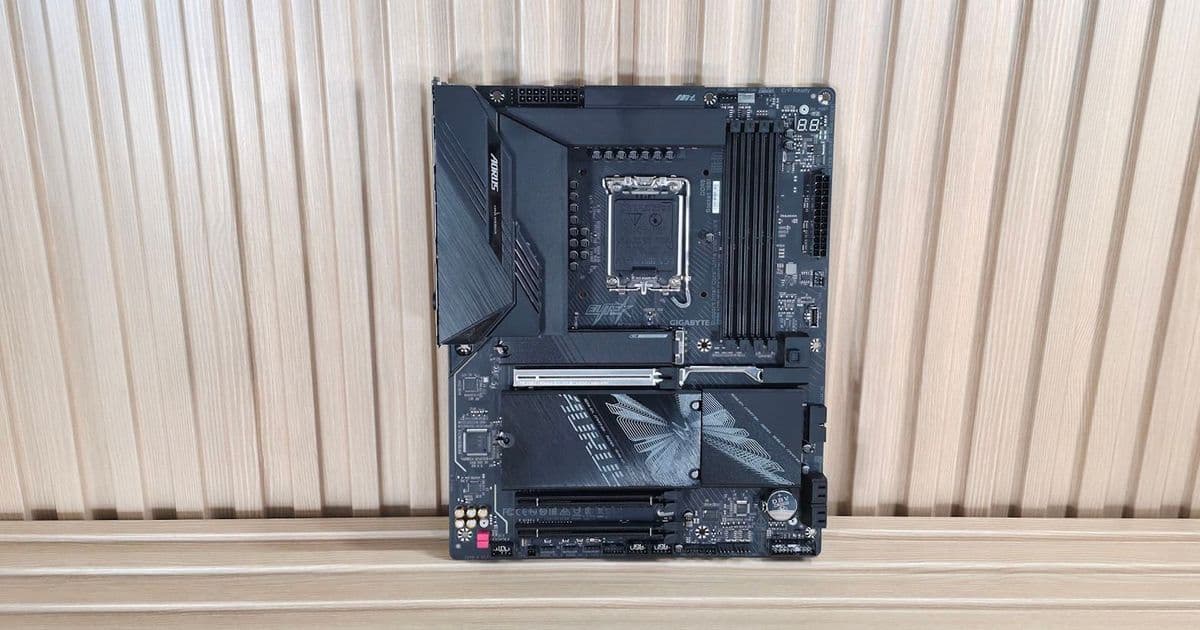
Gigabyte's Z890 Aorus Elite Wifi7 Plus delivers a cost-effective entry into Intel's latest platform with competitive networking capabilities and storage options, though it makes some compromises in connectivity and audio components.
Gigabyte has entered the mid-range motherboard market with the Z890 Aorus Elite Wifi7 Plus, a refresh board priced at $269.99 that offers a balanced feature set for budget-conscious builders. This ATX-form motherboard represents the company's strategy to provide a cost-effective gateway into Intel's latest LGA 1851 platform while maintaining key performance and connectivity features expected in the current market cycle.
Chip Architecture and Platform Integration
The Z890 Aorus Elite Wifi7 Plus is built around Intel's Z890 chipset, serving as a refresh to the Z790 platform. The board natively supports Intel's latest Core Ultra processors including the Core Ultra 7 270K Plus and 250K Plus, eliminating the need for BIOS flashing for full compatibility—a significant consideration for users concerned about platform accessibility.
The voltage regulation system employs a 19-phase design with 16 dedicated to Vcore, utilizing OnSemi NCP302155 60A SPS MOSFETs. This configuration delivers approximately 960A of total current capacity, sufficient to handle Intel's latest high-end CPUs including the Core Ultra 9 285K, Core Ultra 7 270K Plus, and Core Ultra 5 250K Plus, with headroom for moderate overclocking. The dual 8-pin EPS power connectors (one required) provide flexibility in power delivery, though both are recommended for optimal stability under sustained heavy loads.
Storage and Connectivity Architecture
The motherboard's storage subsystem comprises four M.2 sockets and four SATA3 ports, supporting RAID 0/1/5/10 configurations. Notably, only one of the M.2 sockets supports PCIe 5.0 x4 speeds (128 Gbps), while the remaining three operate at PCIe 4.0 x4 (64 Gbps). The top M.2 socket, which connects directly to the CPU, features a relatively small heatsink that reviewers noted may be inadequate for sustained high-performance operation.
The connectivity architecture includes:
- 1 USB4 (40 Gbps) Type-C port
- 2 USB 3.2 Gen 2 (10 Gbps) ports
- 3 USB 3.2 Gen 1 (5 Gbps) ports
- 4 USB 2.0 (480 Mbps) ports
- 5 GbE Ethernet via Realtek RTL8126 controller
- Intel Wi-Fi 7 (BE200NGW) supporting 320 MHz bandwidth
The rear I/O configuration reveals a strategic compromise in connectivity, with only a single Type-C port included—a notable limitation compared to some competing boards in this price segment.
Manufacturing Quality and Component Selection
The board's construction features a multi-layer PCB with plate-style heatsinks covering most critical components. Gigabyte employs a mixed approach to thermal management, with brushed aluminum finishes on primary heatsinks and textured matte finishes on others. The VRM heatsinks are described as "large with plenty of surface area," though the M.2 heatsink for the PCIe 5.0 slot is criticized as undersized.
The audio solution utilizes the Realtek ALC1220 codec, which was the flagship of its generation but has since been superseded by newer models like the ALC408X. This represents a component selection that prioritizes cost over the absolute latest technology—a common strategy in mid-range products.
The board includes three full-length PCIe slots: one PCIe 5.0 x16 slot connected directly to the CPU, and two PCIe 4.0 x4 slots connected via the chipset. This configuration allows for multi-GPU setups (though CrossFire/SLI support is explicitly listed as unavailable) and high-speed expansion cards.
Market Position and Supply Chain Context
Priced at $269.99, the Z890 Aorus Elite Wifi7 Plus occupies a competitive position in the mid-range motherboard segment. This pricing reflects current market dynamics where component costs have stabilized following the supply chain disruptions of recent years, though remain elevated compared to pre-pandemic levels.
The board's feature set demonstrates a balanced approach to cost management:
- Strengths: Fast networking (5 GbE + Wi-Fi 7), adequate storage options, sufficient USB connectivity
- Compromises: Limited Type-C ports, last-generation audio codec, minimal RGB lighting
The inclusion of Ultra Turbo modes represents Gigabyte's software strategy to differentiate their products through performance enhancements accessible via BIOS configuration. This approach allows the board to punch above its weight in performance metrics while maintaining hardware cost targets.
The 3-year warranty aligns with industry standards for this price segment, though some competitors are beginning to offer extended warranties as a differentiator in an increasingly competitive market.
Performance and Value Proposition
In testing, the Z890 Aorus Elite Wifi7 Plus demonstrated performance matching other motherboards in its class across gaming, office work, and creative workflows. This consistency suggests that while component selection may include some cost-saving measures, the overall implementation maintains solid performance characteristics.
The board's value proposition centers on providing a balanced feature set without wasteful abundance. For builders prioritizing networking performance and platform compatibility over extensive connectivity options, this motherboard offers a compelling entry point into Intel's latest platform. However, those requiring multiple Type-C ports or the latest audio codecs may need to consider higher-tier options or competing products.
The inclusion of power/reset buttons on the rear IO and debug LED/POST code display reflects Gigabyte's attention to practical features that enhance the building and troubleshooting experience—elements that add value beyond raw specifications.
In conclusion, the Z890 Aorus Elite Wifi7 Plus represents a strategic refresh that balances cost considerations with competitive features, positioning it as a viable option for budget-conscious builders seeking to leverage Intel's latest platform without compromising on essential performance and connectivity requirements.
Comments
Please log in or register to join the discussion