The mathematical journey from planetary motion to special functions, revealing how solving orbital mechanics problems gave birth to one of mathematics' most important function families.
The elegant dance of celestial bodies has captivated human imagination for millennia, but it was Johannes Kepler who first mathematically described the elliptical paths of planets orbiting our sun. His work, built upon Tycho Brahe's meticulous observations, revealed not just the shape of these orbits but also the precise mathematical relationships governing planetary motion. At the heart of this celestial mechanics lies what we now call Kepler's equation, a seemingly simple relationship that has profound mathematical consequences, including the emergence of Bessel functions.
Kepler's Equation and the Challenge of Celestial Mechanics
Kepler's equation relates three different measures of a planet's position in its elliptical orbit: the mean anomaly (M), the eccentric anomaly (E), and the eccentricity (e) of the orbit. The equation takes the form:
E - e sin(E) = M
While this equation appears straightforward, solving for E as a function of M and e presents a significant mathematical challenge. There is no elementary closed-form solution that can express E explicitly in terms of M and e using basic algebraic functions, trigonometric functions, exponentials, or logarithms. This fundamental difficulty has driven mathematical innovation for centuries.
The three measures of position—mean anomaly, eccentric anomaly, and true anomaly—each describe where a planet is in its orbit but from different perspectives:
- Mean anomaly represents the position if the planet were moving in a circular orbit at constant angular speed
- Eccentric anomaly relates to the position on an auxiliary circle circumscribing the elliptical orbit
- True anomaly gives the actual angular position as seen from the focus of the ellipse
For many astronomical calculations, we know the mean anomaly M and need to find the eccentric anomaly E, which then allows us to determine the planet's actual position in space.
Approaches to Solving Kepler's Equation
Mathematicians have developed several approaches to solve Kepler's equation:
Iterative methods: One can make an initial guess for E, plug it into the right-hand side of the equation to get a new E, and repeat this process until convergence. This approach, while straightforward, may require many iterations for high precision or high eccentricity.
Newton's method: This more sophisticated root-finding algorithm converges much faster than simple iteration, making it practical for computational applications.
Series expansion: The approach that leads to Bessel functions involves expanding E in a sine series and determining the coefficients analytically.
The sine series approach offers a particular advantage: once the coefficients are determined, we have an analytical expression for E as a function of M that can be evaluated for any value of M without needing to solve Kepler's equation repeatedly.
The Sine Series Solution and Emergence of Bessel Functions
The sine series solution begins with the observation that E - M = 0 at both E = 0 and E = π. This suggests that E - M can be expanded in a sine series over the interval [0, π]:
E - M = Σ a_n sin(nM)
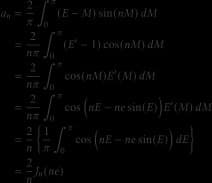
The coefficients a_n can be calculated using standard Fourier analysis techniques. Through integration by parts and applying Kepler's equation itself, these coefficients reveal a remarkable connection to Bessel functions.
The mathematical derivation proceeds as follows:
- Calculate the Fourier coefficients a_n using the standard formula
- Apply integration by parts to simplify the expression
- Substitute Kepler's equation to relate the integral to known quantities
- Recognize that the resulting expression matches the integral representation of Bessel functions
This process demonstrates that the coefficients a_n are proportional to Bessel functions of the first kind J_n(ne):
a_n = (2/n) J_n(ne)
Thus, the solution to Kepler's equation can be expressed as:
E = M + Σ (2/n) J_n(ne) sin(nM)
Mathematical Significance and Broader Implications
The connection between Kepler's equation and Bessel functions represents a beautiful example of how problems in one area of mathematics (celestial mechanics) can lead to developments in another area (special functions). Bessel functions, which arise naturally in problems with cylindrical symmetry, have found applications far beyond their original astronomical context:
- Wave propagation in cylindrical media
- Heat conduction in cylindrical objects
- Signal processing, particularly in frequency analysis
- Quantum mechanics in cylindrical potentials
The mathematical techniques developed to solve Kepler's equation have proven valuable across scientific and engineering disciplines. The integral representation of Bessel functions, which motivated this entire line of inquiry, has become a fundamental tool in mathematical physics.
For those interested in exploring this connection further, the MathWorld entry on Kepler's Equation provides additional context, while the Wikipedia page on Bessel functions offers a comprehensive overview of these remarkable mathematical objects.
The story of how Kepler's equation led to Bessel functions illustrates a profound truth in mathematics: the deepest and most beautiful results often emerge from attempts to solve concrete, practical problems. The celestial dance of planets, observed and quantified by astronomers, has given us mathematical tools that continue to illuminate our understanding of the universe in ways its original discoverers could never have imagined.
Comments
Please log in or register to join the discussion