OpenAI's radical experiment in building software with zero manually-written code reveals fundamental shifts in engineering practices, tooling requirements, and the very definition of software development.
The Architecture of AI-Generated Software: OpenAI's Codex Experiment
In a remarkable departure from conventional software development, OpenAI has undertaken an ambitious experiment: building and shipping a complete software product with zero lines of manually-written code. Over five months, their team constructed approximately one million lines of code—application logic, tests, CI configuration, documentation, and internal tooling—entirely generated by Codex agents. This approach, they estimate, achieved what would have taken ten times longer with traditional human coding.
The Fundamental Shift: From Coding to Scaffolding
The most profound insight from OpenAI's experiment lies in the redefinition of the engineer's role. With Codex handling the actual implementation, human engineers transitioned from writing code to designing environments, specifying intent, and constructing feedback loops that enable reliable agent execution. This represents not merely a productivity enhancement but a fundamental paradigm shift in how software gets built.
"We intentionally chose this constraint so we would build what was necessary to increase engineering velocity by orders of magnitude," explains the team. The constraint forced them to confront what changes when a software engineering team's primary job is no longer to write code, but to enable others—AI agents—to do that work effectively.
Technical Architecture for Agent-First Development
OpenAI's approach required developing entirely new technical infrastructure to support AI-generated code. Their system centers on making the codebase maximally "legible" to Codex agents, creating an environment where AI can reason effectively about the entire business domain directly from repository artifacts.
Observability as First-Class Citizen
A critical innovation was integrating observability directly into the agent's workflow. They wired Chrome DevTools Protocol into the agent runtime, enabling Codex to reproduce bugs, validate fixes, and reason about UI behavior through DOM snapshots, screenshots, and navigation. Similarly, they built a local observability stack where logs, metrics, and traces are exposed to Codex via ephemeral worktrees.
This observability integration allows agents to validate requirements directly: prompts like "ensure service startup completes in under 800ms" or "no span in these four critical user journeys exceeds two seconds" become tractable execution targets rather than vague aspirations.
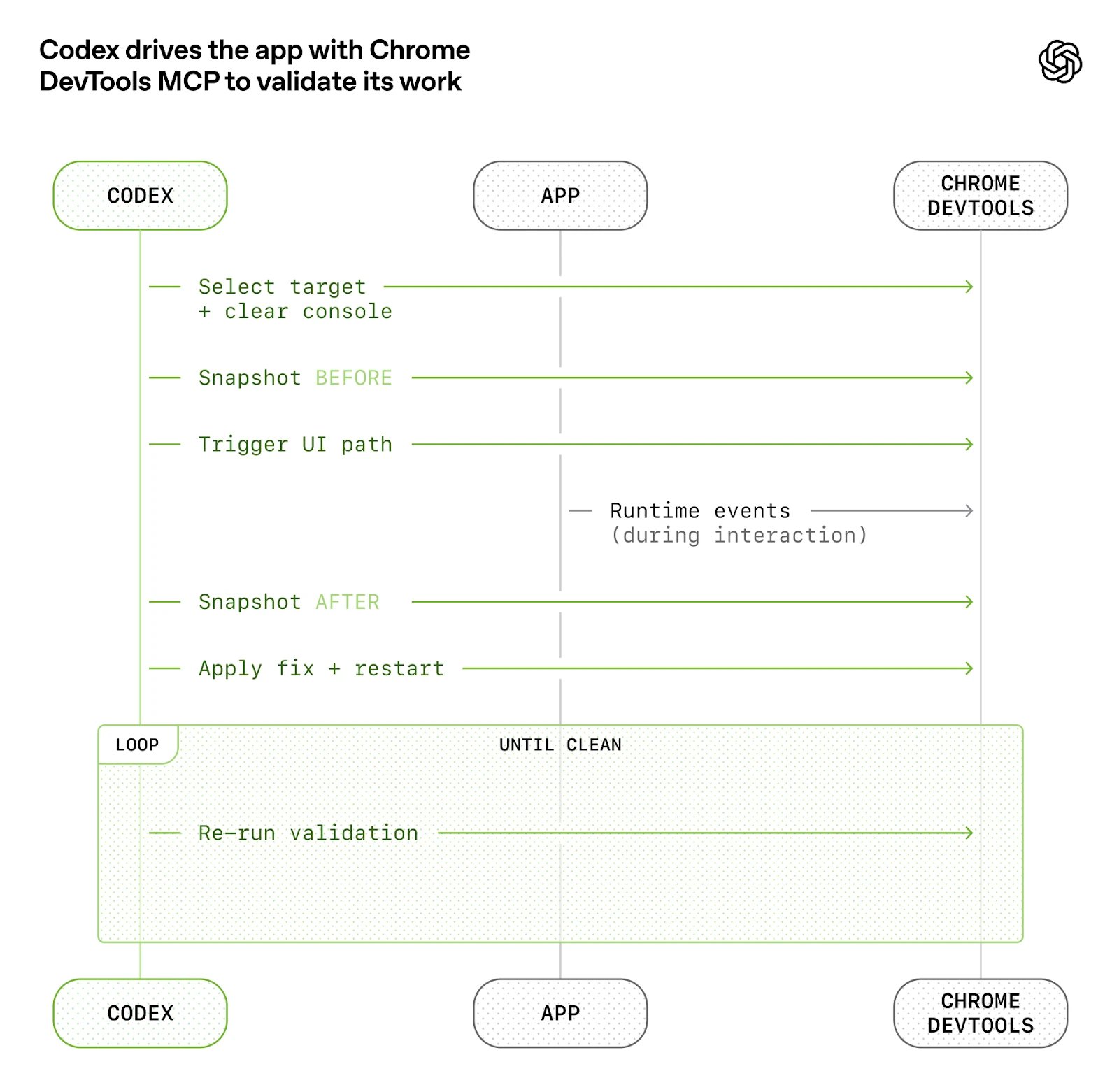 Codex drives the app with Chrome DevTools MCP to validate its work
Structured Knowledge Systems
Context management emerged as one of the biggest challenges in making agents effective at large, complex tasks. OpenAI initially attempted a comprehensive "AGENTS.md" approach but discovered that "too much guidance becomes non-guidance." Instead, they developed a structured documentation system where the repository itself serves as the system of record.
Their documentation architecture treats AGENTS.md as a table of contents rather than an encyclopedia, with deeper knowledge organized in a structured docs/ directory. This includes design documents, execution plans, product specifications, and references—all cross-referenced and validated through custom linters. A recurring "doc-gardening" agent scans for stale documentation and opens fix-up pull requests, ensuring knowledge stays current with actual code behavior.
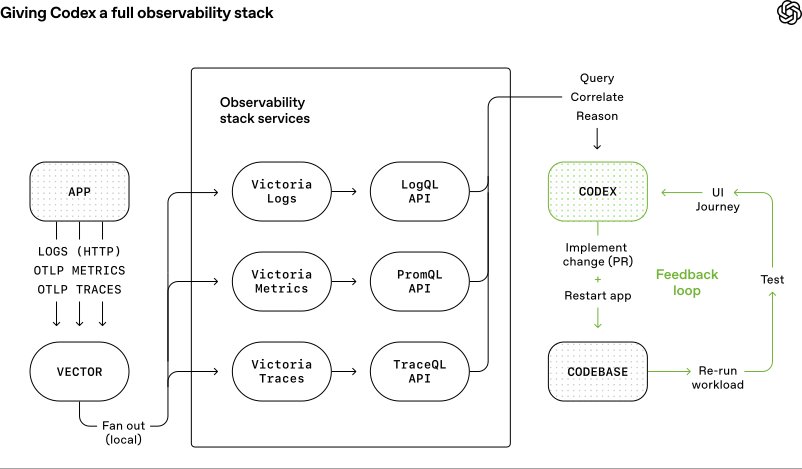 Giving Codex a full observability stack in local dev
Enforcing Architectural Boundaries
With no human code reviewers to catch architectural drift, OpenAI developed mechanical enforcement of architectural constraints. They built the application around a rigid layered model where each business domain is divided into fixed layers with strictly validated dependency directions.
The architecture follows a specific rule: within each business domain, code can only depend "forward" through a fixed set of layers (Types → Config → Repo → Service → Runtime → UI). Cross-cutting concerns enter through a single explicit interface called Providers. These constraints are enforced through custom linters—themselves generated by Codex—and structural tests.
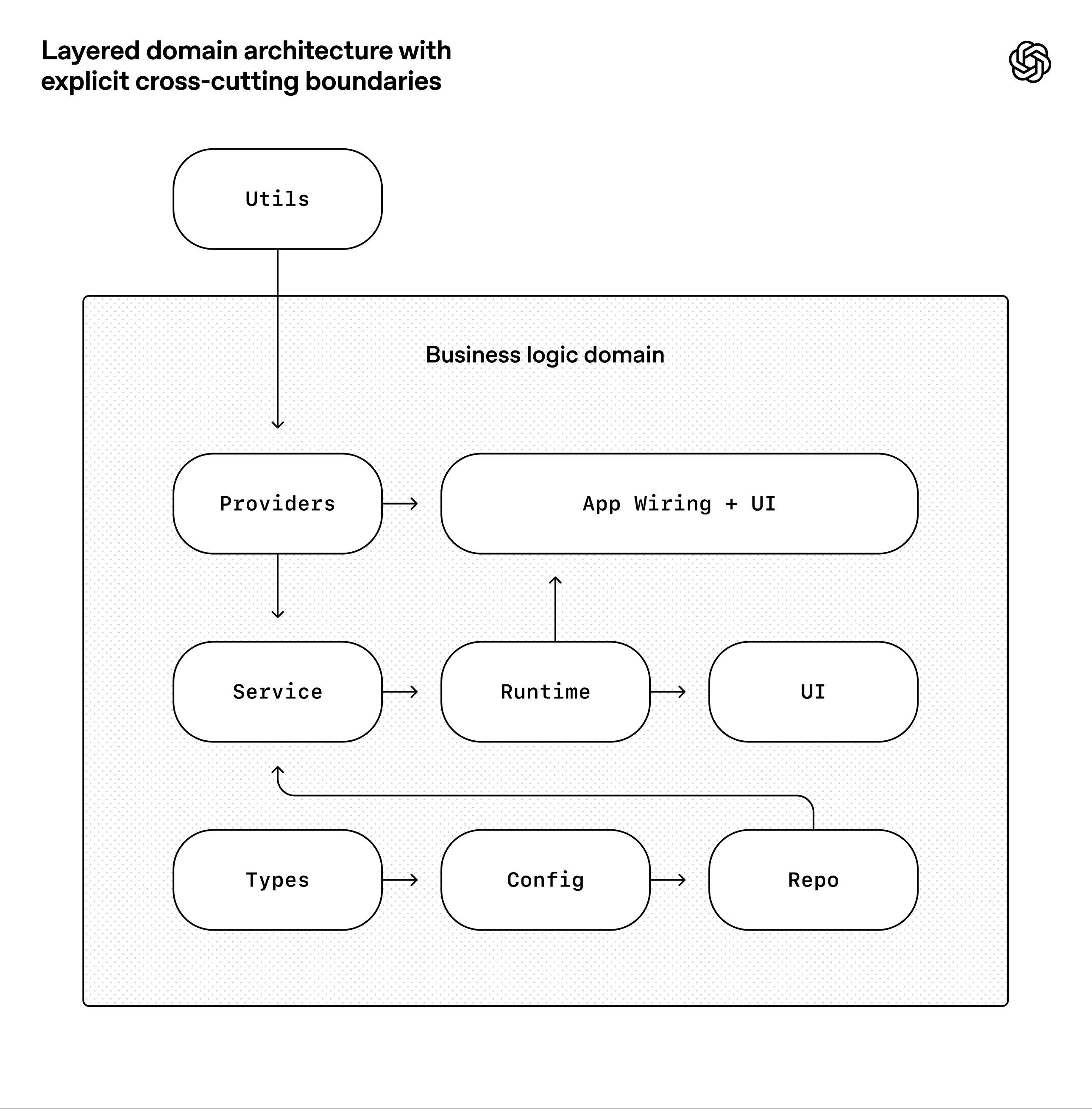 Layered domain architecture with explicit cross-cutting boundaries
The Challenge of Knowledge Boundaries
A fundamental insight emerged from their experiment: "From the agent's point of view, anything it can't access in-context while running effectively doesn't exist." This creates a stark boundary between repository-local knowledge and external information.
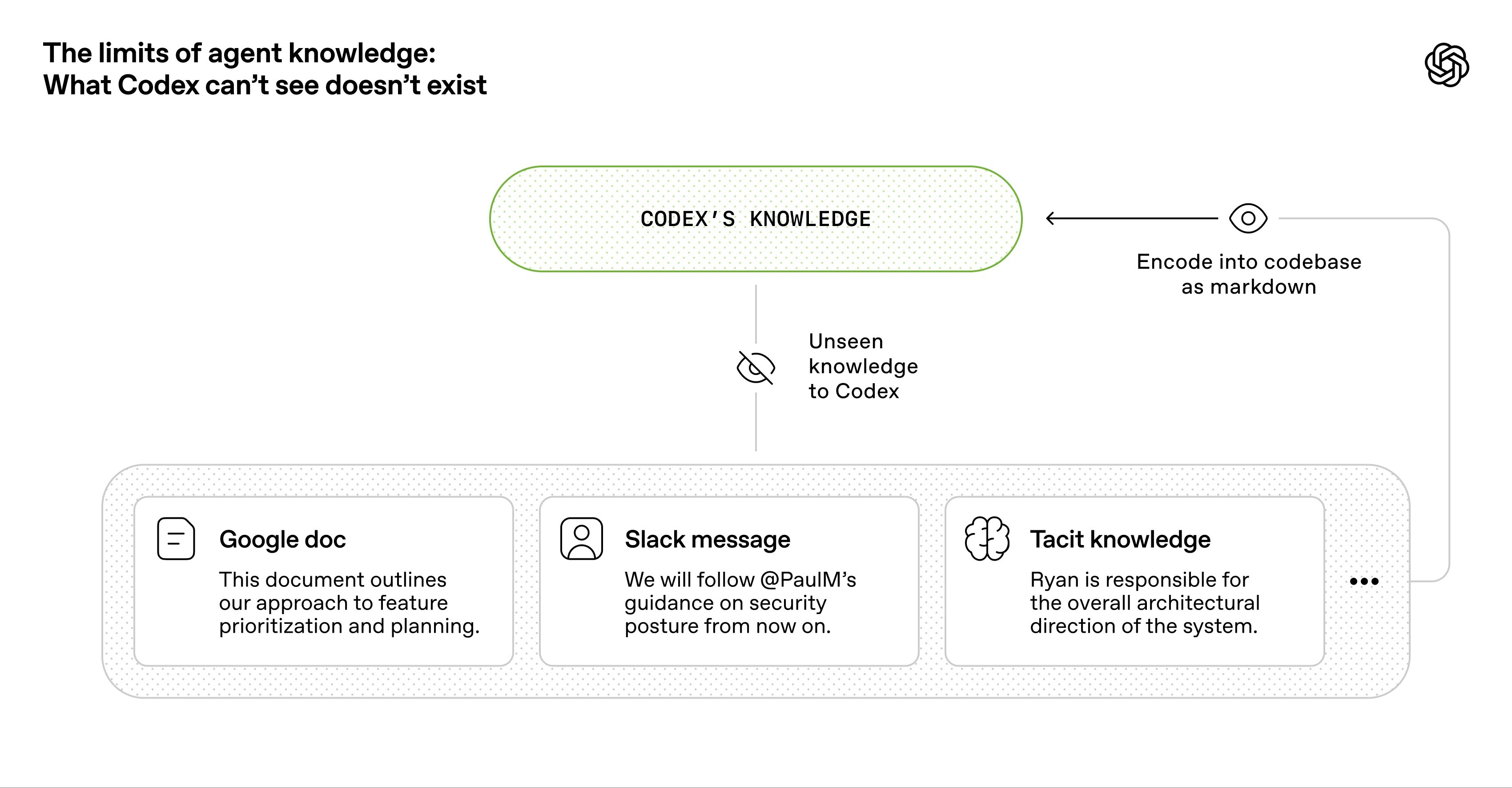 The limits of agent knowledge: What Codex can't see doesn't exist
Knowledge that lives in Google Docs, chat threads, or people's heads remains inaccessible to the system. This realization drove OpenAI to progressively push more context into the repository, treating it as the single source of truth. The team learned that architectural decisions and discussions needed to be encoded as versioned artifacts rather than ephemeral communications.
"In the same way you would onboard a new teammate on product principles, engineering norms, and team culture," they note, "giving the agent this information leads to better-aligned output."
Throughput and the New Merge Philosophy
As Codex's throughput increased—averaging 3.5 pull requests per engineer per day—conventional engineering norms became counterproductive. The repository operates with minimal blocking merge gates, and pull requests are intentionally short-lived.
"Test flakes are often addressed with follow-up runs rather than blocking progress indefinitely," the team explains. "In a system where agent throughput far exceeds human attention, corrections are cheap, and waiting is expensive."
This represents a significant departure from traditional CI/CD practices, where blocking failures and comprehensive review gates have long been standard. The trade-off favors continuous progress over perfect execution at each step, with the understanding that errors can be corrected more quickly than they can be prevented in a high-throughput environment.
Golden Principles and Entropy Management
Full agent autonomy introduces novel challenges around code quality and consistency. Codex tends to replicate existing patterns—even suboptimal ones—leading to gradual architectural drift. Initially, humans spent significant time cleaning up what they termed "AI slop," but this approach didn't scale.
Instead, they developed "golden principles"—opinionated, mechanical rules that keep the codebase legible and consistent for future agent runs. These include preferring shared utility packages over hand-rolled helpers and validating data boundaries rather than making assumptions about shapes.
On a regular cadence, background Codex tasks scan for deviations, update quality grades, and open targeted refactoring pull requests. "Technical debt is like a high-interest loan," they observe. "It's almost always better to pay it down continuously in small increments than to let it compound and tackle it in painful bursts."
The Path to Full Autonomy
Recently, OpenAI's system crossed a meaningful threshold where Codex can end-to-end drive a new feature from a single prompt. Given a high-level goal, the agent can now:
- Validate the current state of the codebase
- Reproduce a reported bug
- Record a video demonstrating the failure
- Implement a fix
- Validate the fix by driving the application
- Record a second video demonstrating the resolution
- Open a pull request
- Respond to agent and human feedback
- Detect and remediate build failures
- Escalate to a human only when judgment is required
- Merge the change
This represents a significant step toward fully autonomous software development, though the team notes that this behavior depends heavily on their specific repository structure and tooling.
Implications for the Future of Software Engineering
OpenAI's experiment suggests several profound implications for software development:
The rise of the "scaffolding engineer": As AI handles implementation, human engineers will increasingly focus on designing environments, feedback loops, and control systems.
Knowledge management becomes paramount: The repository transforms from a code store to a comprehensive knowledge system that must encode not just what to build, but how to build it and why.
Architectural constraints enable speed: Far from being a drag on productivity, strict architectural boundaries become prerequisites for maintaining coherence in high-throughput AI-generated systems.
Observability and validation merge: The distinction between development and operations blurs as agents continuously validate their own work against production-like environments.
Continuous quality enforcement: Traditional QA processes transform from periodic reviews to continuous, automated quality enforcement encoded directly in the development environment.
Unanswered Questions
Despite their success, OpenAI acknowledges several open questions:
- How does architectural coherence evolve over years in a fully agent-generated system?
- Where does human judgment add the most leverage, and how can that judgment be encoded to compound over time?
- How will these systems evolve as AI models continue to become more capable?
What's becoming clear is that building software still demands discipline, but that discipline manifests differently than before. The tooling, abstractions, and feedback loops that keep codebases coherent are increasingly important, while the actual lines of code become less central to the engineering process.
As OpenAI concludes, "Our most difficult challenges now center on designing environments, feedback loops, and control systems that help agents accomplish our goal: build and maintain complex, reliable software at scale."
This experiment represents not just a technological curiosity but a glimpse into the future of software development—one where human creativity and judgment remain essential, but are expressed through entirely different mechanisms than we've known before.
Comments
Please log in or register to join the discussion