The latest Gleam release focuses on practical developer experience improvements for JavaScript targets, introducing source maps for proper runtime debugging, enhanced language server fault tolerance to prevent cascading errors, and performance optimizations in string pattern matching. These changes address long-standing pain points that hindered adoption in web development workflows while maintaining Gleam's core strengths of type safety and scalability.
Gleam v1.16.0 has arrived with a clear focus on making the language more practical for real-world JavaScript development. While the language's type safety and Erlang VM compatibility remain foundational, this release tackles specific friction points that developers encountered when using Gleam in browser environments or large-scale projects. The most immediately impactful addition is source map generation for JavaScript targets—a feature that transforms the debugging experience from frustrating guesswork to precise, source-level inspection.
{{IMAGE:1}}
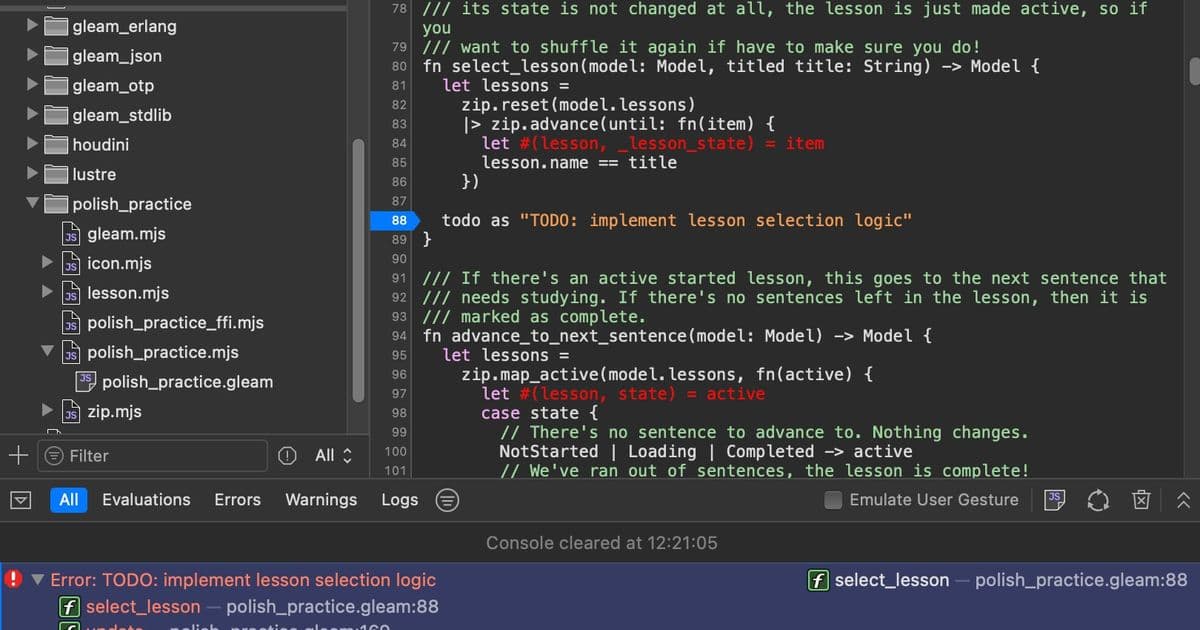
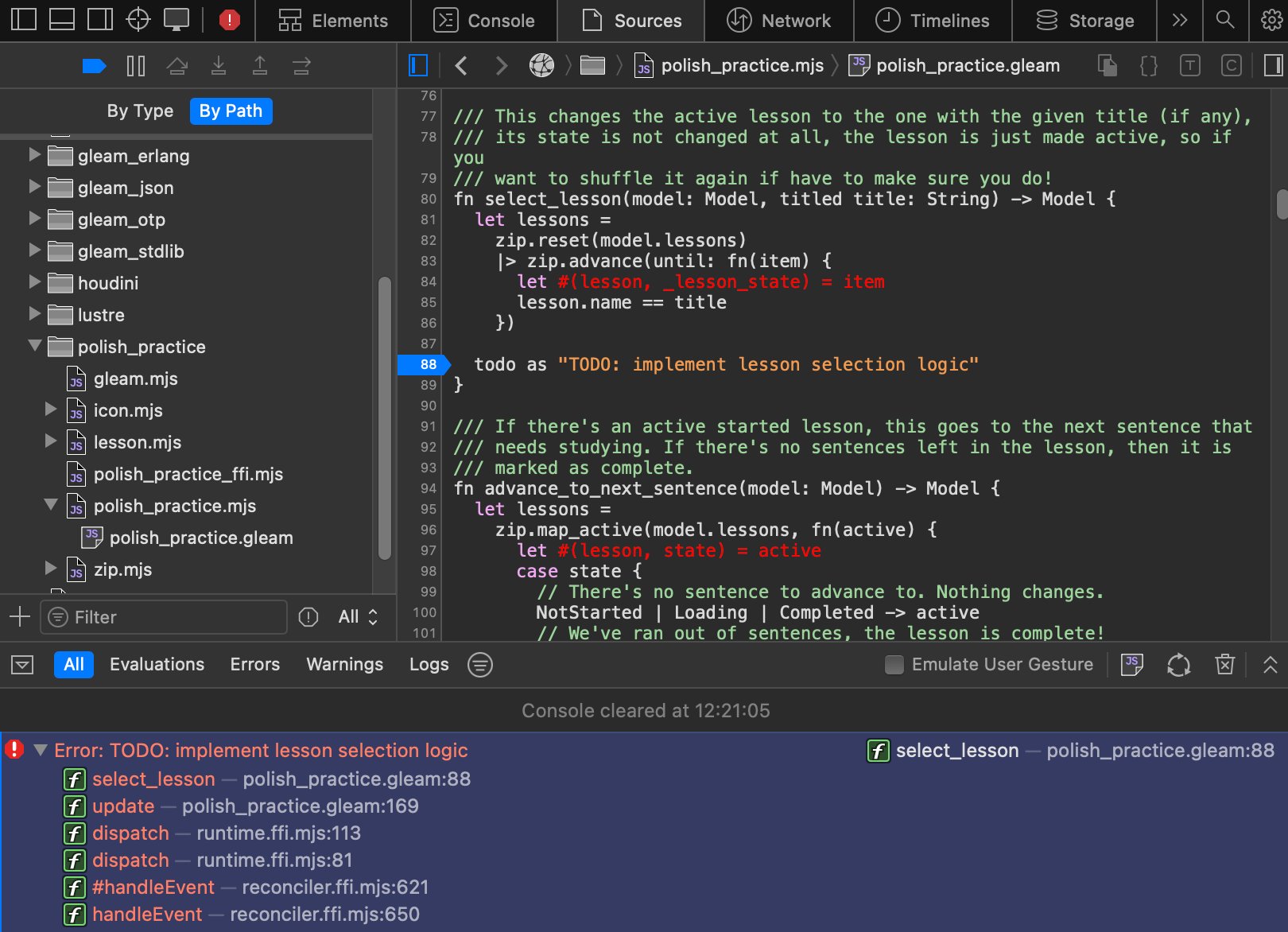
For years, Gleam developers compiling to JavaScript faced a common obstacle: when runtime errors occurred, stack traces pointed to minified JavaScript code rather than the original Gleam source. This made debugging feel like solving a puzzle without the picture on the box. Source maps solve this by creating a translation layer between the compiled output and the original source. As demonstrated in Safari's developer tools (see below), developers can now set breakpoints directly in Gleam code, inspect variables in their original form, and see accurate stack traces that map exceptions back to the exact line in their .gleam files. To enable this, developers simply set javascript.source_maps = true in their gleam.toml—no additional build steps are required when using standard serving methods or Lustre's dev tools.
Beyond debugging, the release significantly improves the language server's resilience in imperfect codebases. Previously, a single module failing to compile would halt the entire analysis process, leaving developers with incomplete or misleading error messages. This was especially confusing in large projects where an upstream error could make the language server appear unresponsive for unrelated modules. The new fault-tolerant approach isolates failing modules, allowing the language server to continue analyzing and providing diagnostics for other parts of the project. When a module genuinely cannot compile, it now clearly highlights the problematic import, eliminating guesswork about whether the tool itself is broken.
Performance also sees a targeted boost in the JavaScript backend. The compiler now generates more efficient code for single-character string prefix matching—a common operation in parsers and validators. Early benchmarks show the glance package (used for parsing Gleam code itself) running nearly 30% faster on JavaScript targets, with median execution time dropping from 14.74ms to 10.72ms. This optimization demonstrates how Gleam's compiler can leverage target-specific knowledge without compromising its cross-runtime guarantees.
Other notable refinements include:
- Record update expressions now recover gracefully from errors, showing clearer messages when used with variant types lacking labeled fields
- The compiler warns when attempting to extract integers larger than JavaScript's 52-bit safe integer limit, preventing silent precision loss
- Invalid Unicode characters that resemble ASCII (like the low single comma quotation mark) now trigger helpful syntax errors instead of obscure parse failures
- Hex package management gains owner addition commands and improved error messages for missing versions
- Language server code actions gained smarter function extraction and type hole replacement capabilities
These changes collectively shift Gleam from a language that is merely capable of targeting JavaScript to one that feels native in that environment. By addressing the practical realities of debugging, large-project navigation, and performance expectations, the release lowers the barrier for teams considering Gleam for web applications. While the language still grows its ecosystem compared to more established alternatives, v1.16.0 removes several paper cuts that previously made daily development feel unnecessarily burdensome. For developers who value type safety but have been frustrated by poor JavaScript interop tooling, this update represents a meaningful step toward making Gleam a viable choice for production frontend work.
Comments
Please log in or register to join the discussion