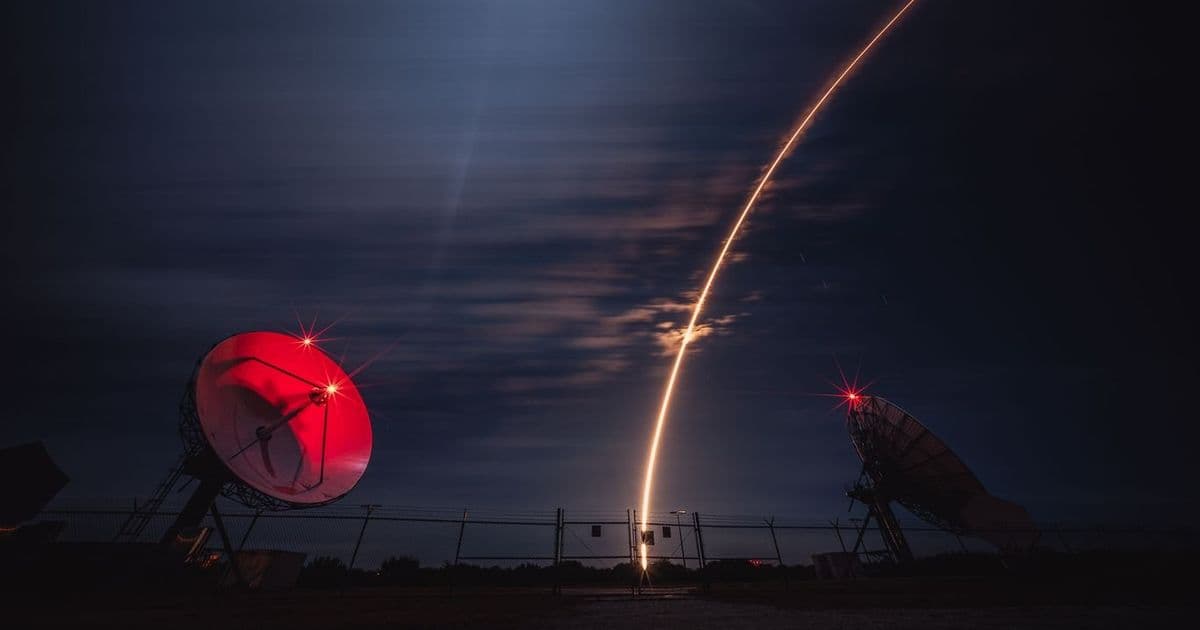
Major nations are investing billions in space-based defense systems, driven by the strategic value of orbital assets and the growing threat of anti-satellite weapons, with commercial satellite operators now caught in the crosshairs of geopolitical tensions.
The United States Space Force, China's People's Liberation Army (PLA) Strategic Support Force, and Russia's Space Forces are collectively requesting over $50 billion in combined FY2025 budgets for space warfare capabilities, according to recent defense appropriations documents. This represents a 37% increase from 2023 spending levels, reflecting a fundamental shift in military doctrine where space is no longer considered a support domain but a primary battlespace.
The strategic calculus changed dramatically in 2022 when Russia demonstrated kinetic anti-satellite (ASAT) capabilities by destroying its own defunct Cosmos 1408 satellite, creating a debris field that forced the International Space Station to perform collision avoidance maneuvers. The event proved that space assets—both military and commercial—are now legitimate targets in modern warfare. The U.S. Department of Defense now classifies 95% of its military communications and 100% of its precision-guided munitions as dependent on space-based systems, creating a critical vulnerability that adversaries can exploit.
China's approach has been methodical and commercially integrated. The PLA's Guo Wang satellite constellation, initially marketed for civilian navigation and communication, now includes dual-use satellites with advanced electronic intelligence capabilities. More concerning to Western planners is China's development of "satellite servicing" vehicles—orbital craft that can approach, inspect, and potentially manipulate other satellites under the guise of debris removal or repair missions. The U.S. Space Force's Space Domain Awareness program has tracked multiple instances of Chinese satellites performing close approaches to American assets in geostationary orbit, with distances under 100 kilometers considered potentially hostile maneuvers.
Commercial space operators face an unprecedented dilemma. Companies like SpaceX, OneWeb, and Amazon's Project Kuiper are building mega-constellations with thousands of satellites, creating infrastructure that is both commercially valuable and militarily significant. The U.S. government has already exercised its right to commandeer commercial satellite bandwidth during conflicts, as seen in the 2022 Ukraine war where Starlink terminals provided critical communications. However, this integration makes commercial satellites legitimate military targets under international law, potentially exposing civilian infrastructure to attack.
The technical challenges of space warfare are driving innovation in defensive capabilities. The U.S. Space Force's Protected Tactical SATCOM program is developing satellites with laser crosslinks that can rapidly reconfigure networks if individual satellites are destroyed. Meanwhile, the European Space Agency's Space Debris Office reports that ASAT tests have increased orbital debris by 15% since 2020, creating a cascading risk where collisions could render entire orbital regions unusable—a scenario known as the Kessler Syndrome.
Financial implications extend beyond military budgets. Insurance premiums for commercial satellites have risen 40% in the last two years, with underwriters now excluding coverage for "hostile acts" from space. This has forced operators to build more resilient systems, including rapid reconstitution capabilities and distributed architectures. SpaceX's Starship program, while primarily designed for Mars colonization, is being evaluated by the Pentagon as a potential rapid satellite deployment system that could replace lost assets within days rather than months.
The regulatory framework remains dangerously outdated. The 1967 Outer Space Treaty prohibits weapons of mass destruction in space but says nothing about conventional weapons or debris-generating ASATs. The UN Committee on the Peaceful Uses of Outer Space has been negotiating a "Space Traffic Management" framework since 2018, but progress has stalled as major powers disagree on whether military satellites should be subject to the same transparency measures as civilian ones.
Looking ahead, the next five years will likely see the deployment of operational space-based directed energy weapons and electronic warfare systems designed to disrupt satellite communications without creating debris. The U.S. Space Development Agency's Transport Layer network, scheduled for full deployment by 2027, aims to create a resilient mesh of hundreds of interconnected satellites that can maintain communications even if 30% are destroyed. China's answer is the Guo Wang constellation's distributed architecture, which uses optical inter-satellite links that are harder to jam than traditional radio frequency systems.
For technology companies, this creates both opportunity and risk. Defense contractors like Lockheed Martin and Northrop Grumman are expanding their space divisions, while commercial operators must now consider geopolitical risk in their launch site selection and supply chain management. The recent trend of "friendshoring"—moving manufacturing to allied nations—has reached space manufacturing, with satellite components increasingly sourced from politically stable countries rather than purely for cost reasons.
The commercial space economy, valued at $469 billion in 2023, now faces an existential question: can it remain commercially driven when its infrastructure has become militarily indispensable? The answer will shape not just the future of space exploration, but the balance of power on Earth itself.
Comments
Please log in or register to join the discussion