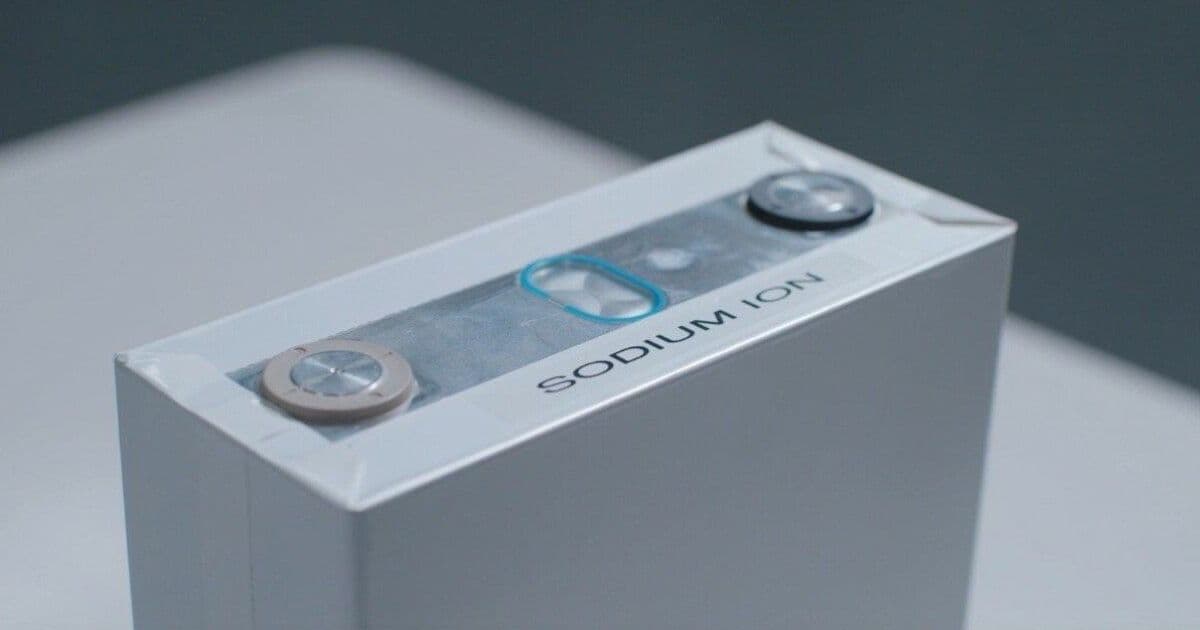
General Motors is partnering with Peak Energy to manufacture sodium-ion battery cells for stationary grid storage, betting that a heavier, cheaper, salt-based chemistry is a better fit for power-hungry datacenters than the lithium-ion packs it builds for cars.
General Motors wants in on the datacenter buildout, and it has chosen an unusual entry point. Rather than chasing servers or cooling contracts, the Detroit automaker is redirecting its battery research toward stationary grid-scale energy storage, and it is doing so with a chemistry it does not use in its electric vehicles.
GM announced a partnership with energy storage firm Peak Energy on Tuesday to develop next-generation sodium-ion battery cells aimed at grid-scale storage. The division of labor is straightforward: GM manufactures the cells, and Peak deploys them inside its own proprietary energy storage systems. GM is also taking an equity stake in Peak, though neither company disclosed the size of the investment.
Why sodium instead of lithium
Sodium-ion and lithium-ion batteries share a fair amount of chemistry. Both are rechargeable, and both shuttle ions between electrodes to store and release energy. The similarities mostly stop there. Sodium is abundant and stable, which makes the supply chain less fraught than lithium's, but it carries far less energy per unit of mass. A sodium battery that stores as much energy as a given lithium-ion pack will be larger and heavier.
For a car, that weight penalty is close to disqualifying. For a battery that sits on a concrete pad next to a datacenter and never moves, it simply does not matter. That is the core of GM's argument.
"When you're talking to a utility, a hyperscaler, or other power providers in need of energy storage solutions, their priority is not maximizing range or minimizing weight," said Kurt Kelty, GM's VP of battery and sustainability, in the company's announcement. "It is delivering reliable, affordable power over long periods of time in real-world conditions."
There is a second technical advantage. GM and Peak say sodium-ion systems can be built more simply and can operate across a wider temperature range than conventional lithium-ion. That matters because grid-scale lithium-ion deployments often depend on energy-intensive cooling to stay within a safe operating window. Peak's systems are passively cooled, and the company claims they cut storage costs by roughly 20 percent compared to conventional lithium-ion installations. By Peak's own analysis, replacing lithium iron phosphate storage with its passively-cooled sodium-ion units across the US could avoid around 2 terawatt hours of wasted energy each year.
How GM's existing expertise transfers
Kelty framed the move as a natural extension of work GM already does. He pointed to "important architectural similarities" between sodium-ion and lithium-ion cells, arguing that GM's accumulated experience in cell design, prototyping, and industrialization carries over directly to grid-scale sodium production. In practice, the manufacturing equipment and process knowledge for assembling and packaging cells overlap considerably, even when the active materials differ. That overlap is what lets an automaker plausibly retool battery research toward a market it has not served before.
GM also notes that advanced sodium-ion cells can endure more charge and discharge cycles than their lithium-ion counterparts. Cycle life is a meaningful metric for stationary storage, where a battery may charge and discharge daily for a decade or more, and where replacement is expensive and disruptive.
The catch
Sodium-ion is not a solved problem. Beyond the lower energy density, the manufacturing ecosystem is far less mature than lithium's. Lithium-ion still dominates energy storage on and off the grid, and it benefits from years of refined production at enormous scale. Researchers have been narrowing the gap, and some claim their sodium cell designs already match or beat lithium-ion on key measures, but those claims have not yet displaced lithium in the market.
There is also a geographic reality. The vast majority of sodium-ion battery factories are in China, which has invested heavily in the chemistry. Whether GM's effort grows into scalable domestic competition, or remains a research bet, is an open question. GM joins Ford and Panasonic among manufacturers repositioning battery capacity toward the datacenter market, where demand driven by AI workloads has buyers reserving cells years in advance.
The company did not provide a timeline. GM did not respond to questions about its sodium-ion roadmap or when the first cells might ship. For now, the partnership signals intent more than product: a large automaker placing a bet that the next big battery market is stationary, hungry for cheap and durable storage, and indifferent to weight.
Comments
Please log in or register to join the discussion