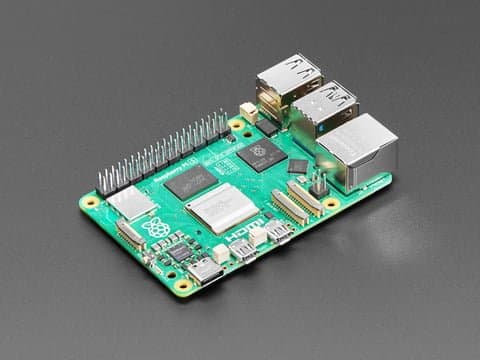
A 16GB Raspberry Pi 5 sells for $350 at Adafruit, four times the price of a base model. The release reopens a long-running argument about what these boards are actually for, and whether more memory pushes the Pi toward, or away from, the maker community that built it.
Raspberry Pi has spent fifteen years selling the idea that a usable computer can cost less than a textbook. So the arrival of a 16GB version of the Raspberry Pi 5, now listed at Adafruit for $350, lands as something more interesting than a routine spec bump. It is a quiet admission that the people buying these boards are no longer mostly hobbyists wiring up LED strips. They are running containers, local databases, and increasingly, machine learning models that want every byte they can get.
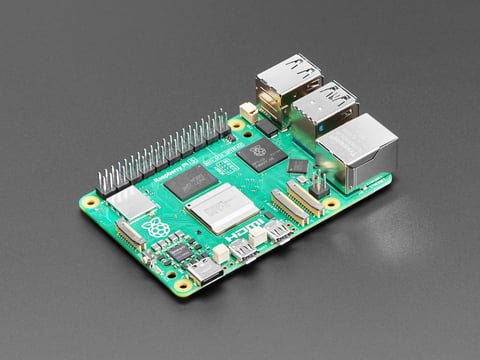
The board itself is the same Pi 5 that shipped in late 2023, built around a 2.4GHz quad-core Arm Cortex-A76, a VideoCore VII GPU clocked at 800MHz, and the in-house RP1 "southbridge" that handles most of the I/O. What changed is the memory ceiling. The lineup now runs from a 1GB model at $49.50 up through 2GB, 4GB, and 8GB tiers, with the 16GB part sitting at the top at seven times the price of the entry point. That spread tells you the product has fractured into several different machines wearing the same circuit board.
What the extra memory actually buys
For a long time the practical limit on a Raspberry Pi was not the CPU but the RAM. The Cortex-A76 cores in the Pi 5 deliver a two to three times CPU uplift over the Pi 4, and the LPDDR4X-4267 memory feeds them faster than anything in the previous generation. But 8GB still forces compromises the moment you try to do something serious. Run a few Docker containers, a Postgres instance, and a web frontend on the same board, and you start watching the kernel reach for swap. Swap on a microSD card or even a decent NVMe drive over the board's single-lane PCIe 2.0 interface is the kind of bottleneck that turns a snappy desktop into a frustrating one.
The 16GB part removes that pressure for a specific class of work. Self-hosted home servers running Home Assistant alongside media services, small Kubernetes clusters where each node needs headroom, and local inference workloads are the obvious beneficiaries. A 7-billion-parameter language model quantized down to 4-bit weights wants somewhere in the neighborhood of 5 to 8GB of memory just to load, and that leaves nothing for the operating system on an 8GB board. With 16GB, running a small model locally on a Pi stops being a party trick and becomes something you might actually leave running.
That is the adoption signal worth watching. The Pi community has spent the last two years quietly turning these boards into always-on infrastructure rather than learning toys, and the memory ladder is following the demand rather than leading it.
The case against, from the people who use them most
Not everyone is convinced, and the skepticism is coming from inside the tent. The most common objection is straightforward arithmetic. At $350 for the board alone, before you add the official 27W USB-C power supply, an active cooler, a case that no longer fits Pi 4 enclosures, and an NVMe drive on a separate M.2 HAT, you are well past $450 for a working system. At that point a used mini PC with an x86 chip, more memory, and an actual SATA or NVMe slot built in is sitting right next to it on the price chart, and it runs the entire universe of x86 software without the occasional Arm compatibility footnote.
That comparison has teeth. Refurbished Intel N100 and older corporate micro desktops have flooded the secondhand market, and they routinely beat a maxed-out Pi on raw performance per dollar for server workloads. The Pi's answer has always been power draw, size, and the 40-pin GPIO header that no mini PC offers. If your project genuinely needs to read sensors, drive displays over the dual four-lane MIPI transceivers, or sit in a battery-powered enclosure, none of those alternatives apply. If it does not, the value proposition gets harder to defend the higher up the memory ladder you climb.
There is a second, quieter critique about identity. The Raspberry Pi Foundation exists as an educational charity, and the cheap board was the whole pitch. A $350 SKU does not betray that mission, the $49.50 board still exists, but it does signal that the commercial and industrial customers Raspberry Pi has courted since going public are now shaping the roadmap. The 16GB part reads as a product for integrators and self-hosters, not for a classroom.
Where this fits in the broader board market
Step back and the 16GB Pi 5 looks less like an outlier and more like the single-board computer category growing up. Competing Arm boards from Radxa, Orange Pi, and others have offered 16GB and even 32GB configurations for a while, often with faster PCIe lanes or built-in NVMe slots. What those boards lack is the thing that has kept Raspberry Pi dominant despite frequently being outspecced: software support and a community large enough that almost any problem you hit has already been solved and documented by someone else. You buy a Pi partly for the hardware and largely for the ecosystem.
That ecosystem advantage is exactly why the memory ceiling matters. A board is only as useful as what people are willing to build and share for it, and the projects pushing against the 8GB wall, local AI, multi-service home servers, light virtualization, are the ones generating the most activity right now. Raspberry Pi raising the ceiling is a bet that those workloads represent where the platform is heading, not a fringe.
The honest read is that both camps are right about different buyers. For someone wiring a weather station or teaching a kid to program, the 16GB board is an absurd purchase, and nobody at Raspberry Pi expects that person to make it. For someone running a rack of low-power services in a closet who values the GPIO, the documentation, and the tiny footprint, $350 for a machine that will idle at a few watts and never need a fan replacement is a reasonable trade. The interesting question is not whether the 16GB Pi is worth it in the abstract. It is whether the line between those two users is the one Raspberry Pi wants to keep drawing, now that the second group is clearly paying the bills.
Comments
Please log in or register to join the discussion