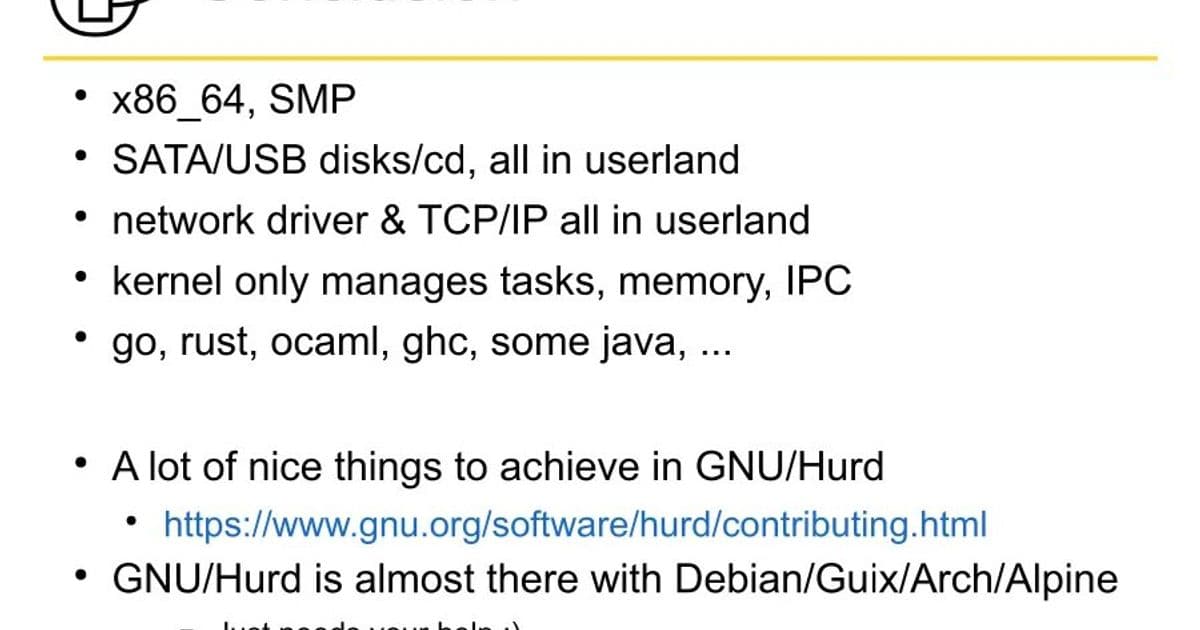
GNU Hurd has reached significant milestones in 2026 with near-complete x86_64 support, working SMP capabilities, and approximately 75% of Debian packages successfully building, marking the most promising progress for the alternative kernel in years.
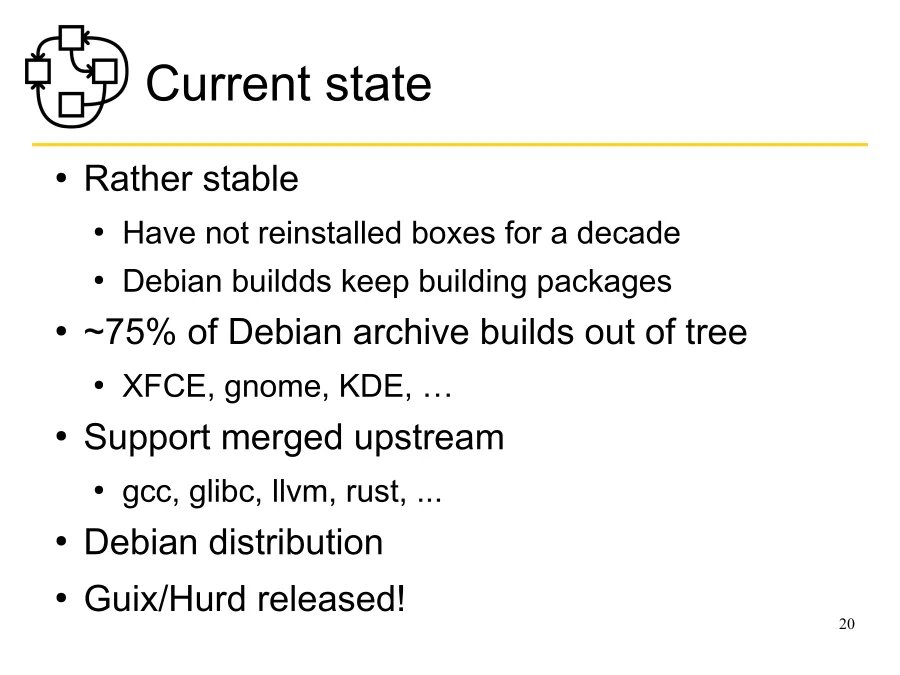
The GNU Hurd microkernel has reached its most promising state in decades, with developers declaring it "almost there" following substantial progress in multiple critical areas. Samuel Thibault's presentation at FOSDEM 2026 in Brussels revealed that Hurd has achieved near-complete x86_64 support, functional symmetric multiprocessing (SMP), and the ability to build approximately 75% of the Debian package archive.
For years, GNU Hurd has remained a curiosity in the operating system landscape, perpetually "almost ready" but never quite reaching the maturity needed for widespread adoption. The project's progress has been hampered by limited hardware driver support and the absence of SMP capabilities, making it unsuitable for modern multi-core systems. However, recent developments have begun to address these fundamental limitations.
Hardware Driver Support Through NetBSD Rump
The most significant breakthrough for Hurd in recent years has been the integration of NetBSD's rump kernel technology. This approach allows Hurd to leverage NetBSD's extensive driver support without requiring native driver development. The rump layer acts as a compatibility layer that translates driver interfaces, enabling Hurd to utilize drivers originally written for NetBSD's monolithic kernel architecture.
This development is particularly crucial because driver support has been Hurd's Achilles' heel. While the Linux kernel benefits from thousands of contributors maintaining drivers for virtually every piece of hardware imaginable, Hurd's smaller developer base made it impossible to maintain comparable driver coverage. The rump integration effectively multiplies Hurd's driver ecosystem by tapping into NetBSD's mature driver infrastructure.
SMP Support Finally Arrives
Another major milestone is the implementation of SMP support. For years, Hurd could only utilize a single CPU core, making it impractical for modern hardware where even budget systems come with multiple cores. The addition of SMP support means Hurd can now take advantage of the full processing power available in contemporary systems.
This development required significant architectural changes to the microkernel design. Unlike monolithic kernels where SMP support can be added more straightforwardly, microkernels like Hurd require careful coordination between the kernel and user-space servers that handle various system functions. The successful implementation of SMP demonstrates that Hurd's architecture can scale to modern hardware requirements.
x86_64 Support Reaches Completion
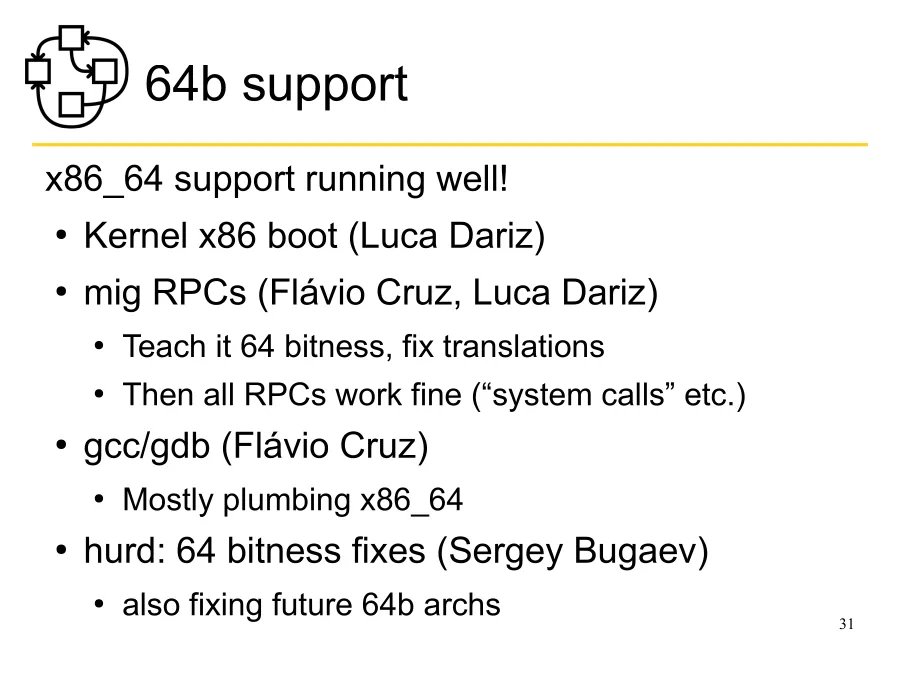
The transition from 32-bit x86 to 64-bit x86_64 architecture has been another long-standing challenge for Hurd. The 64-bit port is now "essentially complete," meaning Hurd can run on modern hardware without the limitations of 32-bit addressing. This includes support for larger amounts of RAM, modern instruction sets, and compatibility with contemporary software that assumes a 64-bit environment.
Software Compatibility Reaches 75% of Debian Packages
Perhaps the most tangible measure of Hurd's progress is its software compatibility. Thibault reported that approximately 75% of the Debian archive now builds successfully for Hurd. This includes complex desktop environments and applications that were previously impossible to run on the platform.
This level of compatibility is significant because it means Hurd can now run most common software without modification. Users can install and run applications through standard package management systems, making the operating system practical for real-world use cases. The remaining 25% of packages that don't build likely include software with very specific kernel dependencies or those requiring features Hurd doesn't yet implement.
Growing Ecosystem of Hurd Distributions
The Hurd ecosystem has expanded beyond the original Debian GNU/Hurd distribution. Guix/Hurd and Alpine/Hurd distributions have emerged, providing alternative approaches to Hurd deployment and testing. This diversification indicates growing interest in the platform and provides users with choices based on their preferences for package management and system philosophy.
Debian GNU/Hurd remains the most mature distribution, benefiting from Debian's extensive package repository and established infrastructure. Guix/Hurd offers a functional package management approach with reproducible builds, while Alpine/Hurd provides a lightweight option for users who prioritize minimal resource usage.

Looking Toward AArch64 Support
The Hurd development team is already looking beyond x86_64, with plans to implement AArch64 support. This forward-looking approach demonstrates confidence in Hurd's current progress and a desire to support modern ARM-based systems, including servers, workstations, and mobile devices that use ARM architecture.
AArch64 support would significantly expand Hurd's potential hardware compatibility, particularly in the growing ARM server market and the continued prevalence of ARM in mobile and embedded systems.
Community Support Still Needed
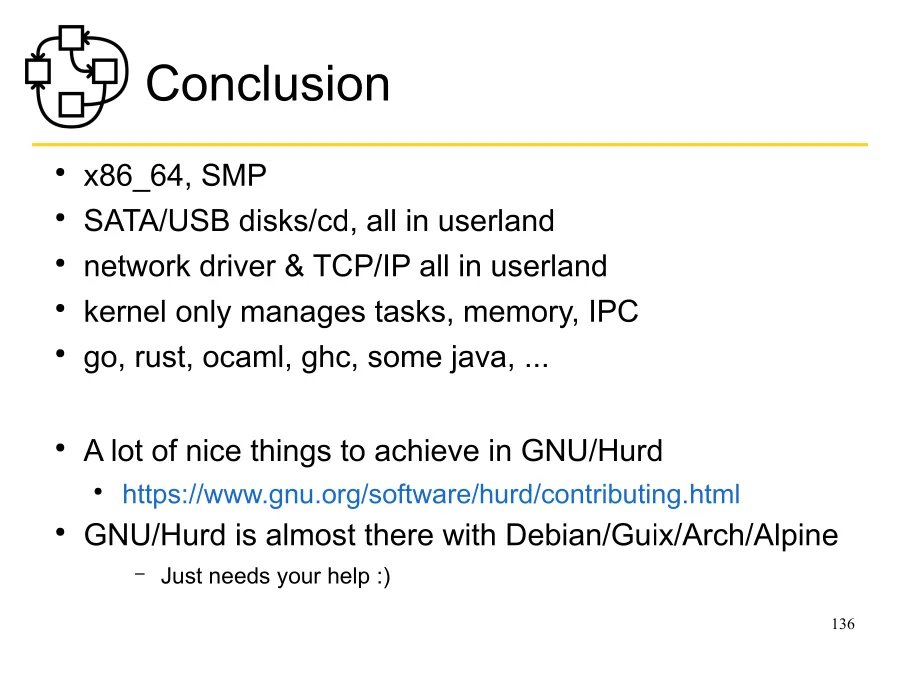
Despite the impressive progress, Thibault emphasized that Hurd still needs community contributions to reach its full potential. The "almost there" status indicates that while Hurd has achieved many critical milestones, it still requires work to become a fully viable alternative to Linux for general-purpose computing.
Areas that could benefit from additional contributors include driver development, performance optimization, and expanding the set of packages that build successfully. The Hurd community is particularly interested in developers who can help with low-level system programming and those willing to test and report issues with specific software packages.
The Significance of Hurd's Progress
GNU Hurd's progress in 2026 represents more than just incremental improvements to an alternative kernel. It demonstrates the viability of microkernel architectures in modern computing environments and provides a genuine alternative to Linux for users who value the GNU project's philosophy of software freedom and user control.
The microkernel approach, which separates kernel functions into distinct user-space servers, offers theoretical advantages in terms of system stability and security. If Hurd can achieve practical usability, it could influence future operating system design and provide a fallback option if Linux development were to face significant challenges.
Current Status and Future Outlook
As of early 2026, GNU Hurd stands at its most advanced state since development began in the 1990s. The combination of x86_64 support, SMP capabilities, and broad software compatibility through Debian package building makes it a practical option for experimentation and potentially for specific use cases where its microkernel architecture offers advantages.
The path forward involves completing the remaining 25% of package compatibility, expanding hardware support beyond what the rump layer provides, and continuing to optimize performance. With active development and growing community interest, Hurd may finally achieve its long-standing goal of providing a complete GNU operating system that doesn't rely on the Linux kernel.
For those interested in exploring Hurd, the FOSDEM 2026 presentation by Samuel Thibault provides detailed technical information about the current state and future directions. The Hurd community welcomes contributors of all skill levels, from those interested in low-level kernel development to users who can help test software packages and report issues.
Comments
Please log in or register to join the discussion