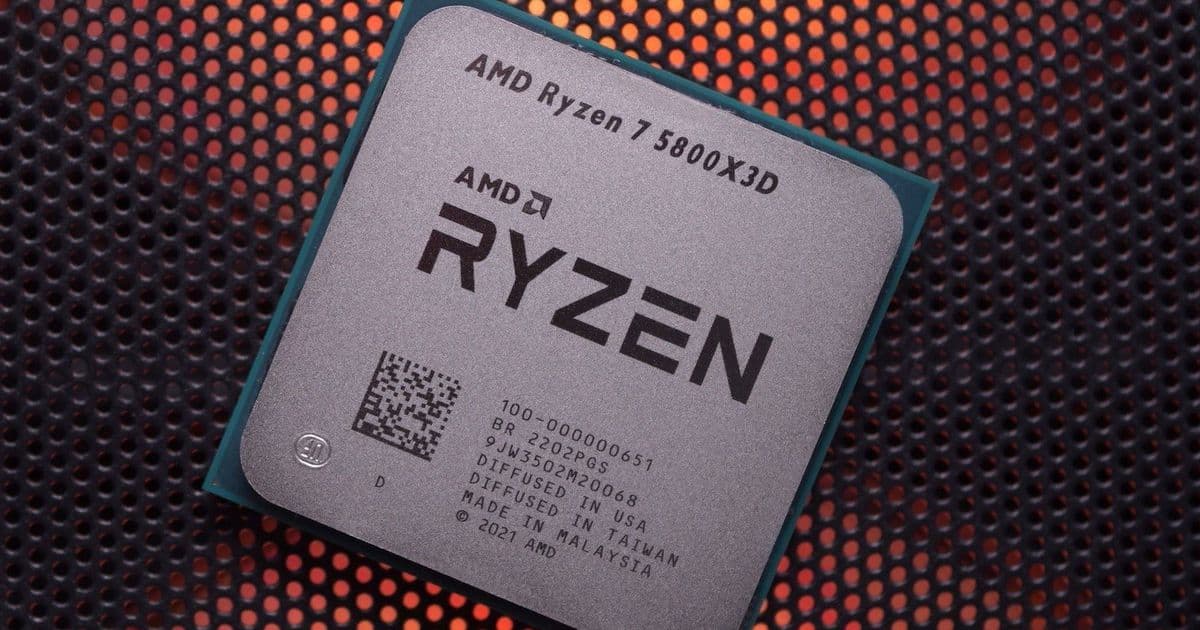
Hardware Unboxed's latest gaming benchmarks reveal the four-year-old Ryzen 7 5800X3D remains remarkably competitive against Intel's flagship Core Ultra 9 285K, trailing by only a few percentage points in 14-game averages. This enduring performance highlights the processor's exceptional value and raises questions about AMD's decision to discontinue it amid rising DDR5 platform costs.
When AMD launched the Ryzen 7 5800X3D in 2022, it wasn't just another processor release—it was a seismic shift in gaming CPU value. At the time, it delivered gaming performance that could outpace Intel's much more expensive Core i9-12900K flagship, all while using the mature AM4 platform and affordable DDR4 memory. Now, four years later, the chip's relevance hasn't faded. In fact, new testing from Hardware Unboxed demonstrates that this aging processor still hangs with the absolute latest silicon from both AMD and Intel.
The Benchmark Reality
Hardware Unboxed tested the Ryzen 7 5800X3D against current-generation CPUs including Intel's Core Ultra 9 285K and AMD's own Ryzen 5 9600X and Ryzen 7 9800X3D. The results are striking. In their 14-game average at 1080p/Medium settings—a common testing methodology that minimizes GPU bottlenecks to isolate CPU performance—the 5800X3D delivered 188 FPS average with 151 FPS in the critical 1% low metric. This places it within striking distance of Intel's current flagship, the Core Ultra 9 285K, and nearly on par with AMD's newer Ryzen 5 9600X.
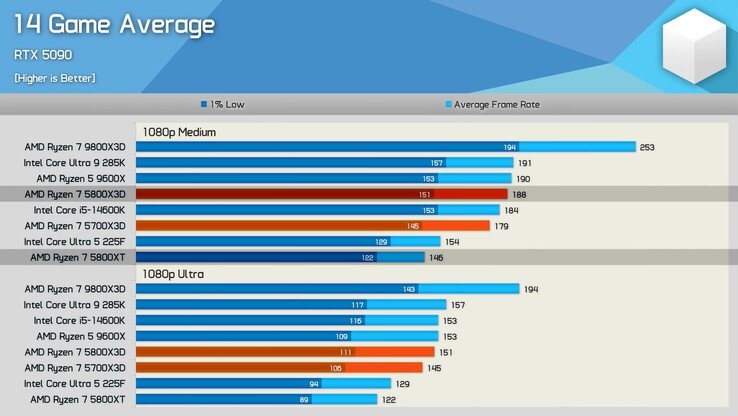
The performance gap widens when comparing to AMD's current X3D champion, the Ryzen 7 9800X3D, which shows a 35% improvement over its predecessor. However, the 5800X3D's ability to stay within a few percentage points of Intel's latest flagship is remarkable for a processor that's now four generations old.
At 1080p/Ultra settings, where GPU limitations become more pronounced, the 5800X3D continues to hold its ground. It matched the performance of both the Core i5-14600K and Ryzen 5 9600X, delivering 151 FPS average compared to their 153 FPS. In practical terms, this means games like Battlefield 6 run with virtually identical performance on the 5800X3D as they do on processors that cost significantly more and require entirely new platforms.
Why the 5800X3D Still Competes
The 5800X3D's longevity stems from AMD's revolutionary 3D V-Cache technology. By stacking 96MB of L3 cache directly on the die, AMD created a processor where memory latency—the Achilles' heel of gaming performance—was dramatically reduced. This architectural advantage doesn't diminish with time. While newer CPUs may have higher clock speeds or more cores, the 5800X3D's massive cache continues to provide a tangible benefit in gaming workloads that are sensitive to memory access patterns.
The chip's 8-core, 16-thread configuration remains more than adequate for modern gaming. Most games still don't scale well beyond 8 cores, and the 5800X3D's per-core performance remains competitive. Its 105W TDP is also reasonable, avoiding the extreme power demands of some newer high-end CPUs.
The AM4 Platform's Enduring Value

Perhaps more significant than the CPU itself is what it represents: the continued value of the AM4 platform. AMD's decision to support AM4 from 2017 through 2022 created an ecosystem where users could upgrade multiple times without changing their motherboard, RAM, or cooler. This stands in stark contrast to the current landscape where both AMD's Zen 5 and Intel's Arrow Lake require DDR5 memory and new motherboards.
The economics here are crucial. DDR4 memory, while still priced higher than historical norms due to supply constraints, remains substantially cheaper than DDR5. A quality 32GB DDR4-3600 CL16 kit might cost $80-100, while comparable DDR5-6000 CL30 kits often exceed $150. When combined with affordable AM4 motherboards still available new for under $100, the total platform cost for a 5800X3D build can be hundreds less than a comparable Arrow Lake or Zen 5 system.
The Market Gap AMD Left Behind
Hardware Unboxed makes a compelling case that AMD should consider bringing back AM4 CPUs like the 5800X3D. The reasoning is straightforward: with DDR5 prices remaining elevated and the memory/SSD market potentially worsening until 2028, many gamers are priced out of current-generation platforms. The 5800X3D offers a path to high-end gaming performance without the platform tax.
For builders on a budget, the math is compelling. A complete 5800X3D system with 32GB of DDR4 and a capable B550 motherboard can be assembled for significantly less than a comparable Core Ultra 9 or Ryzen 9000-series build. Yet in gaming, the performance difference is often negligible, especially at 1080p and 1440p where GPU limitations dominate.
Who Should Consider the 5800X3D Today?
Current AM4 Owners: If you're running a Ryzen 3000 or 5000 series CPU (excluding the 5800X3D itself), upgrading to the 5800X3D remains one of the most cost-effective performance boosts available. The drop-in compatibility means minimal additional costs beyond the CPU itself.
Budget-Conscious New Builders: For gamers targeting 1080p or 1440p high-refresh-rate gaming, a 5800X3D build paired with a mid-range GPU like an RTX 4070 or RX 7800 XT delivers exceptional value. The platform costs are lower, and the gaming performance is still excellent.
Esports and Competitive Gamers: The 5800X3D's strong 1% low performance—critical for smooth gameplay in titles like CS2, Valorant, and Apex Legends—makes it a viable option even for serious competitive players who prioritize frame consistency over raw average FPS.
The Caveats
The 5800X3D isn't without limitations. Its single-core performance falls behind modern CPUs, which matters in some productivity tasks and games that are heavily single-threaded. The platform lacks PCIe 5.0 support, which could become relevant for future GPU generations. And for users who need more than 8 cores for streaming, content creation, or other workloads, newer platforms offer better multi-threaded performance.
Perhaps most importantly, the 5800X3D is discontinued. While some retailers still have stock, availability is dwindling. The used market remains an option, but prices vary significantly. AMD has shown no indication of bringing the chip back, despite the clear market demand for affordable high-end gaming CPUs.
The Broader Pattern
The 5800X3D's enduring relevance highlights a broader trend in PC hardware: the diminishing returns of annual upgrades. Four years after its release, a CPU that cost $450 at launch still delivers 90%+ of the performance of chips that cost twice as much on entirely new platforms. This challenges the traditional upgrade cycle and suggests that for many users, holding onto capable hardware longer makes economic sense.
It also underscores the importance of platform longevity. AMD's decision to extend AM4 support created a generation of hardware with exceptional staying power. The company's subsequent move to AM5 and DDR5, while technologically necessary, has created a cost barrier that leaves many gamers behind.
Looking Forward
For AMD, the 5800X3D's performance against current silicon presents both a compliment and a challenge. The chip's success validates their 3D V-Cache approach, but its continued relevance also questions whether the market needs more frequent CPU releases. For Intel, the results are a reminder that gaming performance isn't just about clock speeds and core counts—cache architecture matters profoundly.
For consumers, the message is clear: the Ryzen 7 5800X3D remains a viable, high-performance gaming CPU in 2026. While newer platforms offer benefits in productivity, connectivity, and future-proofing, the 5800X3D's gaming prowess endures. In a market where complete PC builds often exceed $2,000, this four-year-old processor offers a path to premium gaming performance at a mid-range price.
The chip may be gone from AMD's lineup, but its performance legacy continues to challenge the notion that newer is always better. For gamers watching their budget while demanding high frame rates, the 5800X3D proves that sometimes the best value in PC hardware comes from looking back at what worked.
Hardware Unboxed's full benchmark analysis is available on their YouTube channel.
Note: Prices and availability mentioned are based on current market conditions and subject to change.
Comments
Please log in or register to join the discussion