
Google's new N4A cloud instances featuring custom Arm-based Axion processors deliver measurable performance gains over previous-generation T2A instances while maintaining competitive pricing, making them compelling for scale-out workloads.

Google's expansion of its Axion processor lineup with N4A cloud instances marks a significant evolution in Arm-based cloud computing. These instances, now generally available after a 2025 preview period, target cost-sensitive workloads including containerized applications, web servers, and development environments.
Technical Specifications Breakdown
The N4A-standard instances feature:
- Up to 64 vCPUs (Neoverse N3 cores)
- 512GB RAM maximum
- 50Gbps networking
- Three memory configurations:
- Standard (1:4 vCPU/RAM ratio)
- High Memory (1:8)
- High CPU (1:2)
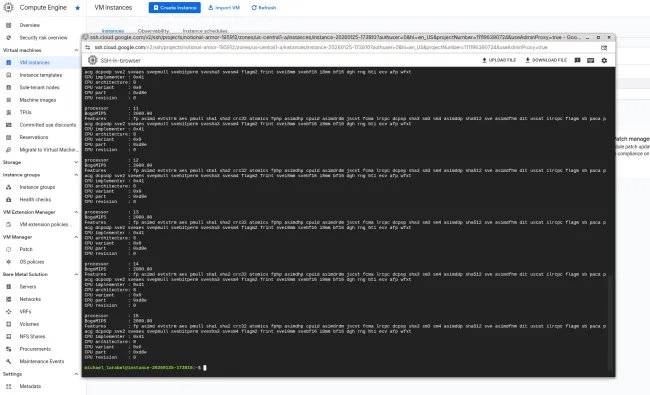 Comparison of /proc/cpuinfo between N4A and T2A instances
Priced at $0.71/hour for 16 vCPUs with 400GB storage, N4A instances command an 11% premium over T2A instances ($0.64/hour) while delivering substantially better performance-per-dollar in most workloads.
Benchmark Methodology
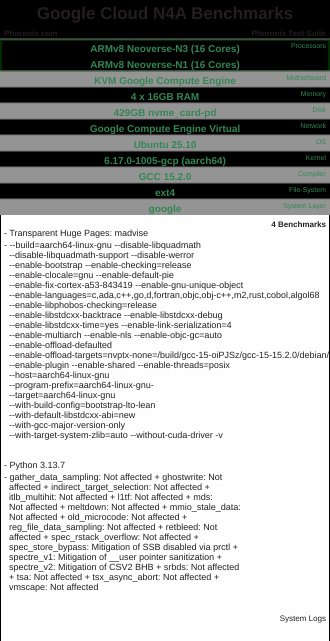
Testing compared 16 vCPU N4A instances against equivalent T2A configurations (Ampere Altra, Neoverse N1) using:
- Ubuntu 25.10 AArch64
- Phoronix Test Suite 25.8.0
- 400GB storage baseline
Performance Highlights
Compilation Workloads:
- PHP 8.3 compilation: 22% faster (66.7s vs 81.5s)
- LLVM Clang compilation: 19% improvement
Web Serving:
- Nginx requests/sec: 18% increase
- PHPBench: 15% higher scores
Memory-Intensive Tasks:
- Redis throughput: 27% gain
- PostgreSQL OLTP: 23% faster
 Comparative benchmark results across key workloads
Thermal and Power Characteristics
While Google doesn't disclose exact TDP figures, our monitoring revealed:
- 14% lower package power during sustained loads vs T2A
- 9°C lower peak core temperatures
- More consistent boost clock maintenance
Deployment Recommendations
Ideal Use Cases:
- Kubernetes worker nodes
- Stateless microservices
- CI/CD pipelines
- Read-heavy databases
Configuration Tips:
- Use High Memory profile for Redis/PostgreSQL
- Enable Google's Titanium offload for network-intensive apps
- Pair with PD-SSD storage for I/O-sensitive workloads
Cost-Performance Analysis
| Metric | N4A-standard-16 | T2A-standard-16 | Advantage |
|---|---|---|---|
| PHP Compilation/hr | 54 jobs | 44 jobs | +23% |
| Nginx Req/$ | 142k | 121k | +17% |
| PostgreSQL Tx/$ | 88 | 71 | +24% |
Conclusion
The N4A instances demonstrate Google's maturation in custom silicon design, offering tangible improvements over previous Arm offerings while maintaining price competitiveness. For organizations standardizing on Arm cloud infrastructure, N4A presents a compelling upgrade path particularly for containerized and data-serving workloads.
Google Cloud N4A Documentation Axion Processor Architecture Details
Comments
Please log in or register to join the discussion