A deep dive into Hacker News' AI content saturation, revealing that AI dominates the top stories and many articles are likely AI-written, raising questions about the platform's future.
How much of Hacker News is AI? That's the question lcamtuf set out to answer in a fascinating experiment that reveals just how thoroughly artificial intelligence has infiltrated one of tech's most influential platforms.
The AI Takeover of Hacker News
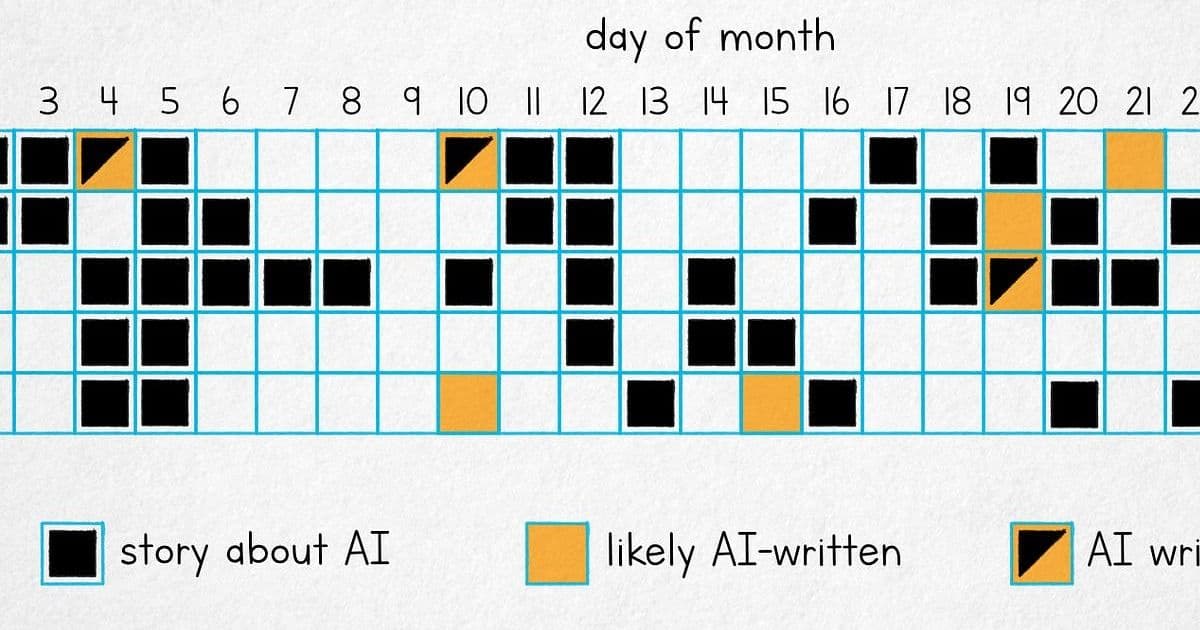
The experiment began with a simple premise: track the top five stories on Hacker News throughout February 2026 and see how many were AI-related. The results were striking.
AI dominated the feed. On February 4th and February 12th, AI took four out of five spots in the daily top stories. February 5th was arguably even worse, with the entire lineup focused on AI topics, including what lcamtuf identified as "submarine marketing" for an AI vendor.
Only three days escaped AI's grip. February 1st, February 9th, and February 25th were the only days where AI stories didn't appear in the top five, though even then they were lurking at positions #7, #8, #9, and #10.
This saturation isn't just about quantity—it's about the nature of the content. Many stories appear to be vendor announcements, marketing pieces, or what lcamtuf calls "submarine marketing," where companies disguise promotional content as genuine news or analysis.
Detecting the AI-Written Content
But the experiment went deeper. lcamtuf wanted to know not just how much AI content was being discussed, but how much of the content itself was AI-generated.
To do this, they used Pangram, a conservative AI detection model. While AI detectors have a bad reputation among tech enthusiasts, lcamtuf argues that many objections are based on outdated assumptions or misconceptions. The key insight is that current LLMs have a quasi-deterministic default voice—ask for the same essay twice and you'll get stylistically similar results, even if the individual mannerisms are human-like.
After manually reviewing flagged stories, lcamtuf found the results made sense, with only a couple of false negatives. One telling example was the #3 story on February 19th: "AI is not a coworker, it's an exoskeleton." In lcamtuf's opinion, this piece contained multiple red flags characteristic of AI-generated writing.
Why This Matters
The implications are significant. Hacker News has long been a bellwether for tech culture and trends. If AI content is dominating both the topics and the writing, it suggests we're in a feedback loop where:
- AI companies generate content about their products
- That content gets promoted on platforms like Hacker News
- More AI content gets created in response to what's trending
- The cycle continues
This creates a distorted view of what's actually important or innovative in technology. As lcamtuf notes, around 2018 Hacker News had a fair number of stories about cryptocurrencies and NFTs—trends that ultimately proved to be bubbles. The current AI saturation might be similarly overhyped.
The Human Element
Interestingly, lcamtuf acknowledges their "complicated relationship" with Hacker News. While it's the most important aggregator of geek news and a major source of traffic to their blog, it's also a source of toxic comments and insults. This personal stake adds credibility to the analysis—it's not someone with an axe to grind, but rather someone deeply embedded in the community who's concerned about its direction.
What's Next?
The experiment raises uncomfortable questions: How do we distinguish genuine innovation from AI-generated hype? What happens when the default voice of online discourse becomes increasingly homogenized by AI writing tools? And most importantly, how do we maintain authentic human conversation in an environment where AI content is becoming the norm rather than the exception?
As lcamtuf's experiment shows, we may be further down this path than many realize. The AI takeover of Hacker News isn't just about technology—it's about how we consume, create, and think about information in the age of artificial intelligence.
For now, the data speaks for itself: on most days in February 2026, if you were reading Hacker News, you were likely reading about AI, written by AI, or both. That's a reality worth contemplating for anyone who cares about the future of tech discourse.
Comments
Please log in or register to join the discussion