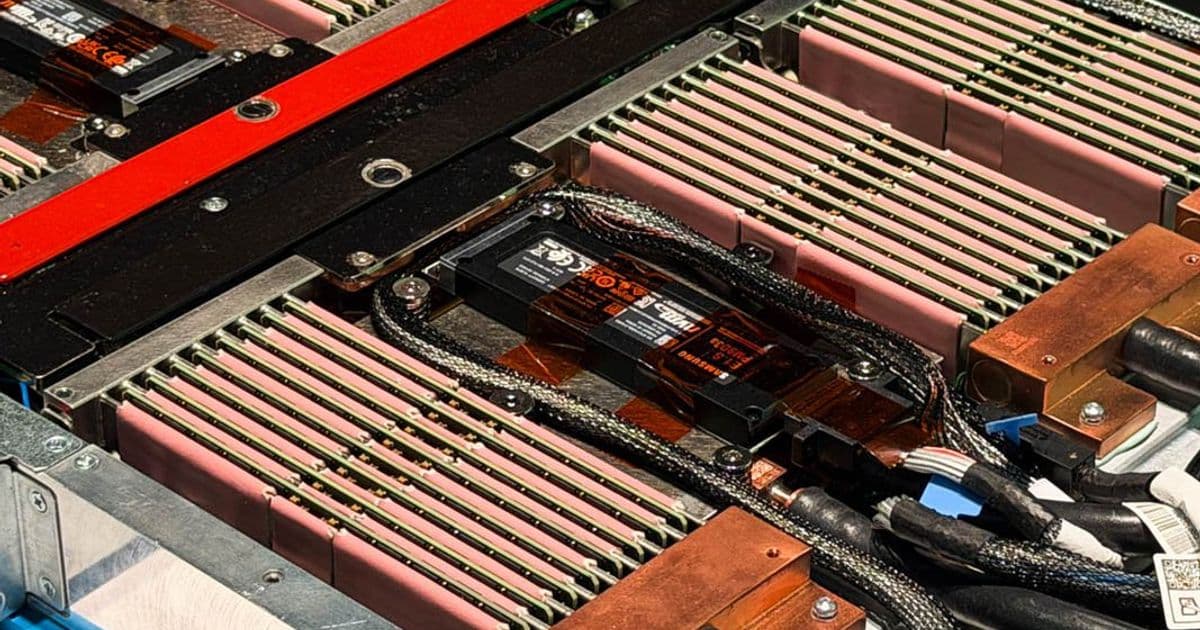
HPE showed a Cray GX250a blade at Discover 2026 with eight AMD EPYC Venice CPUs, liquid-cooled DIMMs, E1.S scratch SSDs and Slingshot fabric for a dense GX5000 rack.
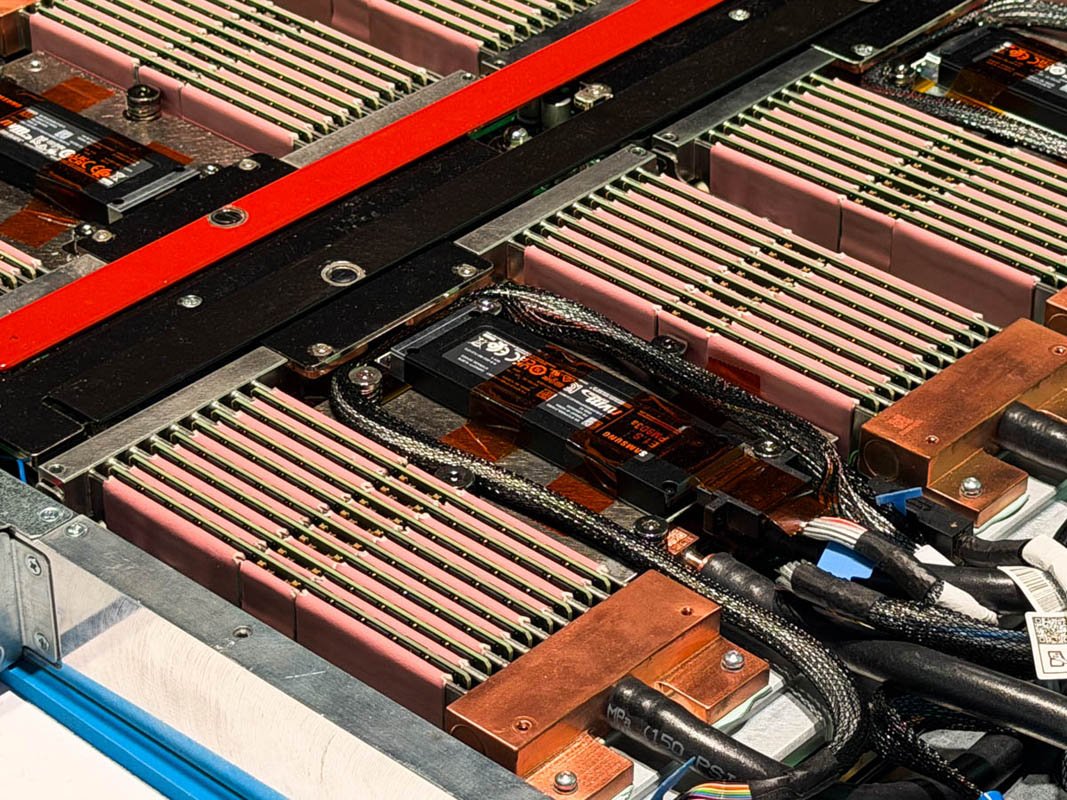
Hewlett Packard Enterprise showed a Cray GX250a compute blade at HPE Discover 2026 with eight AMD EPYC Venice CPUs and a claimed 81,920 cores per rack.
The blade previews the next CPU-dense path for HPE's Cray supercomputing line. ServeTheHome photographed the sled on the HPE show floor and captured the parts that matter for builders: socket count, memory layout, cooling path, scratch storage and fabric attachment.
Product
HPE built the Cray GX250a for the Cray GX5000 platform. The display system used eight AMD EPYC Venice CPUs in one compute blade. Each CPU had 16 memory channels, giving one blade 128 memory channels before networking and storage enter the plan.
| Item | Data from the display and photos |
|---|---|
| Platform | HPE Cray GX5000 |
| Compute blade | HPE Cray GX250a |
| CPU platform | AMD EPYC Venice |
| CPUs per blade | Eight |
| Memory channels per CPU | 16 |
| Claimed rack core count | 81,920 |
| Rack blade count shown | 36 |
| Cooling plant shown | 1.6 MW CDU |
| Fabric shown | Slingshot 400 side pods |
HPE placed a power busbar through the center of the sled. The company routed liquid-cooling mating points on each side and kept cable paths near the outer edges. That layout gives service teams a clean front-to-back view of the blade instead of a dense cable stack across the CPU field.
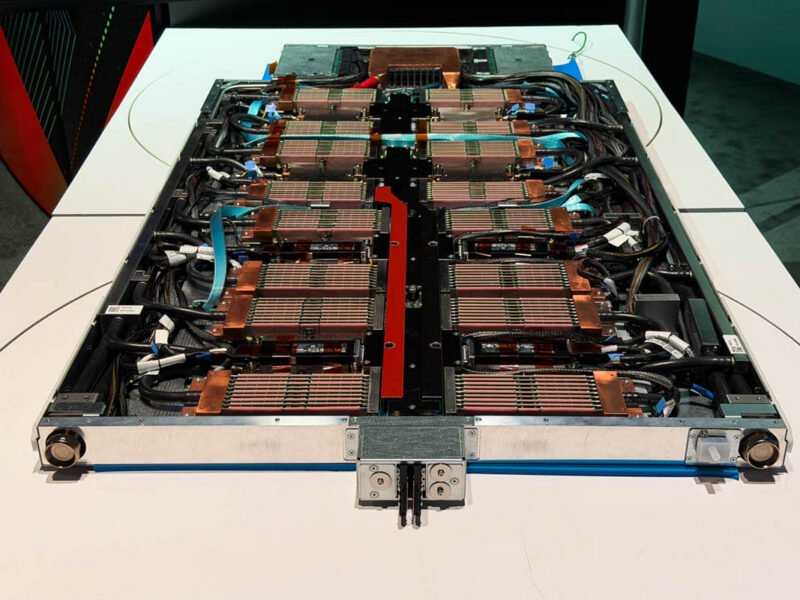
From the rear, you can trace the rack design in layers. HPE runs power through the middle and pushes liquid lines plus signal cables to the sides. The layout resembles OCP Open Rack v3 at a glance, but HPE uses a Cray implementation with different mating hardware and a different service model.
The CPU field dominates the blade. HPE placed eight sockets across the sled, each with liquid-cooled memory beside it. ServeTheHome said the DIMMs looked like MRDIMMs, but HPE staff did not confirm the module type from the show-floor view.
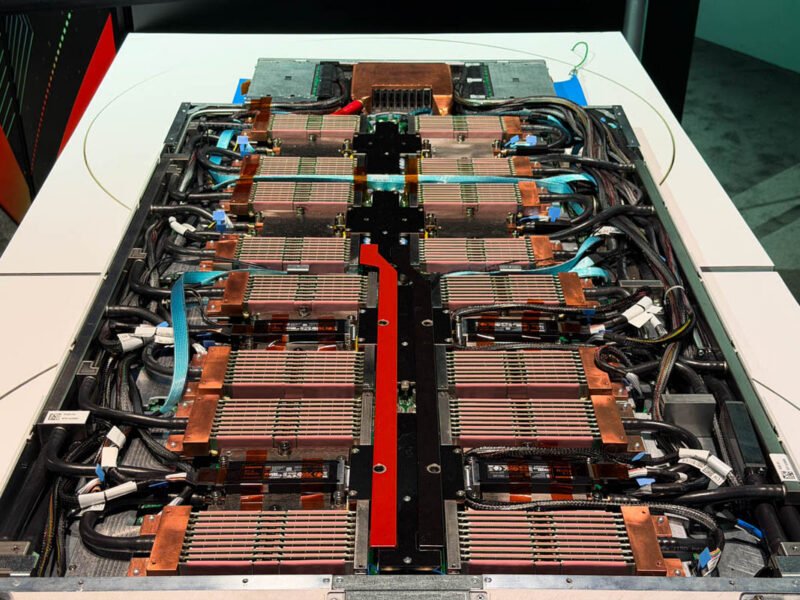
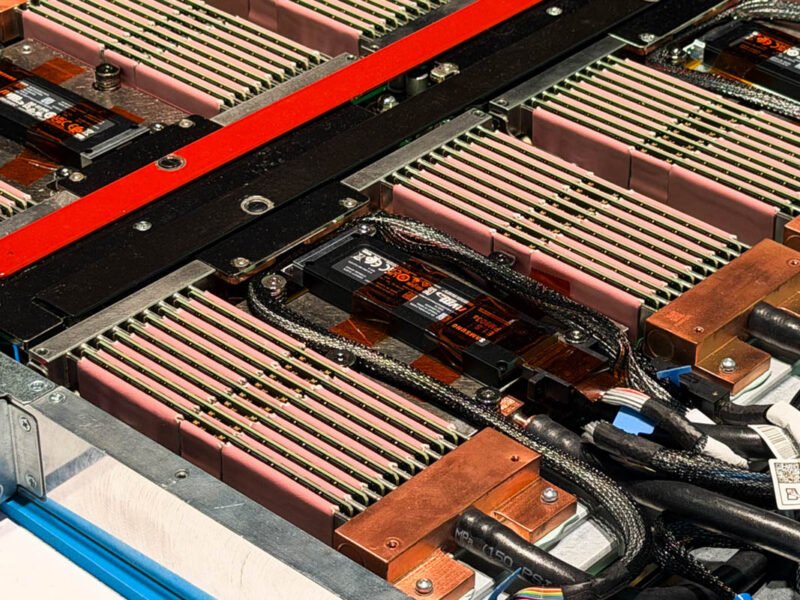
HPE also placed Samsung E1.S EDSSF SSDs on top of several CPU coldplates. HPE staff told ServeTheHome that the drives provide fast scratch storage. That placement gives each node local flash close to the CPUs, which helps checkpoint, spill and temporary data workflows that can punish shared file systems.
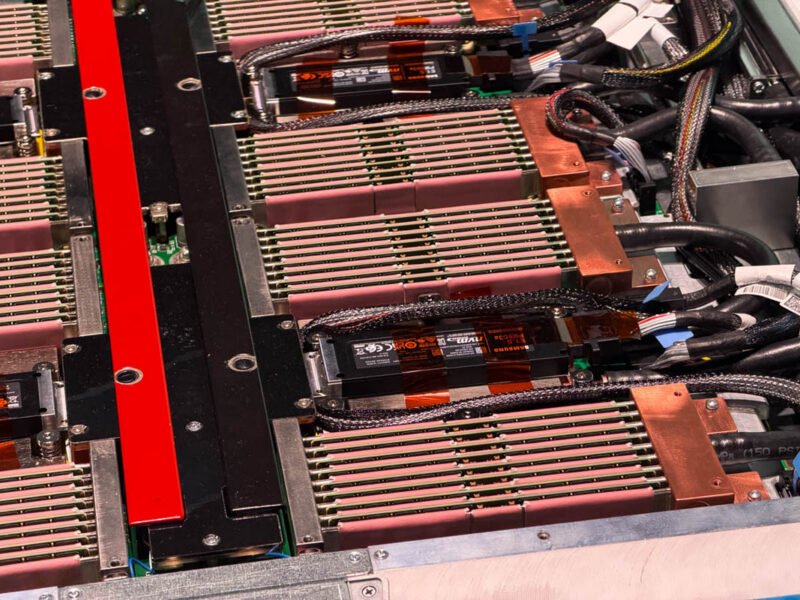
Four CPU positions lacked the top SSDs, which gave ServeTheHome a better view of the coldplates. The AMD EPYC coldplate used six screw points. The photos also showed the DIMM cooling hardware around each socket, a key detail for anyone expecting Venice systems to push memory bandwidth as hard as core count.
Performance data
HPE did not give LINPACK, HPCG, STREAM or application benchmark scores for the GX250a at the show. Builders should treat 81,920 cores per rack as density data, not throughput data. Core count sets the ceiling for parallel work, but memory bandwidth, fabric latency, power limits and compiler support decide how much work a rack completes.
The rack math needs attention. HPE said a GX5000 rack can reach 81,920 cores. The visible layout points to 36 blades per rack and eight CPUs per blade. Divide 81,920 by 288 sockets and you get 284.4 cores per socket. AMD has not announced a Venice core count on its EPYC server processor page that resolves that number.
| Density calculation | Result |
|---|---|
| 36 blades x eight CPUs | 288 CPU sockets |
| 81,920 cores / 288 sockets | 284.4 cores per socket |
| 81,920 cores / 36 blades | 2,275.6 cores per blade |
| 1.6 MW / 81,920 cores | 19.5 watts of cooling capacity per core |
HPE may count processors outside the 36 compute blades, or the final rack population may differ from the show-floor chassis. HPE may also target a Venice SKU count that AMD has not published. Until HPE gives a socket-level bill of materials, the 81,920-core figure works best as a rack claim that still needs topology detail.
The density target dwarfs common air-cooled CPU racks. ServeTheHome framed current dense air-cooled CPU racks around 8,000 cores. HPE's GX5000 target reaches about 10 times that count. That jump requires liquid cooling, rack-scale power delivery and a fabric that can keep thousands of CPU cores fed.
Power and cooling
HPE showed a coolant distribution unit that can handle 1.6 MW for this generation. Data center teams should read that as a heat-removal target for the rack class, not measured blade draw. Wall power depends on power conversion, pump load, memory speed, SSD count, fabric mix and CPU bin.
The 1.6 MW figure changes planning. A small cluster of these racks moves into utility and mechanical design territory fast. Ten racks at that envelope ask the facility team for 16 MW of cooling capacity before they add storage, login nodes, switches outside the Cray frame and power overhead.
Liquid-cooled DIMMs also change service assumptions. Memory replacement in this class requires leak management, torque control and technician access around coldplates. HPE's use of standard DIMM form factors helps parts planning, but the cooling hardware makes field service a rack procedure instead of a simple server pull.
The local E1.S drives create a second thermal question. HPE put scratch flash above several CPU coldplates, which saves board area and keeps the drives near the compute complex. Storage teams still need endurance data, replacement paths and failure-domain guidance before they size checkpoint workloads around those devices.
Fabric and compatibility
HPE staff described the side pods as Slingshot 400, with two NICs on each side. They also said the same area can take future Slingshot 800 hardware. HPE markets Slingshot as its HPC Ethernet fabric for large systems, and the GX250a appears built around that rack-scale network plan.
ServeTheHome said the connectors looked similar to OCP NIC 3.0 connectors, with cables running to each CPU. That detail matters because CPU-to-NIC topology can make or break MPI scaling. A balanced design can reduce contention between sockets. A poor mapping can strand cores behind the wrong path to the fabric.
HPE mounted the front networking section proud of the rack face. An operator pulls optics at a right angle to the motion most server racks require. That cabling pattern can help aisle access, but facility teams need cable-management drawings before they lock row spacing and service clearances.
The show unit carried a Vanover VP1-01 node label. ServeTheHome read that as a sign HPE showed a working system, not a static mock-up. Installed SSDs and DRAM support that reading. HPE also roped off the system, which fits a live prototype or preproduction platform.
Build recommendations
Operators should start with the facility plan, then validate the node. A GX5000 rack in this class needs direct liquid cooling and high-current feeds before buyers can talk about core count. The CDU, manifold, leak detection plan and service clearance belong in the first design meeting.
CPU buyers should wait for AMD and HPE to publish Venice SKU details before they model software throughput. Core count alone does not answer scheduler density, memory bandwidth per core or license cost per rack. The 16-channel memory design looks promising for bandwidth-heavy codes, but benchmark data must prove it.
Network teams should treat Slingshot as part of the compute purchase. The rack design puts fabric hardware into the node layout, so buyers cannot separate server selection from interconnect design. Ask HPE for NIC mapping, injection bandwidth, cable routing, optic service steps and Slingshot 800 upgrade terms.
Storage teams should test the E1.S scratch tier with real checkpoint and spill patterns. Local flash can take pressure off a shared parallel file system, but it also creates failure cases that the job scheduler must handle. Ask HPE how the GX5000 exposes those drives, how admins replace them and how software drains jobs from a blade with a failed scratch device.
HPE's Discover 2026 system gives AMD Venice a credible dense platform target. The unanswered questions concern the exact core math, power draw under load and benchmark scaling. Once HPE publishes those numbers, the GX5000 will give HPC teams a clear choice: spend facility budget on liquid-cooled CPU density or keep spreading work across more air-cooled racks.
Comments
Please log in or register to join the discussion