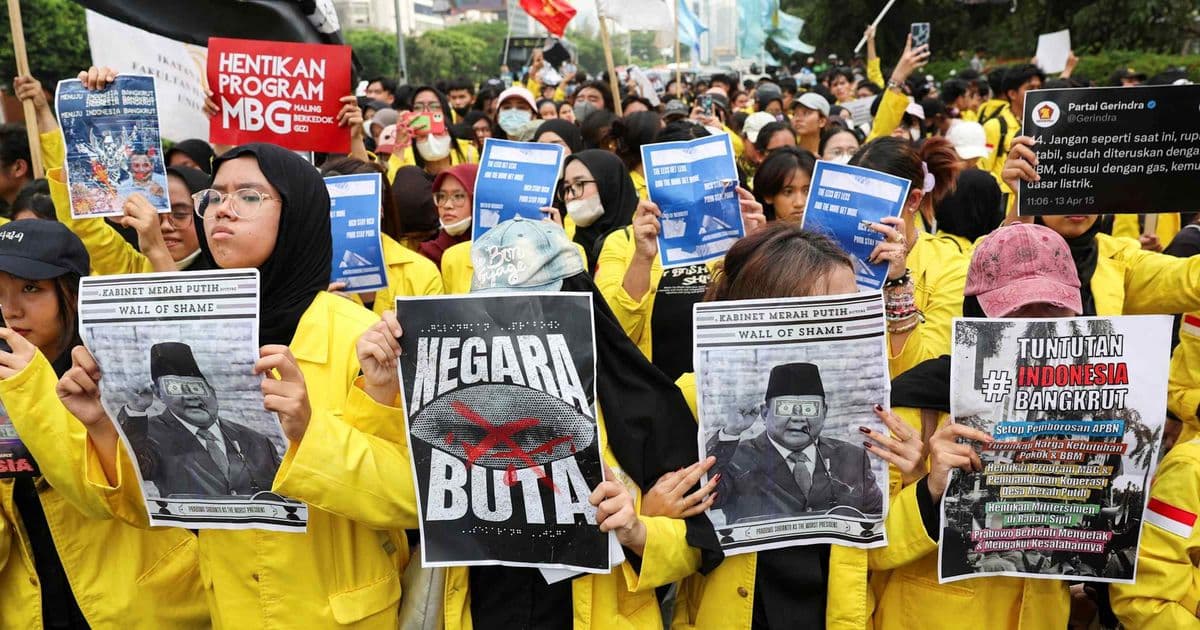
Indonesia's largest protests since last year's deadly unrest expose fractures in the government's fiscal strategy, with students and civil society groups demanding an end to flagship spending programs amid rising debt concerns and currency instability.

Civil society groups, students, and ride-hailing drivers staged demonstrations across Indonesian cities on Friday, marking the largest wave of protests in Jakarta since deadly unrest gripped the capital last year. The rallies, branded under the slogan "Indonesia Bankrupt," directly target President Prabowo Subianto's flagship spending initiatives and demand fundamental fiscal reform.
Protesters聚集 at central Jakarta locations condemned multiple government policies: ballooning state budget allocations, a recent fuel price increase, the controversial free meals program for schoolchildren, and expanding military involvement in civilian governance. The breadth of grievances reflects mounting public frustration with economic management that critics say prioritizes political optics over fiscal sustainability.
Market Context: Rupiah Under Pressure, Emergency Rate Hike Signals Alarm
The protests coincide with significant financial turbulence. Bank Indonesia conducted an emergency monetary policy meeting earlier this week, raising the benchmark interest rate by 0.25 percentage points to defend the rupiah against sustained selling pressure. The currency has weakened notably against the dollar amid growing investor concern about Indonesia's fiscal trajectory.
Indonesian equities have experienced sharp sell-offs as policy uncertainty escalates. Foreign investors have been net sellers of Indonesian government bonds for several consecutive weeks, reflecting diminished confidence in the government's ability to balance ambitious spending programs with debt sustainability targets.
The Prabowo administration has doubled down on several high-cost initiatives since taking office, including the free meals program estimated to cost billions of dollars annually and significant increases to military spending. Critics argue these programs were launched without adequate revenue mechanisms, relying instead on deficit financing that pushes Indonesia's debt-to-GDP ratio toward thresholds that historically trigger investor flight in emerging markets.
What It Means: Fiscal Credibility at Stake
The "Indonesia Bankrupt" framing represents a potent political challenge because it connects street-level economic pain to macro-level fiscal decisions. Ride-hailing drivers protesting fuel price hikes experience the direct impact of subsidy reforms, while students question whether education spending is being crowded out by military budgets and populist nutrition programs.
For international investors, the protests introduce a new variable into an already complex risk assessment. Indonesia's fiscal credibility, built over decades of relatively prudent macroeconomic management, faces its most serious test since the Asian Financial Crisis. The government must now navigate between protester demands for spending cuts, its own political commitments to flagship programs, and market requirements for fiscal discipline.
The emergency rate hike by Bank Indonesia suggests monetary authorities are already in crisis management mode. Further rupiah weakness could force additional tightening, potentially constraining economic growth at a time when global trade uncertainties already threaten Indonesia's export-dependent sectors.
Strategically, the Prabowo government faces a classic emerging market dilemma: maintain popular spending programs to preserve political support while demonstrating enough fiscal restraint to prevent capital flight. The protests suggest the public is losing patience with the first approach, while markets are losing patience with the lack of the second.
Indonesia's experience echoes similar fiscal pressures across emerging Asia, where governments face rising demands for social spending amid tightening global financial conditions. The outcome of this standoff will influence not only Indonesia's economic trajectory but also the broader calculus for emerging market fiscal policy in an era of constrained monetary policy and geopolitical uncertainty.
Comments
Please log in or register to join the discussion