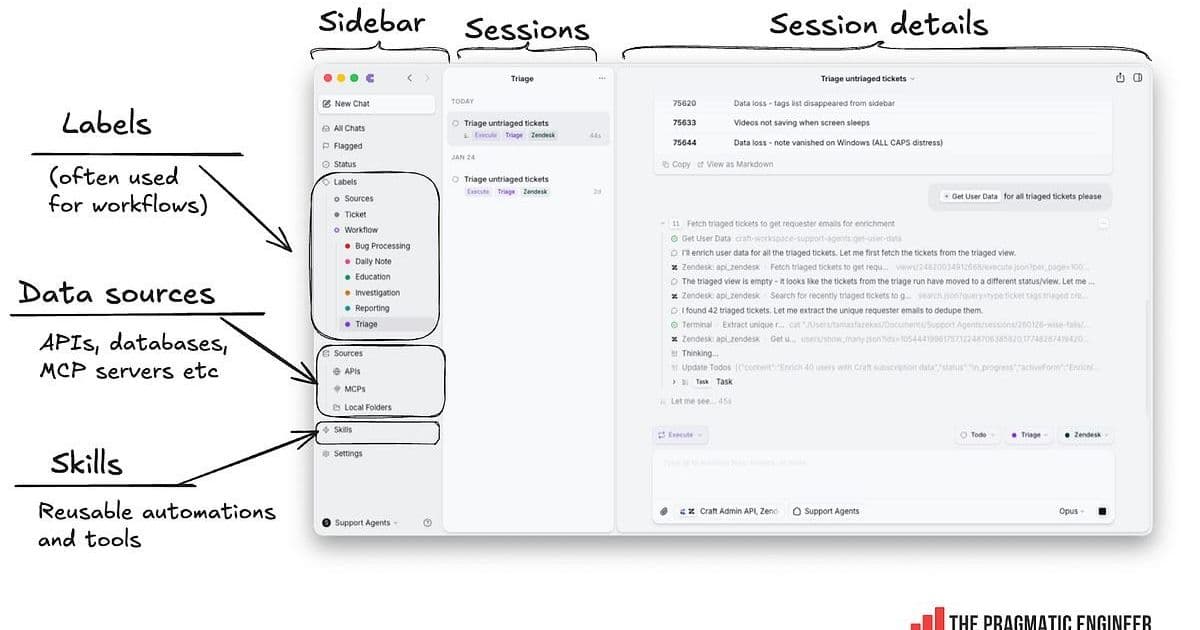
Craft Docs, a five-year-old startup known for its sleek UX, has made a sharp pivot to AI by building a universal agentic tool called Craft Agents. The company has mandated every engineer and non-engineer to try adding the new tool to their workflows – and they say the results have been jaw-dropping. During January, the Craft team has completely changed how they work, and now feel more productive than ever. Also, non-engineers are hooked on using AI with Craft Agents.
What's new
Craft Docs, a five-year-old startup known for its sleek UX, has made a sharp pivot to AI by building a universal agentic tool called Craft Agents. The company has mandated every engineer and non-engineer to try adding the new tool to their workflows – and they say the results have been jaw-dropping. During January, the Craft team has completely changed how they work, and now feel more productive than ever. Also, non-engineers are hooked on using AI with Craft Agents.
Why it matters
This isn't a young startup chasing hype. Craft is an experienced engineering operation with 1 million active users, 50,000 paying customers, and a 20-person engineering team with a median tenure of nearly four years. They care deeply about engineering excellence and product quality – the startup won Apple's Mac App of the Year award in 2021, and built their own, custom rendering stack to boost user experience above the competition.
Craft's AI-first makeover represents a mature startup deciding that AI tools have reached an inflection point which means the company needs to change how it works, or be left behind. The results are showing that AI can fundamentally change how software is built and how teams work together.
How to use it
The journey to AI adoption
Craft's path to AI adoption was methodical and deliberate:
Three years of AI experimentation with no "stickiness"
- 2022: Launched a basic AI assistant using OpenAI's GPT-3.5 API, but it was "one-shot" with only 4,096 token context window
- 2023-2024: Resisted the "Copilot everywhere" temptation, avoiding shipping AI features that would be gimmicks
- December 2024: Reasoning models marked turning point – Balint implemented a highly requested feature (hand-drawn shape recognition) in one day instead of weeks using GPT-4o
The breakthrough: "visual Claude Code"
Balint built Craft Agents during Christmas break 2024, creating a UI on top of Claude Code that non-technical users could actually use. The tool includes:
- A concept of "sources": data sources to connect to the agent (databases, APIs, MCPs)
- Support for running parallel agents, visualization, and switching between them
- Support for workflows via a label system
- A permissions system defining whether data sources can only be read, or if they can also be written to
- A readonly agent run mode, "ask to edit" mode, and a mode for making edits without asking
- Expanding Claude Code's "skills" concept
- Theming options for the tool
How non-engineers are using it
The biggest adopters have been in customer support, marketing, and HR:
Customer Support Workflows
- Bug triaging and processing with parallel agents
- Daily updates summarizing work done by users
- Education license requests for academic institutions
- Data enrichment that automatically pulls user details from Craft's database
Example bug processing workflow:
- Identify platform and area which the bug belongs to, and tag it
- Crosscheck with Linear (issue tracking system)
- If similar issues exist, link to that issue
- If no similar issues found, create new issue and assign to relevant developer team
- Do technical root cause analysis
- Draft ready-to-send response for customer
- Create engineering tickets with code references
Marketing Team
- Building websites without developer input
- Creating launch pages, feature descriptions, comparison pages
- Previously required pairing with web engineers who dreaded the unchallenging work
HR Team
- Built Bamboo HR plugin to handle age-based holiday allocations
- Automating payroll system file generation
- Other tedious administrative tasks
Finance Team
- Built tool that exports Revolut business account to CSV
- Cross-references with employee Slack channel where invoices are posted
- Matches and creates format for accounting tool submission
New way to build software
Craft is experimenting with a fundamentally different development approach:
Traditional approach:
- Plan changes ahead of time
- Write the code
- Code review
- Deploy to production
New AI-assisted approach:
- Fast iteration without traditional code reviews
- "Weaving in" ideas rather than formal pull requests
- Not using SDKs much in development
- Difficult migrations take a week instead of months
- One-person responsibility squads
- Some developers struggle with fast change and even quit
Technical implementation
Craft Agents is built on Electron, allowing it to run on Mac, Windows, and Linux. The architecture includes:
- Claude Agent SDK framework for building production-ready agents
- Custom permissions system with three modes: Explore (readonly), Auto (can write without user input), Ask to Edit (requires confirmation)
- API source implementation that acts like an MCP server but hijacks requests to add credentials securely
- Parallel agent execution with visualization
- Custom theme system (including unofficial Matrix and Half-Life themes created by users)
Open source and remixing
Craft Agents is open source under Apache License 2.0, and "remixing" is already happening:
- Researchers are forking and modifying the code for personal needs
- Example: Lisa Skorobogatova modified Craft Agents to support projects and allow drag-and-drop to move chats into projects
- The permissive license allows forking, modifying, and distributing with only requirement to include the license text
The tool represents a significant shift in how mature startups are approaching AI adoption – not as a gimmick, but as a fundamental change in how they build software and how their teams work together.
Note: I have no financial affiliation with Craft Docs, own no shares in the company, and have not been paid to write this article. Obviously, there are family ties, which in this case enabled me to convince him to share more details than he originally intended!
Comments
Please log in or register to join the discussion