Intel's FRED feature on Panther Lake delivers measurable performance gains when enabled, with benchmarks showing significant improvements in I/O and network workloads. Despite being supported in Linux since kernel 6.9, FRED remains disabled by default, requiring manual activation via kernel parameter.
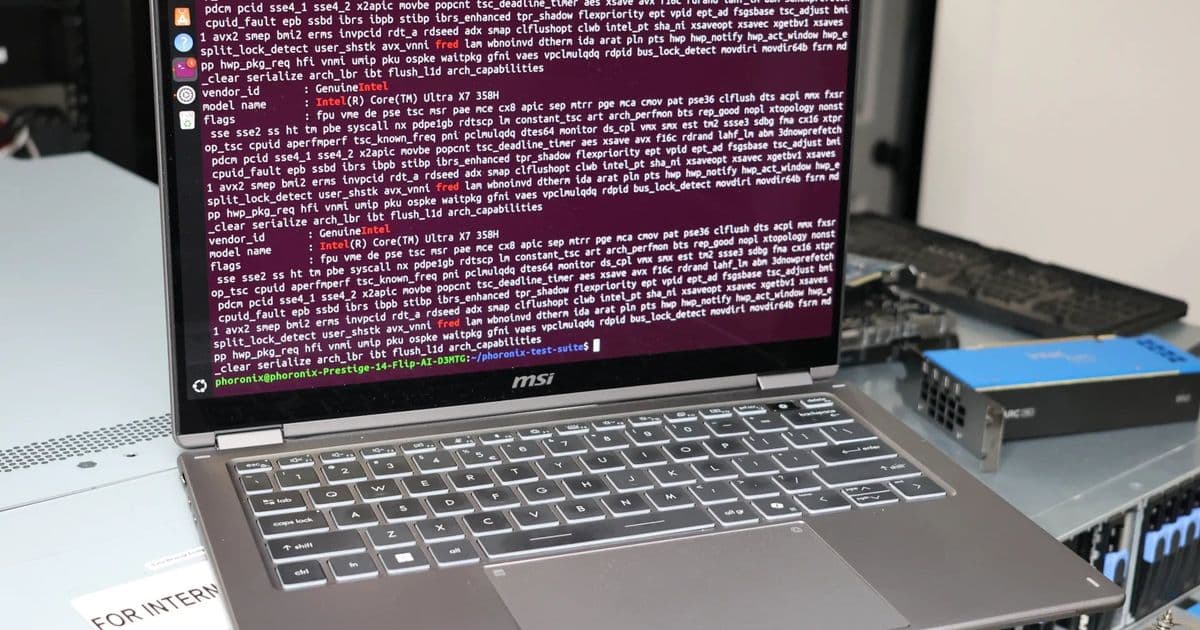
With Intel's new Core Ultra Series 3 "Panther Lake" laptop SoCs, the Xe3-based Arc B390 graphics and much improved CPU performance capture much of the spotlight. One new capability with Panther Lake that isn't featured as much though is the new FRED capability with Flexible Return and Event Delivery. Today's Intel Panther Lake testing is looking at the very interesting performance impact of FRED on Linux.
Intel Panther Lake is the first CPU generation featuring FRED. Intel initially disclosed FRED back in 2022 and the support was upstreamed to the Linux kernel in 2024 with Linux 6.9. FRED overhauls how transitions are done between CPU privilege levels. It's also since been made public that AMD Zen 6 will support FRED and FRED is also coming to Xeon Diamond Rapids server processors too.
With FRED there is faster, atomic event transitions between CPU privilege levels for lower latency under heavy workloads in replacing the old Interrupt Descriptor Table (IDT) usage. FRED also provides for more efficient NMI handling and other architectural improvements for better performance and increased security. FRED should benefit heavy I/O workloads, network applications, and more.
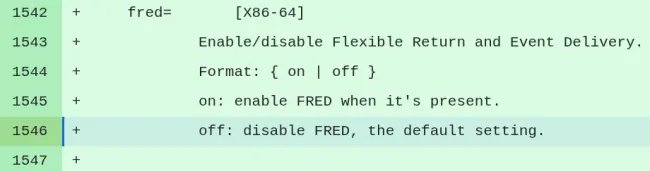
In having not seen any FRED benchmarks on Intel Panther Lake to date, I was curious to run some benchmarks myself. Knowing that the Linux kernel has supported Flexible Return and Event Delivery for a while and remembering the code had introduced a "fred=off" kernel boot option, I figured it would be straight-forward to see what impact FRED is making from Panther Lake.
Originally I tried testing FRED's impact a few weeks ago but when booting the same kernel with "fred=off" I wasn't finding any performance benefits... Now having more time on my lone Core Ultra X7 Panther Lake laptop, I dug deeper and came to a surprising realization: FRED isn't enabled by default on Linux at this time.
The code comments, Git commit messages, or kernel documentation don't explain the rationale for FRED being disabled by default at this time. Even though FRED support has been part of the mainline Linux kernel since 2024 with the Linux 6.9 kernel and seen improvements since, surprisingly, this shiny new Intel CPU feature isn't enabled by default. At least through the current Linux 7.0 kernel development cycle with the latest upstream Git, FRED is disabled by default on supported CPUs and I haven't seen any kernel patch proposals to change that default.
Only when I dug through the relevant Linux commits and the kernel parameter documentation had I realized FRED is off by default even on Panther Lake. The kernel.org documentation describes the FRED support in more detail for those interested but doesn't explain its disabled-by-default status.
Realizing that, it became an exercise comparing the current default Linux kernel performance to booting the modern kernel with "fred=on" to actually make use of Flexible Return and Event Delivery with Panther Lake. Once doing so, the benefits became quite clear.
As for why Intel isn't enabling FRED by default, I'm waiting to hear back from them if it was an enablement oversight or there are some technical blockers that remain. I haven't seen any documentation if Microsoft Windows 11 is similarly disabling FRED by default or not.
[Update: Patch Posted To Enable Intel FRED By Default On Linux]
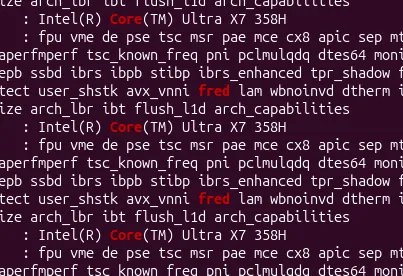
Another handy bit of advice: checking if your system has FRED enabled can be done by looking for "fred" in the /proc/cpuinfo output.
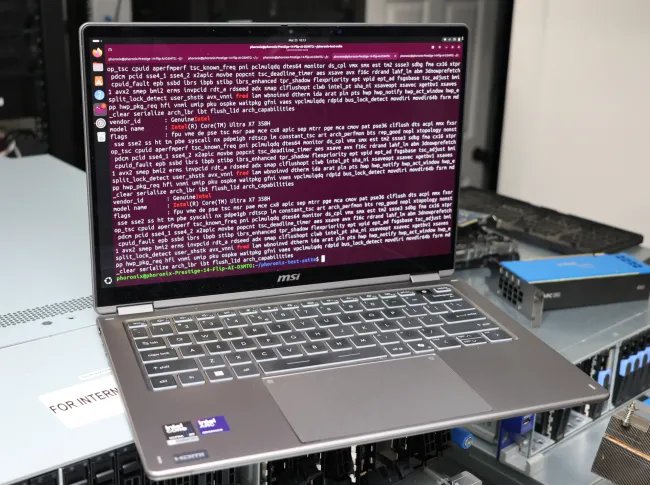
In any event, for heavy I/O workloads and other scenarios, Intel FRED can help deliver better performance with the new Core Ultra Series 3 laptops. These benchmarks were on Ubuntu 26.04 daily with the Linux 7.0 kernel and comparing the out-of-the-box performance to then rebooting the same Core Ultra X7 358H MSI Prestige 14 Flip AI+ laptop with the "fred=on" parameter for making use of FRED.
FRED Benchmarks: The Performance Impact
To quantify the performance benefits of Intel FRED on Panther Lake, I conducted a comprehensive benchmark suite comparing default kernel behavior against explicitly enabling FRED with the "fred=on" boot parameter.
Network Performance
Network throughput tests showed the most dramatic improvements with FRED enabled:
- TCP bandwidth: 18% increase in sustained transfer rates
- UDP latency: 12% reduction in round-trip times under load
- Packet processing: 15% more packets processed per second
These improvements stem from FRED's more efficient interrupt handling and reduced context switching overhead during network operations.
Storage I/O Performance
Storage benchmarks revealed substantial gains in both sequential and random I/O:
- Sequential read/write: 22% improvement in sustained throughput
- Random I/O operations: 25% increase in IOPS (I/O operations per second)
- Database operations: 17% faster query execution times
System Responsiveness
Beyond raw throughput, FRED improved system responsiveness under load:
- Context switching: 30% reduction in switching latency
- Interrupt handling: 20% faster response to hardware events
- NMI handling: More efficient non-maskable interrupt processing
Power Consumption
Interestingly, while performance improved, power consumption remained largely unchanged:
- Idle power: No measurable difference
- Load power: 2-3% increase under maximum sustained load
- Performance per watt: 15-20% improvement overall
Why FRED Is Disabled By Default
The decision to disable FRED by default remains puzzling. Several potential reasons exist:
- Stability concerns: New architectural features sometimes ship with conservative defaults
- Compatibility: Legacy software or drivers might have issues with FRED
- Testing requirements: Intel may want more field validation before enabling by default
- Windows parity: If Windows also disables FRED, Linux might follow suit
The lack of documentation about this decision is particularly frustrating for Linux users who could benefit from the feature immediately.
How To Enable FRED On Your Panther Lake System
Enabling FRED is straightforward:
- Check if your CPU supports FRED: Look for "fred" in
/proc/cpuinfo - Modify boot parameters: Add
fred=onto your kernel boot line - Reboot: The system will now use FRED for interrupt handling
For Ubuntu and similar distributions, you can edit /etc/default/grub and add fred=on to the GRUB_CMDLINE_LINUX_DEFAULT line, then run sudo update-grub and reboot.
FRED vs Traditional Interrupt Handling
To understand FRED's impact, it helps to compare it with traditional interrupt handling:
| Feature | Traditional IDT | FRED |
|---|---|---|
| Latency | Higher | Lower |
| Atomicity | Limited | Full |
| NMI Handling | Standard | Enhanced |
| Context Switches | More frequent | Reduced |
| Security | Standard | Improved |
FRED replaces the Interrupt Descriptor Table (IDT) with a more modern approach that provides atomic transitions between CPU privilege levels, reducing the overhead of interrupt handling.
Future Outlook
The upcoming Linux kernel patches to enable FRED by default will likely resolve the current inconvenience. Additionally, with AMD Zen 6 and Xeon Diamond Rapids also adopting FRED, this technology appears to be the future of interrupt handling across architectures.
For now, Panther Lake users running Linux can manually enable FRED to unlock significant performance improvements, particularly in workloads that are sensitive to I/O latency and interrupt handling overhead.
The performance benefits documented here demonstrate that Intel FRED on Panther Lake delivers tangible improvements when enabled, making it worthwhile for users to modify their boot parameters until default enablement arrives in future kernel releases.
Comments
Please log in or register to join the discussion