Intel's Data Streaming Accelerator 3.0 gets kernel support with new sysfs interfaces and Max SGL Size capabilities.
Intel has taken a significant step toward enabling its next-generation Data Streaming Accelerator (DSA) 3.0 technology with the recent merge of initial kernel support in Linux 7.0. The patches, which have been in development since last year, introduce the foundational infrastructure needed to support DSA 3.0 capabilities on future Intel Xeon processors, likely the upcoming Diamond Rapids family.
Understanding Intel's Data Streaming Accelerator
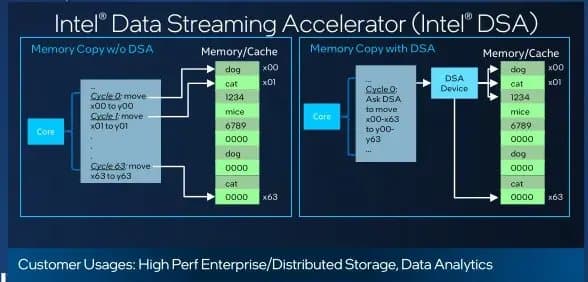
The Intel Data Streaming Accelerator is a hardware offload engine designed to handle data movement and transformation tasks that would traditionally burden the CPU. By dedicating specialized silicon to these operations, DSA can provide substantial performance improvements for data copy operations and analytics workloads. The technology has been present in recent Xeon processors, and DSA 3.0 represents the next evolutionary step in Intel's data acceleration strategy.
DSA works by allowing software applications to offload memory operations to dedicated hardware, freeing up CPU cycles for other tasks. This is particularly valuable in data center environments where large-scale data movement and transformation are common operations. The accelerator can handle various data movement patterns, including scatter-gather operations, which are essential for modern memory management techniques.
What's New in DSA 3.0 Support
The Linux 7.0 kernel merge introduces several key features for DSA 3.0 support:
New Sysfs Interfaces
The most significant addition is a new sysfs interface for DSA 3.0 capability registers. This interface allows user-space applications to query the hardware for information about available DSA 3.0 features. The sysfs interface is crucial because it provides a standardized way for applications to discover and utilize the accelerator's capabilities without hard-coding hardware-specific details.
Max SGL Size Support
A particularly important feature is the addition of Max SGL Size support. Scatter-Gather Lists (SGLs) are data structures used to describe non-contiguous memory regions. Some DSA 3.0 opcodes, particularly Gather copy and Gather reduce operations, require proper sizing of these lists before they can be used by user-space applications. The Max SGL Size parameter ensures that applications can properly allocate and manage these structures for optimal performance.
Breaking Kernel Conventions
Interestingly, the new DSA 3.0 capabilities sysfs interface breaks from typical Linux kernel practices. While the kernel generally follows a convention of allowing only one value per sysfs file, the DSA 3.0 implementation stuffs three values into a single sysfs file. This deviation from established patterns may raise eyebrows among kernel developers who value consistency in the kernel's user-space interface design.
The decision to break this convention likely stems from the need to efficiently expose multiple related capability values that are intrinsically linked. However, it does represent a departure from the kernel's usual approach to sysfs file organization.
Integration into Linux 7.0
The DSA 3.0 patches were merged as part of the DMA engine pull request for Linux 7.0. This integration path makes sense given that DSA is fundamentally a Direct Memory Access technology that offloads data movement operations from the CPU. The DMA engine subsystem is the natural home for such functionality within the kernel's architecture.
Looking Ahead to Diamond Rapids
While the patches have been merged for Linux 7.0, the actual hardware support for DSA 3.0 is expected to arrive with Intel's Diamond Rapids processors. This timing makes sense, as kernel support typically needs to be in place before new hardware ships to ensure immediate compatibility and performance optimization opportunities.
Diamond Rapids represents Intel's next major Xeon processor generation, and the inclusion of DSA 3.0 suggests that Intel is continuing to invest heavily in hardware acceleration technologies for data center workloads. The improvements in DSA 3.0 likely include enhanced performance, new capabilities, and better integration with modern software stacks.
Impact on Software Development
For software developers, the introduction of DSA 3.0 support in Linux 7.0 opens up new possibilities for performance optimization. Applications that perform heavy data movement operations can potentially see significant speedups by leveraging the accelerator. However, developers will need to update their software to take advantage of the new capabilities, particularly the Max SGL Size feature and the new sysfs interfaces.
Database systems, analytics platforms, and other data-intensive applications are likely to benefit the most from DSA 3.0 acceleration. As more software adopts support for these hardware features, we can expect to see measurable performance improvements in real-world workloads.
Performance Implications
While specific performance numbers for DSA 3.0 aren't yet available, the progression from previous DSA generations suggests substantial improvements. Each generation of DSA has brought better performance for data movement operations, and DSA 3.0 is expected to continue this trend. The addition of new opcodes and the expanded capabilities of the scatter-gather engine should translate to faster data processing in supported applications.
The real-world impact will depend on how effectively software vendors adopt the new APIs and optimize their applications for the hardware. Early adopters in the database and analytics space are likely to see the most immediate benefits.
Comments
Please log in or register to join the discussion