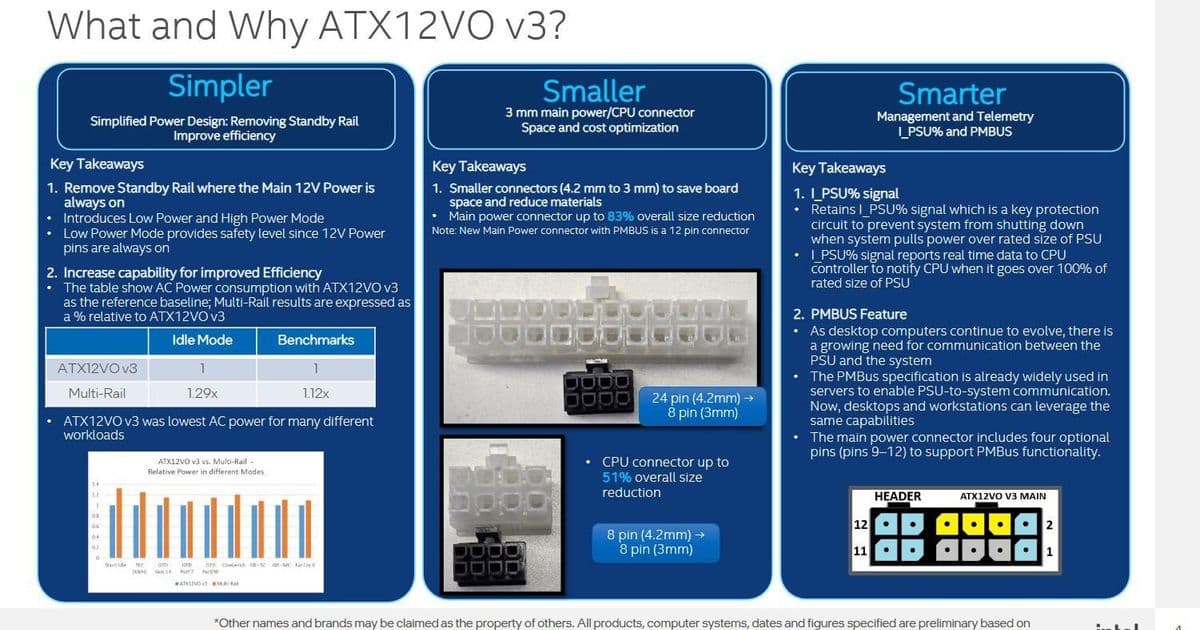
The third revision of Intel’s ATX12VO power‑delivery standard trims the motherboard connector from 10 pins to 8 pins, adds optional PMBus monitoring, and removes the standby rail to raise idle efficiency by up to 22 %. The changes target OEM and compact‑desktop designs, while giving system builders real‑time PSU utilization data.
Intel is preparing to roll out ATX12VO V3, the third iteration of its 12‑volt‑only power‑delivery specification. Leaked slides from an internal Intel presentation (shared on X by @momomo_us) show a compact 8‑pin motherboard connector, optional PMBus pins for granular power monitoring, and the elimination of the traditional 5 VSB standby rail. The move follows the original ATX12VO launch in 2020 and the V2 update in 2022 that added PCIe 5.0 support and basic power‑delivery telemetry.
Technical specifications
| Feature | ATX12VO V2 (2022) | ATX12VO V3 (proposed) |
|---|---|---|
| Motherboard power connector | 10‑pin, 3 mm pitch | 8‑pin, 3 mm pitch (≈ 83 % smaller than legacy 24‑pin) |
| CPU power connector | 8‑pin, 3 mm pitch | 8‑pin, 3 mm pitch (≈ 51 % size reduction) |
| Standby rail | 5 VSB present | Removed – 12 V rail stays live at all times |
| Monitoring interface | Basic voltage/current sensing via ATX12VO‑V2 firmware | Optional PMBus (four extra pins) + I_PSU% signal for real‑time utilization |
| Power‑efficiency claim | 5‑10 % improvement over legacy ATX | Up to 22 % lower idle draw (1.29× vs. multi‑rail) and 12 % lower draw under benchmark loads |
The connector reduction is more than a cosmetic change. By shrinking the 10‑pin block to eight pins, Intel claims a size reduction of up to 83 % compared with the classic 24‑pin ATX connector. The CPU‑power plug follows suit, shrinking by roughly 51 %. On a typical micro‑ATX board, the saved real‑estate translates to 5–7 mm of extra layout freedom, a tangible benefit for thin‑and‑light OEM chassis.
Removing the standby rail
Traditional ATX supplies keep a 5 VSB rail active even when the system is off, consuming 0.5‑1 W on average. ATX12VO V3 proposes to eliminate that rail entirely, leaving the 12 V rail powered at all times. Intel’s internal testing shows a 1.29× power reduction at idle compared with a conventional multi‑rail design, and a 1.12× reduction under typical benchmark loads. The trade‑off is that wake‑on‑LAN or other low‑power “off‑state” features will need to be driven from the 12 V rail or handled by an auxiliary controller on the motherboard.
PMBus integration and I_PSU% signaling
PMBus is a two‑wire, I²C‑compatible protocol widely used in server‑grade power supplies for telemetry and control. By allocating four pins on the new 8‑pin connector for PMBus, ATX12VO V3 gives desktop‑class systems access to the same level of detail: per‑rail voltage, current, temperature, and power‑good status. The I_PSU% line reports the PSU’s instantaneous load percentage, allowing the BIOS or OS to throttle workloads before the supply reaches its thermal or current limits. In practice, a system could automatically down‑clock a high‑end GPU when the PSU approaches 90 % capacity, avoiding sudden shutdowns.
Market implications
OEM and compact‑desktop segment
ATX12VO has already found traction in business‑class desktops, thin clients, and some pre‑built consumer machines because it simplifies the power‑stage design and reduces BOM cost. The connector shrink and standby‑rail removal sharpen that advantage for compact OEM platforms that struggle with board‑space constraints. A typical 150 mm‑wide mini‑tower can now accommodate a larger VRM or additional M.2 slots without redesigning the chassis.
Power‑supply manufacturers
For PSU makers, the smaller connectors mean less copper and fewer plastic housings per unit, potentially shaving $0.8‑$1.2 off the bill‑of‑materials for a 400 W unit. However, integrating PMBus circuitry and the I_PSU% driver adds a modest cost increase—estimated at $0.3‑$0.5 per supply. The net effect should still be a positive margin shift, especially for volume OEM orders.
System‑builder and enthusiast impact
Enthusiast builders have largely ignored ATX12VO because the standard limits direct 5 V/3.3 V rails, forcing voltage regulation onto the motherboard. ATX12VO V3 does not address that concern, so the standard will likely remain niche for high‑performance custom builds. The real benefit for enthusiasts could be the enhanced telemetry; a motherboard that exposes PMBus data via a Windows or Linux utility could let overclockers see PSU voltage ripple in real time.
Timing and adoption outlook
Intel has not set an official launch date, but the slides suggest an announcement at Computex 2026. Assuming a typical 12‑month qualification cycle, the first compliant PSUs could appear in Q4 2027, with OEM adoption beginning in early 2028. Early adopters are expected to be large‑scale system integrators (Dell, HP, Lenovo) targeting thin‑client and edge‑compute markets.
Bottom line
ATX12VO V3 tightens the physical and electrical envelope of desktop power delivery. By cutting connector size, dropping the standby rail, and adding server‑grade monitoring, Intel aims to make the standard more attractive for space‑constrained OEM designs while giving system firmware better insight into PSU health. The changes are unlikely to sway the enthusiast segment, but they could accelerate ATX12VO’s penetration in business and compact‑desktop markets, especially if PSU manufacturers can price the new features competitively.
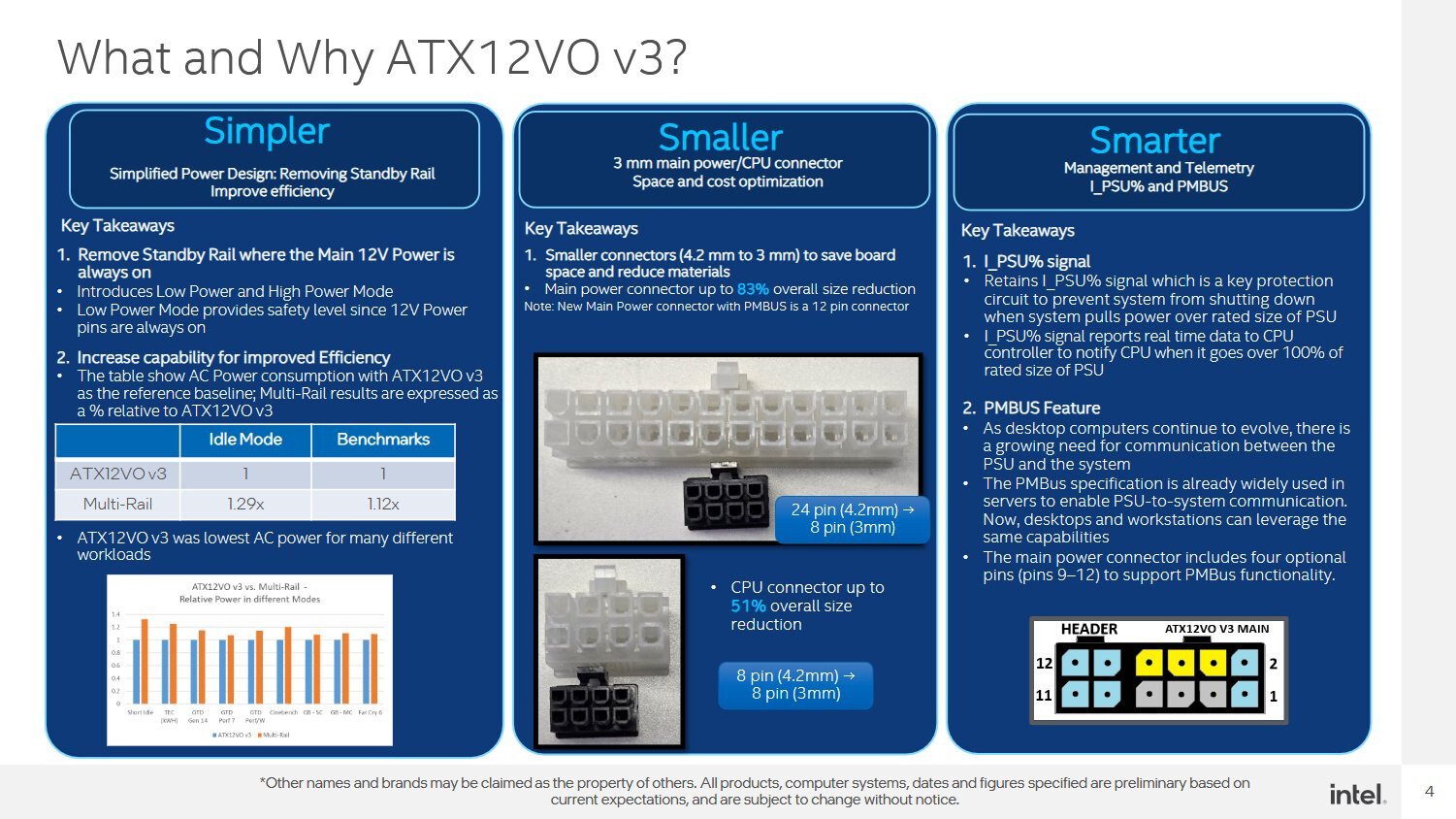
Image credit: @momomo_us on X
Comments
Please log in or register to join the discussion