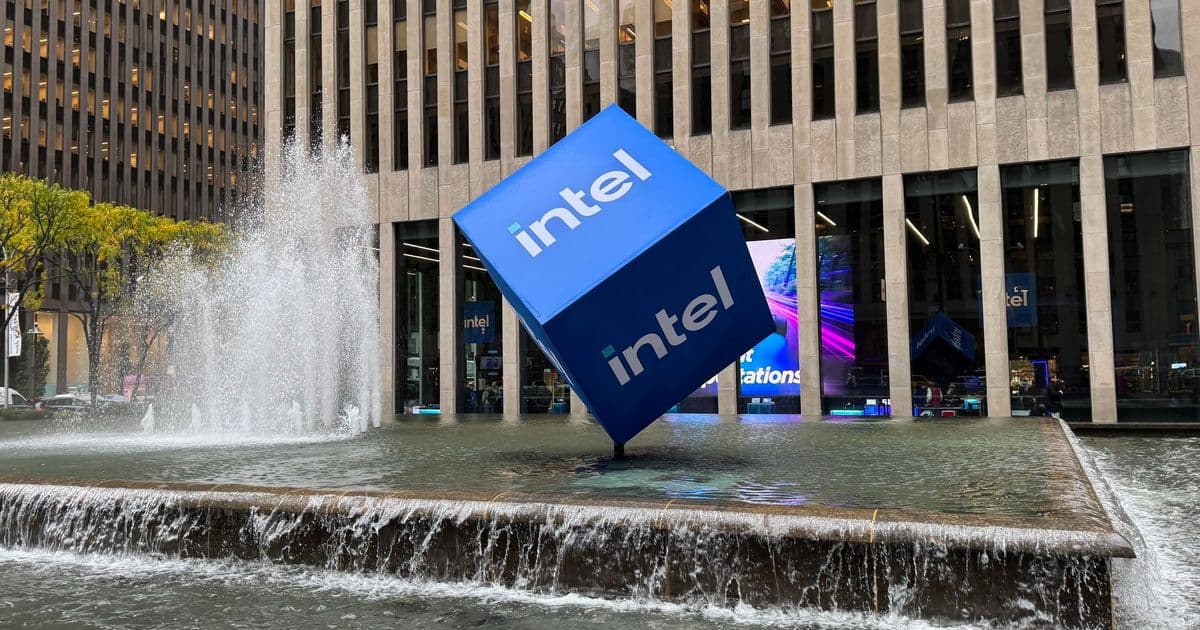
Intel's market capitalization reaches its highest level in 25 years, driven by AI initiatives, foundry ambitions, and renewed investor confidence in the company's turnaround strategy.
Intel's market capitalization reached $305 billion on Thursday, marking its highest valuation in over 25 years and signaling renewed investor confidence in the company's turnaround strategy. The surge comes as Intel ramps production of its next-generation processors and positions itself as a major player in the AI and foundry markets.
Production Ramping and Product Momentum
Intel is currently scaling production of two critical processor families at its Arizona fabrication facility. The Core Ultra 300 series, codenamed "Panther Lake," represents Intel's latest client processor architecture, while the Xeon 6+ series, known as "Clearwater Forest," targets the data center market. These production ramps are central to Intel's strategy to regain market share in both consumer and enterprise segments.
Market Valuation Context
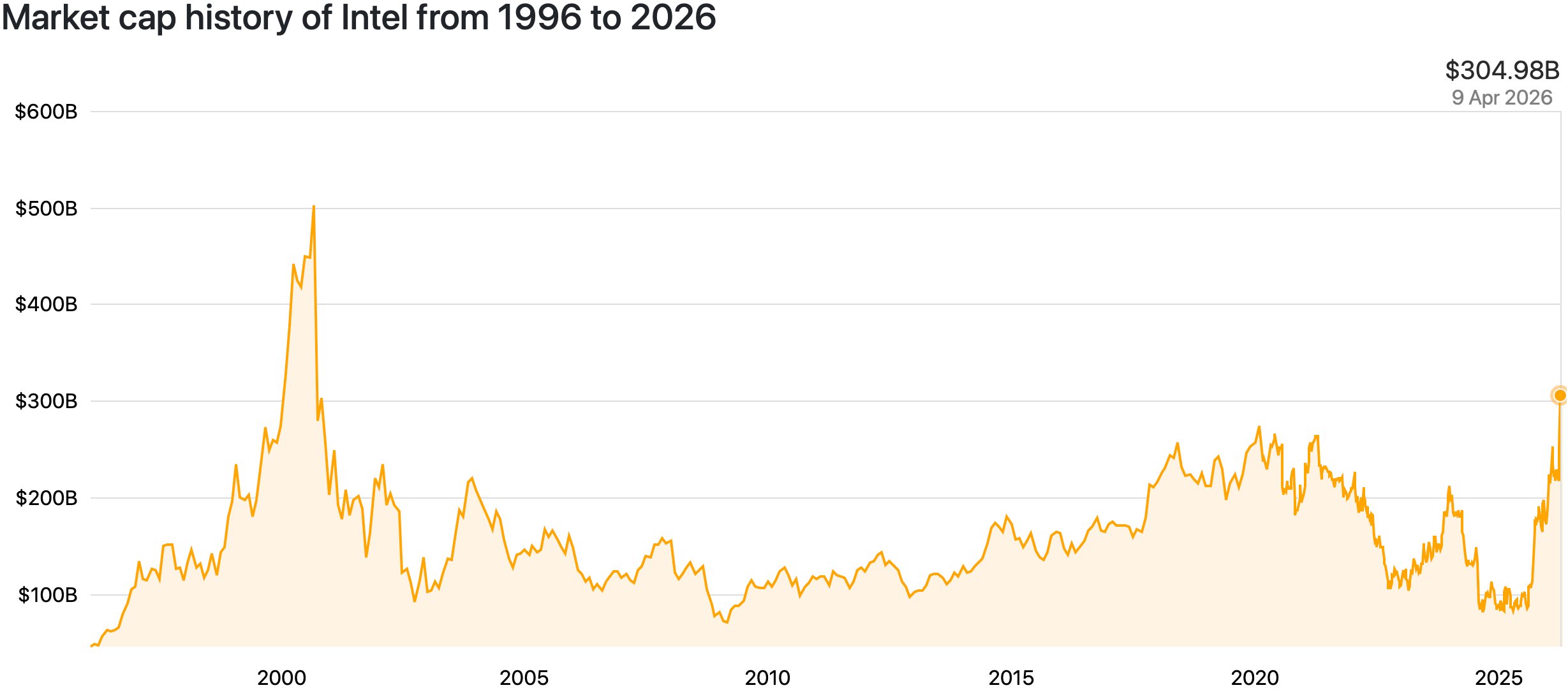
The $305 billion market cap represents a 3.5x increase from mid-April 2025 and a 2.8x jump from August 2025, when the U.S. government announced plans to acquire a 10% stake in the company. This valuation places Intel as the world's 48th most valuable company, ahead of established semiconductor players like KLA, IBM, Siemens, and Texas Instruments, though still trailing ASML, AMD, Applied Materials, and Lam Research.
Historical Comparison
Intel's current valuation exceeds its recent peaks: $257.23 billion in mid-2018 during data center growth, $273.43 billion in early 2020 amid cloud computing expansion, and $262.87 billion in April 2021 during pandemic-driven PC and cloud demand. However, it remains well below the company's all-time high of $502.71 billion in August 2000, which would be equivalent to approximately $1 trillion in today's dollars.
Key Drivers of Growth
Several strategic announcements have fueled investor optimism:
Google Xeon Commitment: Intel secured a multi-year agreement for Google to use Xeon processors, reinforcing the relevance of Intel's CPU technology in cloud infrastructure.
TeraFab Partnership: The collaboration with TeraFab, backed by Elon Musk, validates Intel's capabilities in designing, producing, and packaging high-performance processors at scale. This partnership is particularly significant as it demonstrates confidence in Intel's foundry services.
AI Market Positioning: Intel has aggressively promoted its AI-related products and roadmaps, emphasizing the applicability of its technologies in the rapidly expanding artificial intelligence sector.
Strategic Narrative vs. Financial Performance
The current valuation reflects more than just financial metrics. Intel's market capitalization is increasingly driven by strategic narratives around AI, foundry services, and advanced process technology, rather than current earnings. This shift represents a transition from Intel's historical dominance in CPUs to a more diversified semiconductor company focused on execution and future opportunities.
Industry Context and Future Outlook
The semiconductor industry is experiencing unprecedented demand driven by AI workloads and data center expansion. Intel's positioning across multiple segments - from client CPUs to data center processors to foundry services - provides multiple growth vectors. The company's ability to execute on its product roadmap and deliver on its foundry ambitions will be critical to maintaining investor confidence.
While the $305 billion valuation indicates strong momentum, it's based on expectations of a turnaround rather than achieved dominance. The coming quarters will be crucial as Intel's new product lines reach market and the company's foundry business begins to generate meaningful revenue.
Intel's resurgence comes at a time when the semiconductor industry faces both opportunities and challenges. The AI boom has created massive demand for processing power, but competition remains intense. AMD continues to gain data center market share, while NVIDIA dominates the AI accelerator market. Intel's strategy of offering comprehensive solutions across CPU, GPU, and foundry services aims to address these competitive pressures.
Technical Execution as Key Metric
Ultimately, Intel's ability to maintain its elevated valuation will depend on technical execution. The company must deliver on its process technology roadmap, successfully ramp its foundry business, and execute its AI strategy. The recent market enthusiasm reflects investor belief that Intel has turned a corner, but sustained growth will require consistent product innovation and operational excellence.
The semiconductor industry's cyclical nature means that today's optimism could face challenges, but Intel's current positioning across multiple high-growth segments provides a foundation for long-term value creation. As production of Panther Lake and Clearwater Forest processors scales, and as foundry partnerships like TeraFab materialize, Intel's market position and valuation will continue to evolve.
Comments
Please log in or register to join the discussion