Community modders have successfully run Intel's 12-core Core 9 273QPE Bartlett Lake CPU on consumer Z790 motherboards, achieving 33,111 points in Cinebench R23 multi-core test at 5.4GHz boost clocks - outperforming AMD's Ryzen 9 9900X3D and demonstrating the potential of Intel's previously locked-down enterprise silicon.
Community modders have achieved a significant milestone in the PC hardware world, successfully running Intel's OEM-only Bartlett Lake CPU on consumer Z790 motherboards and achieving benchmark scores that surpass AMD's Ryzen 9 9900X3D in multi-core performance tests.
The Bartlett Lake Breakthrough
The Core 9 273QPE, a 12-core, 24-thread processor from Intel's Bartlett Lake family, was never intended for consumer use. These chips were designed exclusively for edge computing and industrial OEM applications, featuring Intel's Raptor Cove P-cores with Hyperthreading but lacking the E-cores found in standard Raptor Lake consumer processors.
However, determined modders on the Overclock.net forums have overcome significant technical barriers to make this enterprise silicon run on standard consumer hardware. The breakthrough came through BIOS modifications that allowed the motherboard firmware to recognize and properly configure the unique 12-core configuration.
Technical Achievement
The modding effort required sophisticated BIOS patching to overcome fundamental compatibility issues. Standard Z790 BIOS implementations were hardcoded to support a maximum of 8 P-cores with Hyperthreading, as consumer 13th and 14th Gen Intel CPUs never exceeded this configuration. The Bartlett Lake's 12 P-cores exceeded this limit, causing system crashes when the BIOS attempted to access the 9th P-core.
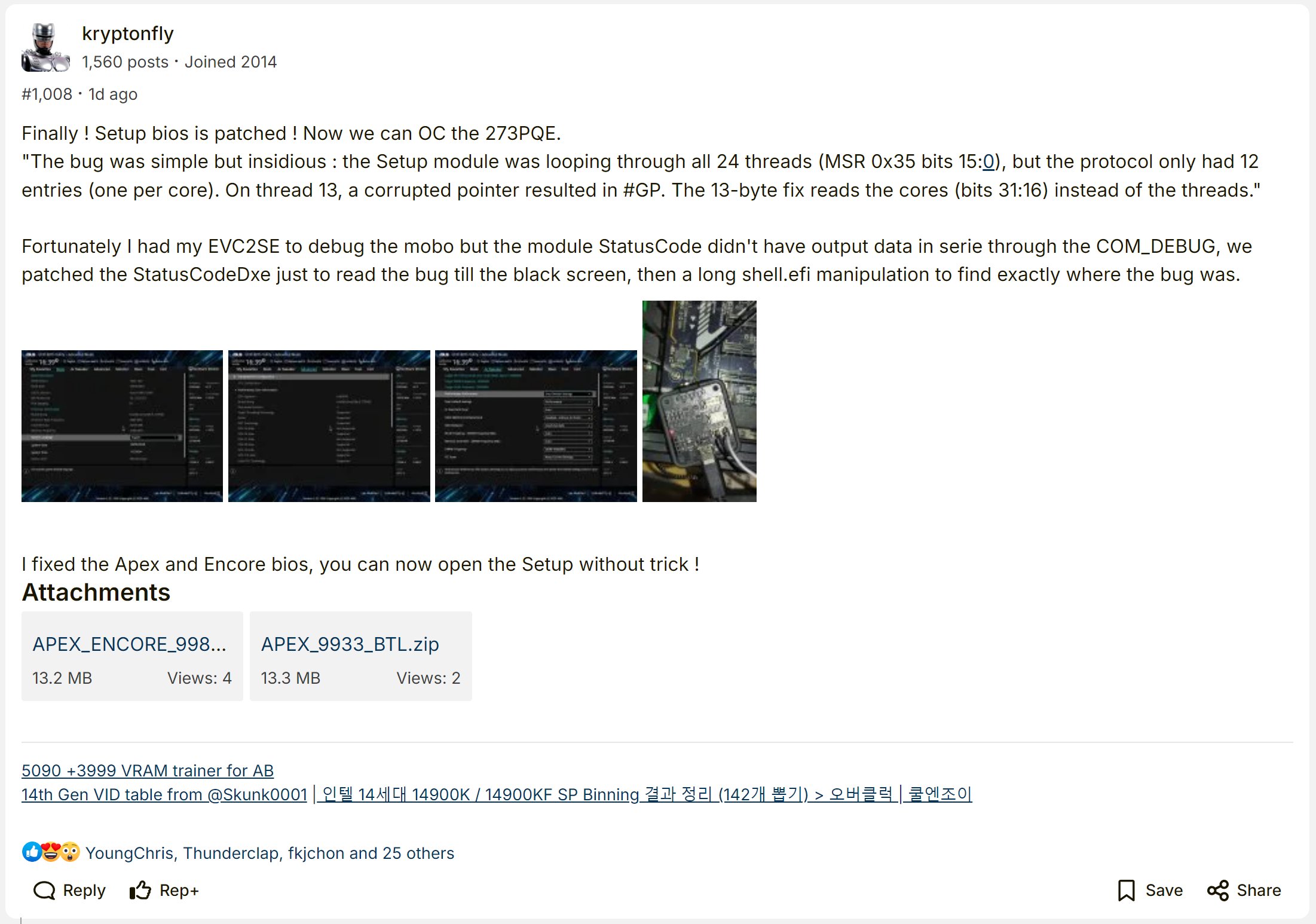
Kryptonfly, a community member, developed the initial patch that injected code into the setup BIOS, forcing it to recognize the Core 9 273QPE. This modification essentially told the firmware to allow 12 physical P-cores instead of the standard 8-core limit.
Benchmark Performance
Several users have reported impressive benchmark results with the modded setup:
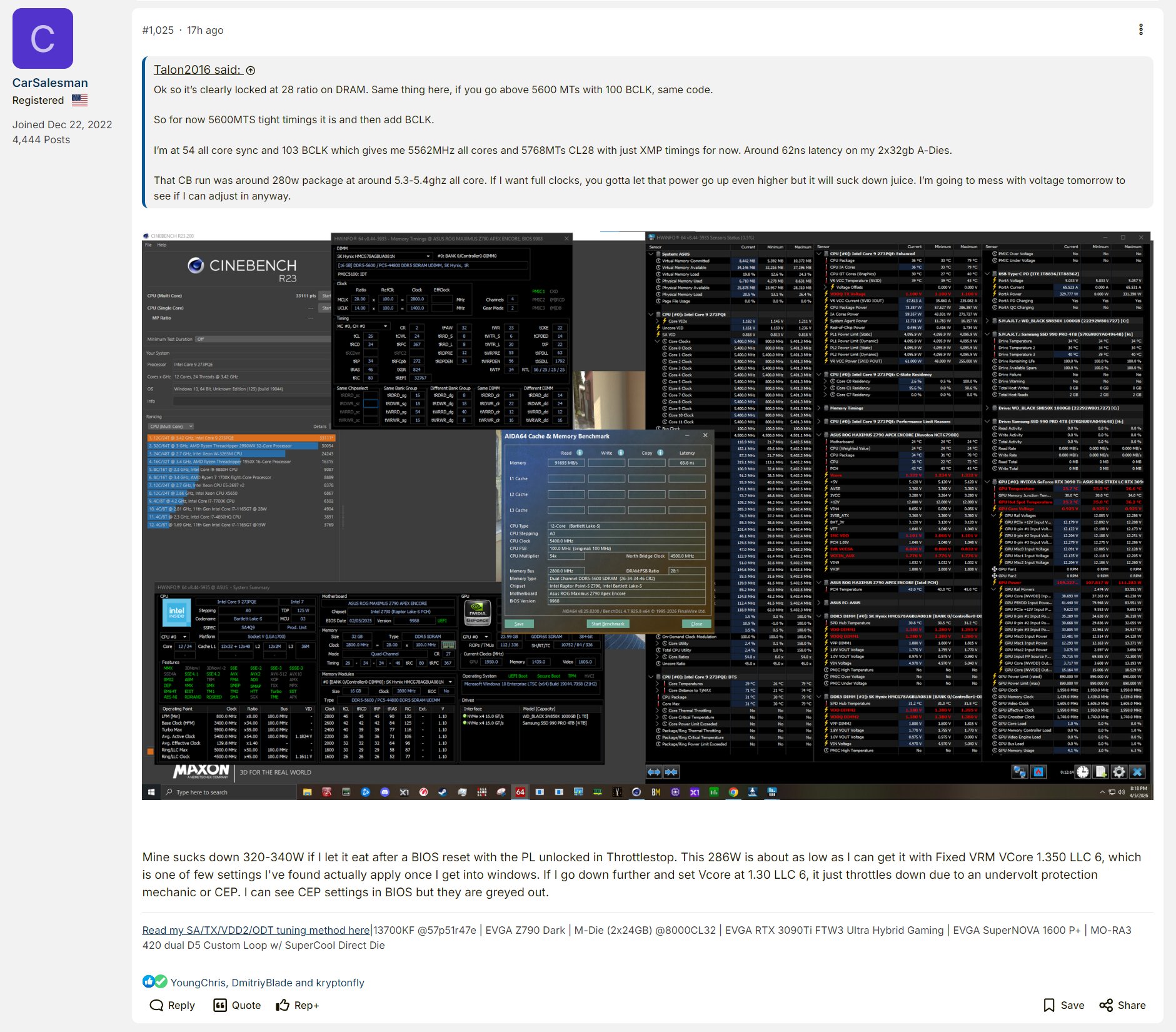
CarSalesman's Results:
- Cinebench R23 Multi-core: 33,111 points
- Power Consumption: 286W
- All-core Boost Clock: 5.4 GHz
- Configuration: Asus ROG Maximus Z790 Apex with 64GB DDR5-5600
This score places the Bartlett Lake CPU slightly above the Ryzen 9 9900X3D's average performance and just below Intel's own Core i7-14700 in the same benchmark.
Talon2016's Results:
- Cinebench R23 Multi-core: 32,288 points (initial run)
- Cinebench R23 Multi-core: 33,818 points (subsequent run)
- Configuration: Asus ROG Maximus Z790 Apex with 64GB DDR5 RAM
- Achievement: Successfully ran Battlefield 6 with Secure Boot enabled
Power and Stability Optimization
The modding community discovered that power delivery and voltage regulation significantly impacted performance. Initial runs by CarSalesman achieved only around 25,000 points in Cinebench due to power delivery limitations and Vdroop-induced throttling, which limited clocks to 4.3 GHz despite unlocked power limits causing consumption above 320W.
By implementing specific BIOS settings:
- Locking Vcore to 1.35V
- Enabling LLC6 (Load Line Calibration level 6)
They achieved more stable voltage under load, allowing higher sustained clocks and more consistent power draw around 286W while maintaining the 5.4 GHz boost across all cores.
Significance for the Hardware Community
This achievement represents more than just impressive benchmark scores. It demonstrates:
Hardware Flexibility: The physical compatibility of Bartlett Lake CPUs with LGA 1700 sockets means these enterprise chips could potentially be repurposed for high-performance consumer builds
Community Innovation: The successful BIOS modifications showcase the PC hardware community's ability to overcome manufacturer-imposed limitations
Performance Potential: A chip designed for industrial applications outperforming AMD's latest gaming-focused X3D processor suggests significant untapped potential in Intel's enterprise silicon
Technical Understanding: The project required deep knowledge of CPU architecture, BIOS programming, and power delivery systems
Technical Context
Bartlett Lake CPUs feature only Raptor Cove P-cores, unlike standard Raptor Lake consumer chips that combine P-cores with E-cores for efficiency. This all-P-core configuration, while power-hungry, provides consistent high-performance cores without the complexity of managing different core types.
The successful implementation of Secure Boot during gaming tests by Talon2016 is particularly noteworthy, as it demonstrates that the modded system maintains security features typically disabled during hardware experimentation.
Future Implications
This modding success opens several interesting possibilities:
- Enterprise Hardware Repurposing: Companies with surplus Bartlett Lake CPUs might find new life for them in enthusiast systems
- Performance Analysis: The ability to compare enterprise and consumer silicon directly could provide insights into Intel's architectural decisions
- BIOS Development: The techniques developed could inform future BIOS modifications for other locked-down hardware
As the Overclock.net thread continues to evolve with contributions from multiple enthusiasts, the Bartlett Lake modding project represents a significant achievement in the ongoing relationship between hardware manufacturers and the enthusiast community that pushes the boundaries of what's possible with existing technology.
Comments
Please log in or register to join the discussion