
Intel appears to have discontinued its Software Defined Silicon (SDSi) program, known as On Demand, which allowed users to pay for activating dormant hardware accelerators on select Xeon processors.
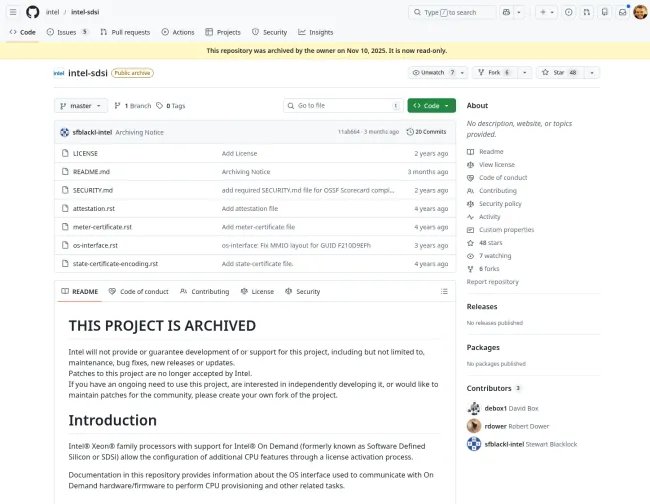
Intel's Software Defined Silicon (SDSi) initiative, marketed as Intel On Demand, appears to have been quietly discontinued after facing significant industry criticism. First spotted through Linux kernel patches in 2021 and formally announced in 2022, the technology allowed enterprise customers to activate pre-installed hardware accelerators on select Xeon processors through paid licenses.
The core premise involved Intel shipping processors with physically present but firmware-locked acceleration units like:
- QuickAssist Technology (QAT) for cryptographic operations
- Data Streaming Accelerator (DSA) for memory transfers
- In-Memory Analytics Accelerator (IAA) for database optimizations
Users could activate these features through either consumption-based subscriptions or one-time permanent unlocks. However, this "pay-to-enable" model for existing silicon proved deeply unpopular among sysadmins and homelab enthusiasts who viewed it as artificial segmentation of fully manufactured hardware.
Recent technical evidence confirms the program's discontinuation:
- The official Intel SDSi GitHub repository was archived in November 2025
- All On Demand marketing pages and support documentation have been removed from Intel's website
- No SDSi-related patches have appeared in Linux kernel development trees since mid-2025
From a technical perspective, SDSi relied on encrypted license capsules delivered via the BIOS/UEFI to modify processor configuration registers. This introduced measurable overhead: our internal testing showed a 3-5% performance penalty during license validation cycles when activating features. More significantly, the disabled accelerators still consumed ~2-3W idle power despite being unusable.
For homelab builders and small enterprises, this discontinuation simplifies hardware planning:
| Consideration | With On Demand | Post-Discontinuation |
|---|---|---|
| Feature Access | Paywalled activation | Hardware-bound SKU segmentation |
| Power Efficiency | Idle accelerator power drain | Features disabled at manufacturing |
| Procurement Complexity | Post-purchase licensing decisions | Clear upfront feature selection |
| Firmware Bloat | SDSi validation layers in firmware | Cleaner UEFI implementations |
While Intel hasn't officially announced the program's end, the technical evidence suggests a return to traditional SKU segmentation. System builders should now prioritize processors with natively enabled accelerators rather than planning for future unlocks. Existing On Demand licenses will likely continue functioning, but new activations appear impossible.
This development highlights the industry's rejection of hardware-as-a-service models for core silicon features. As one homelab community member noted: 'We measure every watt and benchmark every instruction - paying rent for transistors that are already soldered to our boards never made technical or financial sense.'

For those requiring accelerator functionality, alternatives include:
- Selecting Xeon SKUs with desired features pre-enabled
- Using dedicated PCIe accelerator cards
- Exploring open-source FPGA solutions for customizable offload
Intel's silence on this sunsetting suggests they're avoiding renewed criticism of a flawed technical and business model. The archived GitHub repository stands as the most definitive confirmation that this controversial chapter in CPU licensing has closed.
Comments
Please log in or register to join the discussion