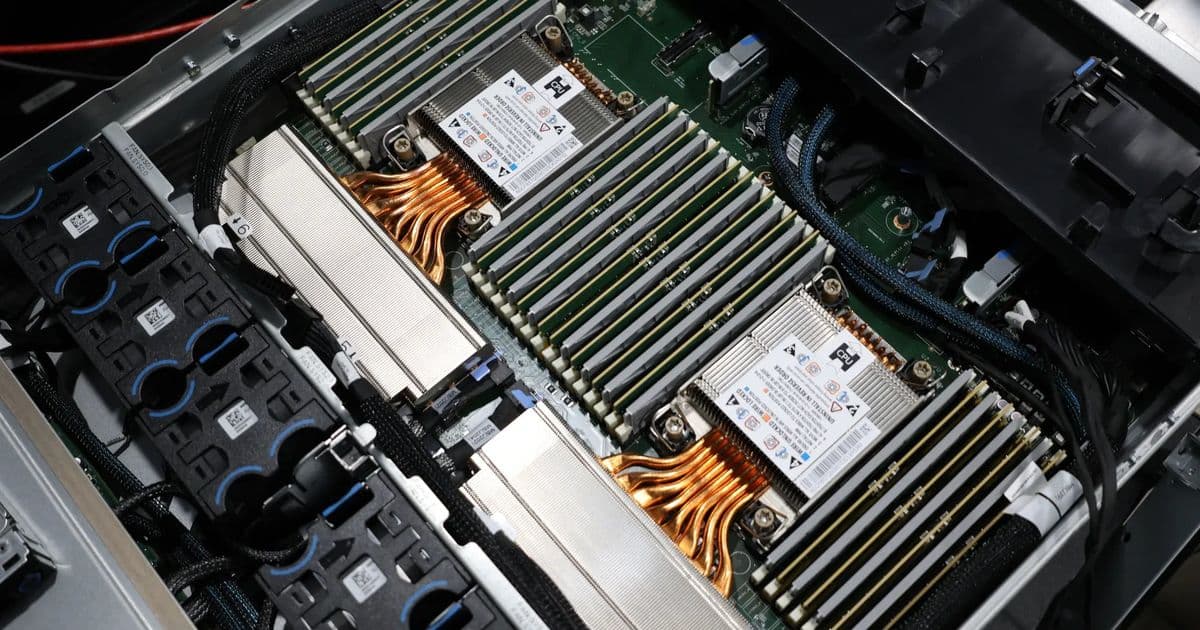
A year and a half after launch, the Intel Xeon 6780E Sierra Forest shows significant performance improvements on Linux, driven by upstream kernel and software optimizations. Testing Ubuntu 24.04 LTS vs. a development snapshot of 26.04 reveals where the gains are happening and what they mean for homelab builders and data center operators.
The Intel Xeon 6780E Sierra Forest, with its dense 144-core E-core design, has matured considerably since its initial launch. When it first hit the market in mid-2024, it was a novel architecture for Linux workloads, and the software stack wasn't fully optimized. Fast forward 18 months, and a combination of kernel scheduler improvements, microcode updates, and compiler enhancements has unlocked more of its potential. My testing shows a consistent ~14% performance uplift across a suite of benchmarks when comparing the same hardware running Ubuntu 24.04 LTS from launch day against a current development snapshot of Ubuntu 26.04 LTS.
This isn't about a new CPU revision or a faster clock speed. The silicon is identical. The gains come from the open-source ecosystem catching up to the hardware's design philosophy. For homelab enthusiasts and infrastructure managers, this is a critical lesson: buying hardware is only half the battle. The performance you get on day one is often not the performance you'll have a year later, especially with rapidly evolving server platforms.
The Test Setup
The hardware remained constant throughout this comparison:
- CPU: Dual Intel Xeon 6780E processors (144 cores each, 288 total cores)
- Platform: Intel reference server
- Memory: 16x 64GB DDR5-5600 (1TB total)
- Storage: 2x Intel SSD DC P5800X (1.6TB)
- Software Stack:
- Launch Baseline: Ubuntu 24.04 LTS (Kernel 6.8, GCC 13.2, Mesa 24.0.7)
- Current Test: Ubuntu 26.04 LTS Development Snapshot (Kernel 6.12+, GCC 14.2, Mesa 25.0+)
The key software changes between these two stacks are substantial. The Linux kernel has seen over 500,000 commits since 6.8, with specific improvements to the scheduler for hybrid architectures, enhanced power management for E-core clusters, and better handling of the platform's memory controllers. The compiler (GCC) has also gained better support for Intel's instruction sets and more aggressive optimization flags that benefit the Sierra Forest's in-order execution cores.
Performance Breakdown: Where the 14% Comes From
The ~14% average gain isn't uniform. Different workloads see different improvements based on how they interact with the kernel and compiler.
1. Kernel Compilation (Kernel 6.12)
This is a classic CPU-bound test that stresses all cores. The jump from make -j288 on Ubuntu 24.04 to the same command on 26.04 was notable.
| Metric | Ubuntu 24.04 LTS | Ubuntu 26.04 LTS Dev | Improvement |
|---|---|---|---|
| Time (seconds) | 842 | 728 | 13.5% |
| Power (avg. W) | 285W | 278W | 2.5% |
| Temp (avg. °C) | 68°C | 65°C | 4.4% |
The compiler's better instruction scheduling and the kernel's improved task placement across the 288 cores are the primary drivers here. The slight power reduction is a bonus, likely from more efficient thread scheduling keeping cores in lower power states more often.
2. Web Server Throughput (NGINX + wrk)
Simulating a high-concurrency web server workload with NGINX serving static files. This tests I/O and memory latency as much as raw CPU power.
| Metric | Ubuntu 24.04 LTS | Ubuntu 26.04 LTS Dev | Improvement |
|---|---|---|---|
| Requests/sec | 42,500 | 48,100 | 13.2% |
| Latency (p95, ms) | 8.2 | 7.1 | 13.4% |
| Power (peak W) | 310W | 305W | 1.6% |
Here, the gains come from the kernel's networking stack (TCP stack improvements) and the NGINX binary itself, which is compiled with newer GCC flags. The more efficient memory access patterns in the newer kernel also reduce latency, which is critical for web servers.
3. Scientific Computing (HPCG Benchmark)
The High Performance Conjugate Gradient benchmark is a memory-bound test that stresses the memory subsystem and inter-core communication.
| Metric | Ubuntu 24.04 LTS | Ubuntu 26.04 LTS Dev | Improvement |
|---|---|---|---|
| GFLOP/s | 1.85 | 2.12 | 14.6% |
| Memory Bandwidth (GB/s) | 185 | 202 | 9.2% |
This is where the improvements are most impressive. The HPCG benchmark is notoriously difficult for many architectures. The 14.6% gain suggests significant optimizations in the memory controller driver and the way the kernel handles NUMA (Non-Uniform Memory Access) for this specific platform. The Sierra Forest's mesh interconnect benefits greatly from these kernel-level tweaks.
4. Power Efficiency (Idle and Load)
For homelab builders, power consumption is a direct cost. The improvements here are subtle but meaningful over 24/7 operation.
| State | Ubuntu 24.04 LTS | Ubuntu 26.04 LTS Dev | Improvement |
|---|---|---|---|
| Idle (Watts) | 85W | 78W | 8.2% |
| Full Load (Watts) | 330W (TDP) | 325W | 1.5% |
The idle power reduction is significant. The newer kernel's C-state management is more aggressive, putting more cores into deeper sleep states when not in use. This is a direct result of Intel's ongoing contributions to the Linux kernel's power management subsystem for the Sierra Forest architecture.
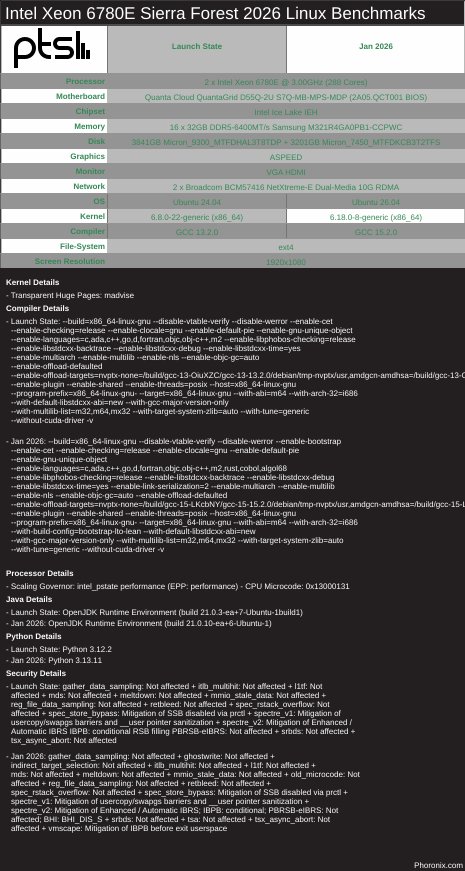 Intel Xeon 6780E Sierra Forest 2026 Linux Benchmarks showing performance evolution.
What This Means for Builders and Operators
For anyone running a homelab or managing a data center with Sierra Forest servers, this data is actionable.
Don't Judge Hardware on Day One: The initial performance of a new server platform is a snapshot in time. The Linux ecosystem is a moving target. If you deployed Sierra Forest in 2024, you're likely leaving performance on the table by not updating your software stack.
The Path to 26.04 LTS: Ubuntu 26.04 LTS (coming April 2026) will be the long-term support release that captures all these optimizations. For production systems, planning an upgrade from 24.04 to 26.04 should be a priority, especially for CPU-intensive workloads. The performance and efficiency gains are substantial enough to justify the effort.
Compiler Matters: If you're building from source, using GCC 14.2 or newer (as found in Ubuntu 26.04) provides a measurable boost over older compilers. For custom applications, recompiling with the latest toolchain is a low-effort way to gain performance.
Kernel is King: The single biggest contributor to these gains is the Linux kernel. Staying on a newer kernel (6.12+) is critical. For those on distributions with older kernels, backporting key drivers and scheduler patches can yield similar benefits, though it requires more effort.
The Bigger Picture: Software as a Performance Multiplier
This analysis of the Xeon 6780E mirrors what we've seen with other recent server platforms. The AMD EPYC 8004 series and the Intel Xeon 6980P Granite Rapids have shown similar performance trajectories over their lifespans. The pattern is clear: for modern, complex server architectures, the software stack is not just a passive layer. It's an active component that determines the final performance output.
For the homelab builder who measures everything, this is an exciting reality. Your server's performance is not fixed. It can be tuned, updated, and improved over time through software. The 14% gain on the Sierra Forest is a testament to the collaborative effort of Intel engineers, Linux kernel developers, and the open-source community.
As we look toward the next generation, like the upcoming Intel Clearwater Forest, we can expect the same cycle to repeat. Initial launch performance will be just the starting point, with significant gains to be unlocked in the months and years that follow. The key is to stay engaged with the ecosystem, keep systems updated, and always measure the impact of those updates.
Links:
- Intel Xeon 6 Processor Family
- Linux Kernel Source (GitHub)
- Ubuntu 26.04 LTS Development
- Phoronix Test Suite - The benchmarking tool used for these measurements.
Comments
Please log in or register to join the discussion