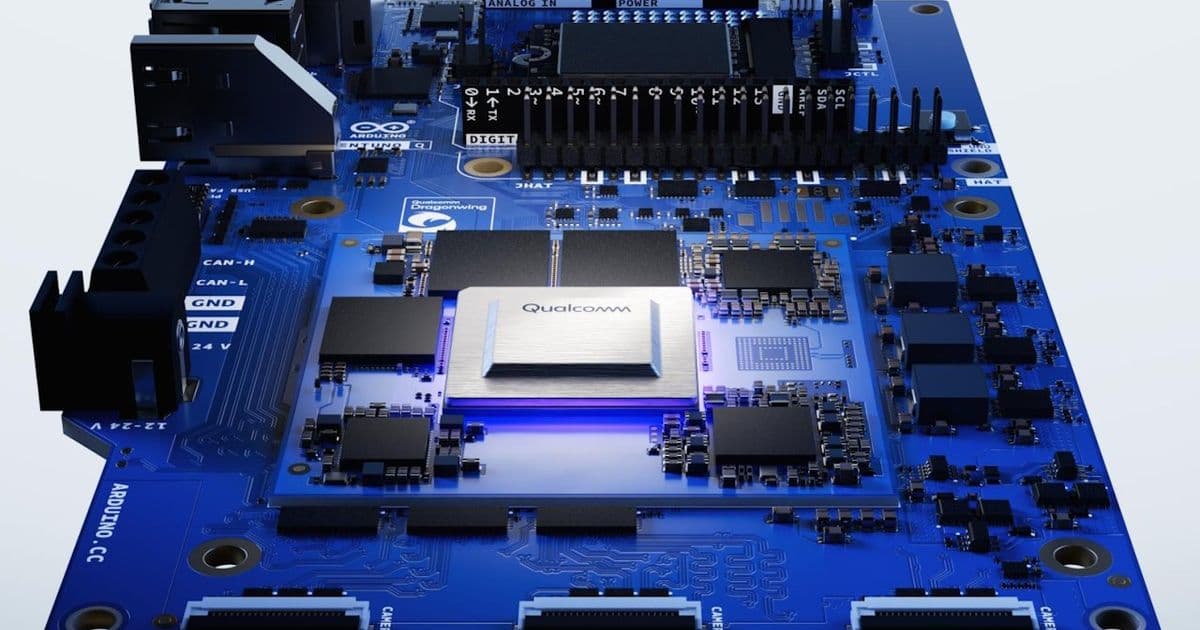
Qualcomm has unveiled the Arduino Ventuno Q, a feature-rich single-board computer designed specifically for physical AI applications, combining powerful processing capabilities with real-time microcontroller control.
What's New: Qualcomm has announced the Arduino Ventuno Q, a new single-board computer (SBC) that targets developers and hobbyists working on physical AI projects. The Ventuno Q combines Qualcomm's powerful Dragonwing IQ8 SoC with a real-time microcontroller unit, creating a unique hybrid solution that bridges high-performance computing with deterministic real-time control.
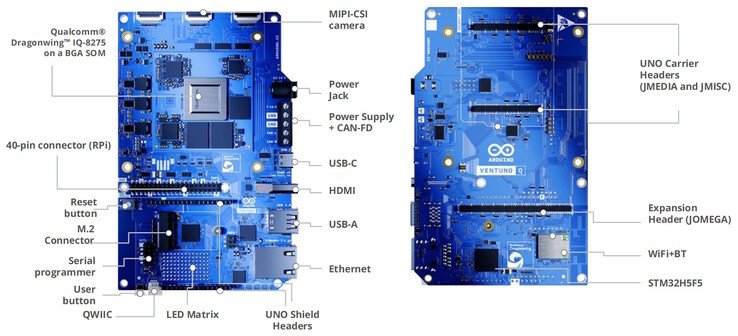
The SBC is built around the Dragonwing IQ8 SoC, which features an 8-core Kryo Gen 6 CPU and Adreno 623 GPU. This processor configuration provides substantial computing power while maintaining power efficiency. The system is paired with 16 GB of LPDDR5 RAM and 64 GB of eMMC storage, offering memory and storage capabilities that significantly exceed typical entry-level SBCs.
A key differentiator of the Ventuno Q is its inclusion of an STM32H5 microcontroller unit with an Arm Cortex-M33 CPU. This dedicated real-time processor handles the precise timing requirements of controlling motors and sensors, a critical capability for robotics and other physical computing applications that need predictable response times.
Connectivity options on the Ventuno Q include USB-C, USB-A, Ethernet, and HDMI ports, along with built-in Wi-Fi and Bluetooth. The board also features a MIPI-CSI camera input, RPi connector, and UNO and expansion headers, providing extensive options for connecting external devices, sensors, and peripherals.
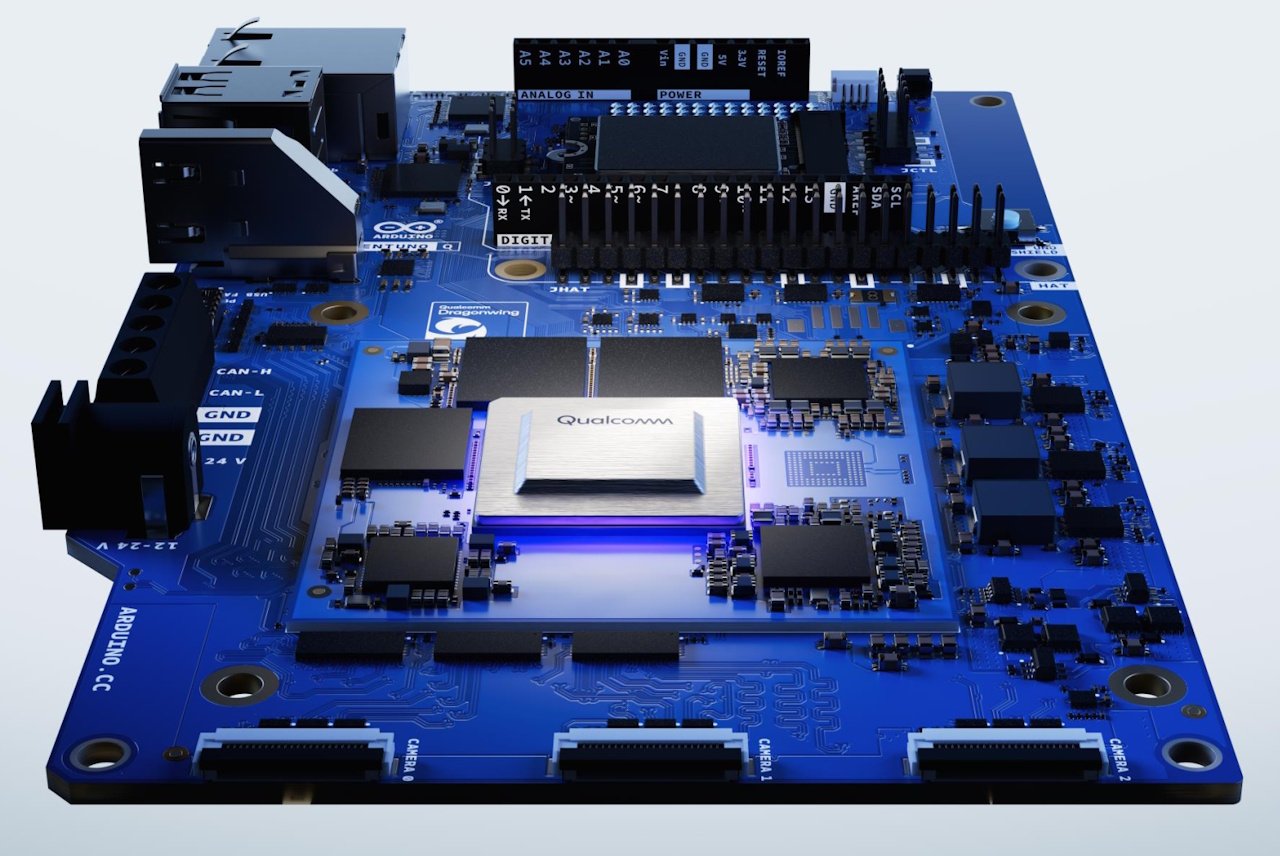
How It Compares: The Arduino Ventuno Q positions itself in a unique space between traditional single-board computers like the Raspberry Pi and more specialized AI accelerators. While many SBCs offer either strong processing capabilities or real-time control, the Ventuno Q combines both in a single package.
Compared to the Raspberry Pi 5, the Ventuno Q offers significantly more RAM (16 GB vs 4-8 GB) and likely superior CPU and GPU performance through the Dragonwing IQ8 SoC. However, the Pi ecosystem has broader software support and a larger community. The Ventuno Q's inclusion of a dedicated real-time microcontroller gives it an advantage for robotics and control applications where timing predictability is critical.
When compared to other AI-focused SBCs, the Ventuno Q's 40 TOPS of AI processing power places it in the mid-range, competitive with devices like the NVIDIA Jetson Nano but potentially more power-efficient. The combination of this AI capability with real-time control makes it particularly suited for edge AI applications that need to interact with the physical world.
The price point of under $300 positions the Ventuno Q as a premium SBC, more expensive than entry-level boards but offering substantially more resources. This makes it accessible to serious hobbyists and professional developers who need more than what basic SBCs can provide.
Who It's For: The Arduino Ventuno Q is specifically designed for developers and hobbyists working on physical AI projects that require both substantial computational power and real-time control. This includes:
Robotics developers who need to run AI models for perception while simultaneously controlling motors and actuators with precise timing. The combination of the main processor for AI tasks and the dedicated microcontroller for real-time control eliminates the need for a separate microcontroller in many designs.
Industrial automation engineers creating smart inspection tools, control systems, or predictive maintenance devices. The 40 TOPS AI processing capability allows for running sophisticated computer vision models directly on the device, while the real-time microcontroller ensures precise control of industrial equipment.
Smart home device creators building voice assistants, security systems, or environmental monitoring devices. The board's connectivity options and processing power support complex AI applications while maintaining the ability to interface with various sensors and actuators.
Educational institutions and research labs working on AI and robotics projects. The Arduino compatibility lowers the barrier to entry for students familiar with Arduino, while the powerful specifications support advanced research projects.
The software environment supports development in Python through the Arduino App Lab, with modular services for networking, AI, and vision sensing that can be containerized using Docker. This approach allows developers to build applications using familiar tools while taking advantage of the specialized hardware capabilities.
The Ventuno Q represents Qualcomm's entry into the physical AI computing space, leveraging their expertise in mobile processors to create a specialized solution for edge AI applications. By combining high-performance computing with real-time control in a single board, Qualcomm has created a compelling option for developers looking to build intelligent physical devices without needing to integrate multiple separate systems.
For those interested in a more affordable option, Arduino offers the Uno Q through their Amazon store, though with significantly reduced specifications compared to the Ventuno Q. The availability of both options allows developers to choose the appropriate platform based on their project requirements and budget constraints.
The Arduino Ventuno Q is scheduled for release in the second quarter of 2026, with pricing set at under $300. Developers interested in this platform should monitor Arduino's official channels for more detailed specifications, documentation, and example projects as the release date approaches.
Comments
Please log in or register to join the discussion