Mozilla and other major browser vendors announce Interop 2026, focusing on 20 new features and 4 investigation areas to improve web compatibility and developer experience across browsers.
The Interop Project represents a remarkable collaboration between browser vendors to address one of web development's most persistent challenges: inconsistent behavior across browsers. For 2026, Apple, Google, Igalia, Microsoft, and Mozilla have committed to improving web compatibility in areas that offer the most benefit to both users and developers.
The Interop Process
The selection process for Interop focus areas begins with proposals of features that are well-defined in stable web standards and have good test suite coverage. The group examines over 150 proposals annually, balancing developer priorities (gathered through surveys and bug reports) with collective resources. The key metric for measuring progress is the pass-rate on Web Platform Tests, which developers can track on the Interop dashboard.
Looking Back at Interop 2025
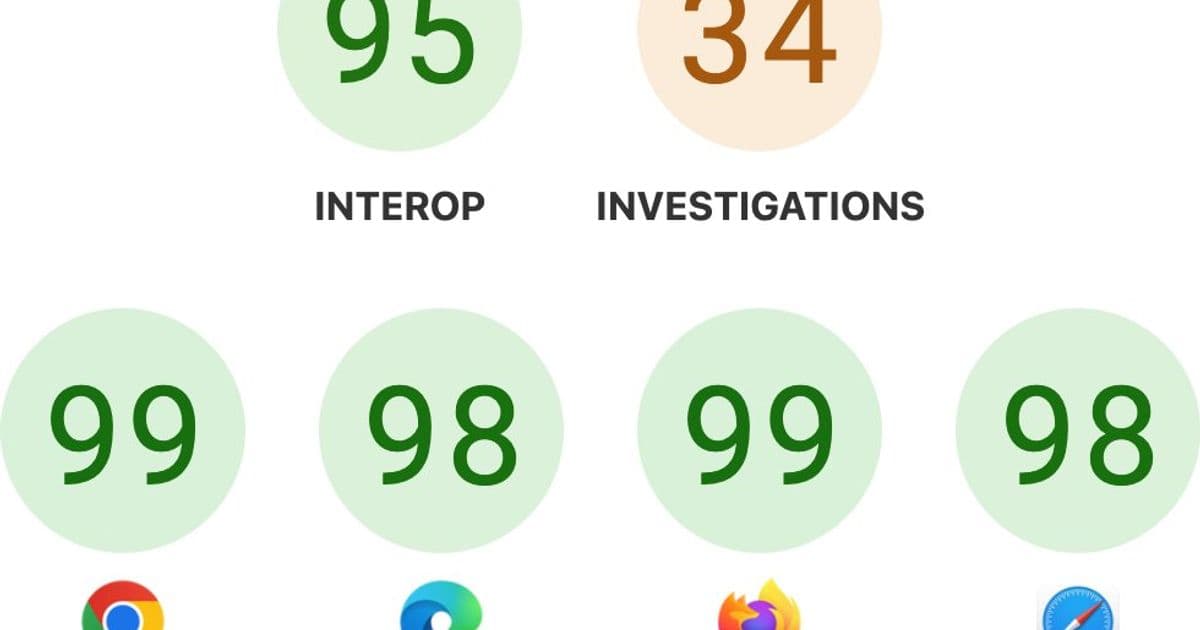
Before diving into 2026, it's worth examining the remarkable progress made in the previous year. Firefox started Interop 2025 with a score of 46 and finished the cycle at 99. More importantly, the overall Interop score—a combined measure across all four major browsers—jumped from 25 to 95. This dramatic improvement means fewer developer hours lost to frustrating browser differences.
The year saw major web platform features become available cross-browser, including Same-Document View Transitions, CSS Anchor Positioning, the Navigation API, CSS @scope, and the URLPattern API. However, the real value came from improving the reliability of existing features like WebRTC, CSS Flexbox, CSS Grid, Pointer Events, and CSS backdrop-filter.
One particularly insightful observation from the 2025 cycle was that achieving good test scores doesn't always translate to consistent behavior. In cases like CSS Anchor Positioning and the Navigation API, browsers could pass tests while behaving inconsistently. This highlighted the importance of ensuring tests align with specifications rather than specific implementations. The project spent time filing issues against relevant specs, improving tests, and making browser behavior more reliable for developers.
Interop 2026 Focus Areas
For 2026, the group has agreed on 20 focus areas formed from 33 proposals, plus 4 investigation areas. Here are the key highlights:
New Features
Cross-document View Transitions allow transitions to work across documents without JavaScript, including sub-features like rel="expect" and blocking="render".
Scroll-driven animations enable animations based on scroll position, replacing heavy JavaScript solutions that run on the main thread.
WebTransport provides a low-level API over HTTP/3, offering multiple unidirectional streams and optional out-of-order delivery as a modern alternative to WebSockets.
CSS container style queries allow applying styles based on computed values of custom properties on the nearest container, enabling sophisticated theming systems.
JavaScript Promise Integration for Wasm allows WebAssembly to asynchronously suspend while waiting on external promises, simplifying compilation of languages like C/C++ that expect synchronous APIs.
CSS attr() expansion moves beyond the 15-year limitation of only working in pseudo-element content, allowing attribute values to be used in most CSS values (with URLs as an exception).
CSS custom highlights let developers register DOM ranges as named highlights that can be styled via the ::highlight(name) pseudo-element, enabling highlights that span between elements without impacting layout.
Scoped Custom Element Registries allow different parts of the DOM tree to use different sets of custom element definitions, meaning the same tag name can refer to different custom elements depending on location.
CSS shape() reimagines path() with CSS syntax instead of SVG path syntax, allowing mixed units and calc() for easier responsive clip-paths and offset-paths.
Additional features include CSS contrast-color, accent-color, dialog closedby, popover="hint", fetch upload streams, IDB getAllRecords(), media pseudo-classes like :playing, and the Navigation API's precommitHandler.
Existing Feature Reliability Improvements
The backbone of Interop remains improving the reliability of existing features. For 2026, the focus includes edge cases in:
- Range headers & form data in fetch
- The Navigation API
- CSS scroll snap
- CSS anchor positioning
- Same-document View Transitions
- JavaScript top-level await
- The event loop
- WebRTC
- CSS user-select
- CSS zoom
Some of these are carried over from 2025 as shortcomings in tests and specs were fixed too late for inclusion in the previous cycle. These edge cases are where developers lose hours of frustrating debugging time.
Investigation Areas
Sometimes, important features don't fit Interop requirements due to insufficient tests, wrong test formats, or missing browser automation features. For 2026, investigations focus on:
Accessibility: Continuing 2025 work to improve testing infrastructure so browsers produce consistent accessibility trees from the same DOM and CSS.
Mobile testing: Addressing viewport changes caused by dynamic UI like location bars and virtual keyboards.
JPEG XL: Improving sparse test coverage and relating existing decoder test suites to browser behavior, particularly around progressive rendering debates.
WebVTT: Ensuring the test suite for synchronized text with video content is fit for purpose.
The Challenge Ahead
Mozilla faces a particular challenge as the only engine not owned by billionaires, committing to more work than other browsers. However, this challenge is embraced as part of the project's mission to deliver features and fixes over the next year.
Developers can follow progress on the Interop dashboard. Missing features from Interop 2026 doesn't mean they won't be worked on—JPEG XL is a prime example where the current test suite wasn't suitable for Interop, but Mozilla is still experimenting with a memory-safe Rust decoder.
The Broader Impact
What makes Interop particularly valuable is its cross-browser commitment. It's not just about implementing new features but ensuring they work consistently and reliably across all major browsers. This reduces the cognitive load on developers who otherwise must account for browser differences, debug inconsistent behavior, and implement workarounds.
The project also improves the web platform itself by identifying ambiguities in specifications and improving test suites. When browsers pass tests but behave differently, it often reveals problems with the tests or specs rather than the implementations.
As Interop 2026 begins, the web development community can look forward to more consistent, reliable behavior across browsers, fewer frustrating edge cases, and new capabilities that work as expected regardless of which browser users choose. This represents a significant step toward the original vision of the web as an open, interoperable platform.
Comments
Please log in or register to join the discussion