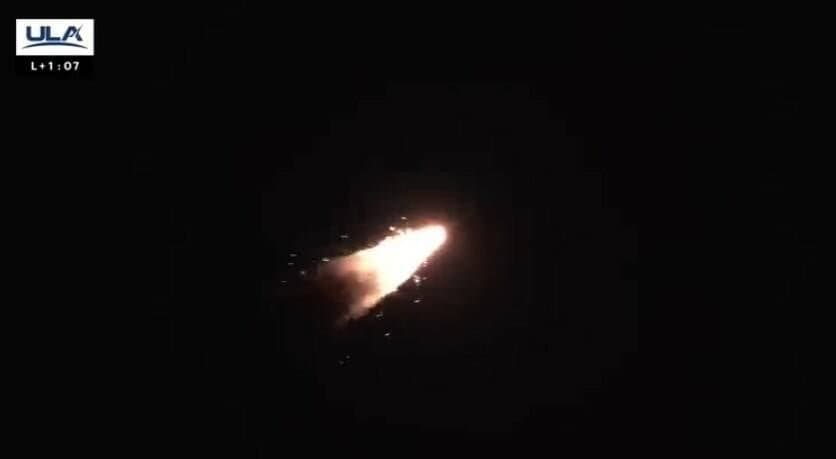
United Launch Alliance's Vulcan Centaur successfully delivered a US Space Force payload to geosynchronous orbit despite a dramatic mid-flight booster nozzle burn-through during ascent from Cape Canaveral.
United Launch Alliance's (ULA) Vulcan Centaur rocket successfully reached orbit on February 12, 2026, despite experiencing a significant performance anomaly during ascent that saw one of its four solid rocket boosters burn through its nozzle in a dramatic mid-flight incident.
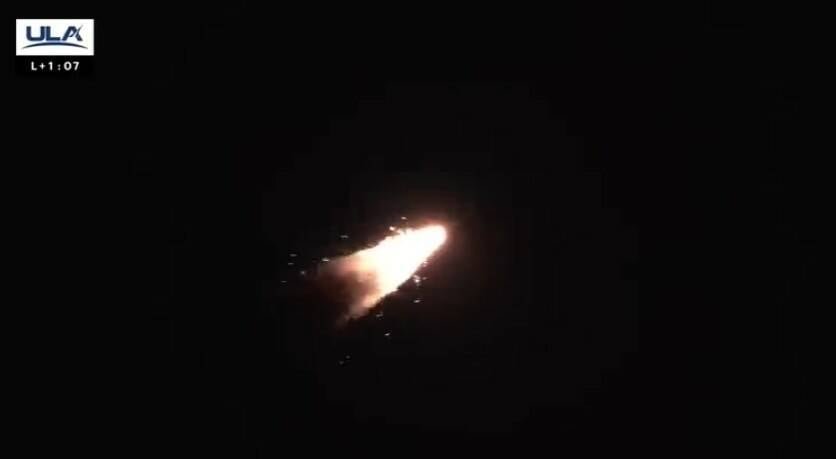
Viewers of the launch from Cape Canaveral at 0422 EST (0922 UTC) witnessed impressive fireworks as the affected booster detached in a shower of fragments. The anomaly occurred during the fourth launch of ULA's heavy-lift vehicle, which serves as the replacement for the Atlas V and Delta IV rocket families.
The incident marks the second time a nozzle anomaly has been observed with the Vulcan Centaur's solid rocket boosters. A similar event occurred during the rocket's second launch in 2024 when operating in a configuration featuring twin solid rocket boosters. The third launch in 2025 proceeded without incident, making this the second anomaly in four flights.
Despite the dramatic mid-flight failure, the mission achieved its primary objective. The US Space Force payload was successfully carried directly to geosynchronous orbit, demonstrating the rocket's ability to compensate for asymmetric thrust caused by the booster failure. The remaining solid rocket boosters and the main BE-4 engines were able to counteract the thrust imbalance, allowing the mission to proceed as planned.
Gary Wentz, ULA vice president of Atlas and Vulcan Programs, addressed the incident in a statement: "We will conduct a thorough investigation, identify root cause, and implement any corrective action necessary before the next Vulcan mission."
The Vulcan Centaur is designed as a heavy-lift vehicle featuring a pair of Blue Origin BE-4 engines powering the first stage, with up to six GEM 63XL solid rocket boosters providing additional thrust when required. The February 12 configuration utilized four of these boosters.
This successful mission, despite the anomaly, represents a significant achievement for ULA as it works to establish the Vulcan Centaur as a reliable launch vehicle for national security and commercial payloads. The company had planned to ramp up Vulcan Centaur operations in 2026, with future launches including payloads for Amazon Leo (formerly Project Kuiper), the e-commerce giant's satellite internet constellation.
The timing of this anomaly raises questions about potential delays to upcoming missions. It remains unclear whether the launches scheduled for Amazon Leo will need to be postponed while ULA conducts its investigation into the cause of the burn-through and subsequent loss of at least part of the rocket nozzle.
Interestingly, ULA was not the only company conducting a significant launch on February 12. Arianespace successfully launched the first four-booster configuration of its Ariane 6 rocket at 1645 UTC. That mission proceeded without incident and successfully deposited 32 Amazon Leo satellites into orbit, highlighting the growing competition in the commercial launch market.
The Vulcan Centaur's ability to complete its mission despite the booster failure demonstrates the rocket's robust design and the effectiveness of its flight control systems. However, the recurrence of nozzle-related anomalies will likely prompt a comprehensive review of the solid rocket booster design and manufacturing processes before the vehicle can be considered fully operational for its planned launch cadence in 2026 and beyond.
Comments
Please log in or register to join the discussion