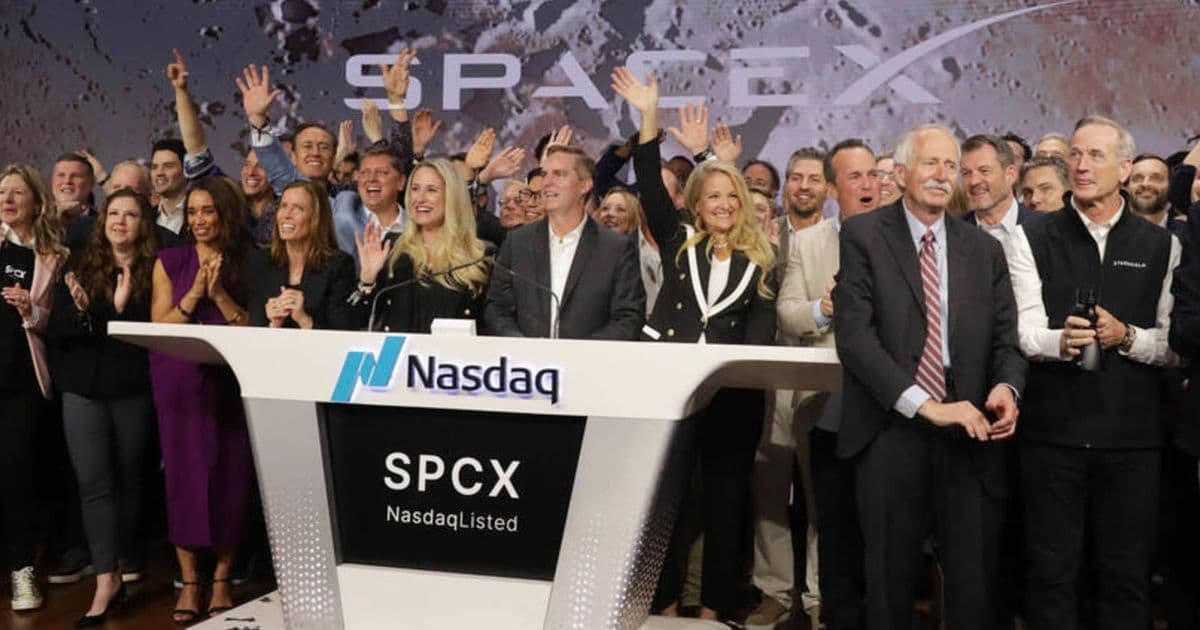
SpaceX’s post-IPO surge gave Elon Musk’s rocket and AI company a $2.65 trillion valuation after traders priced in Starlink growth, reusable launch dominance, and a $60 billion Cursor deal.
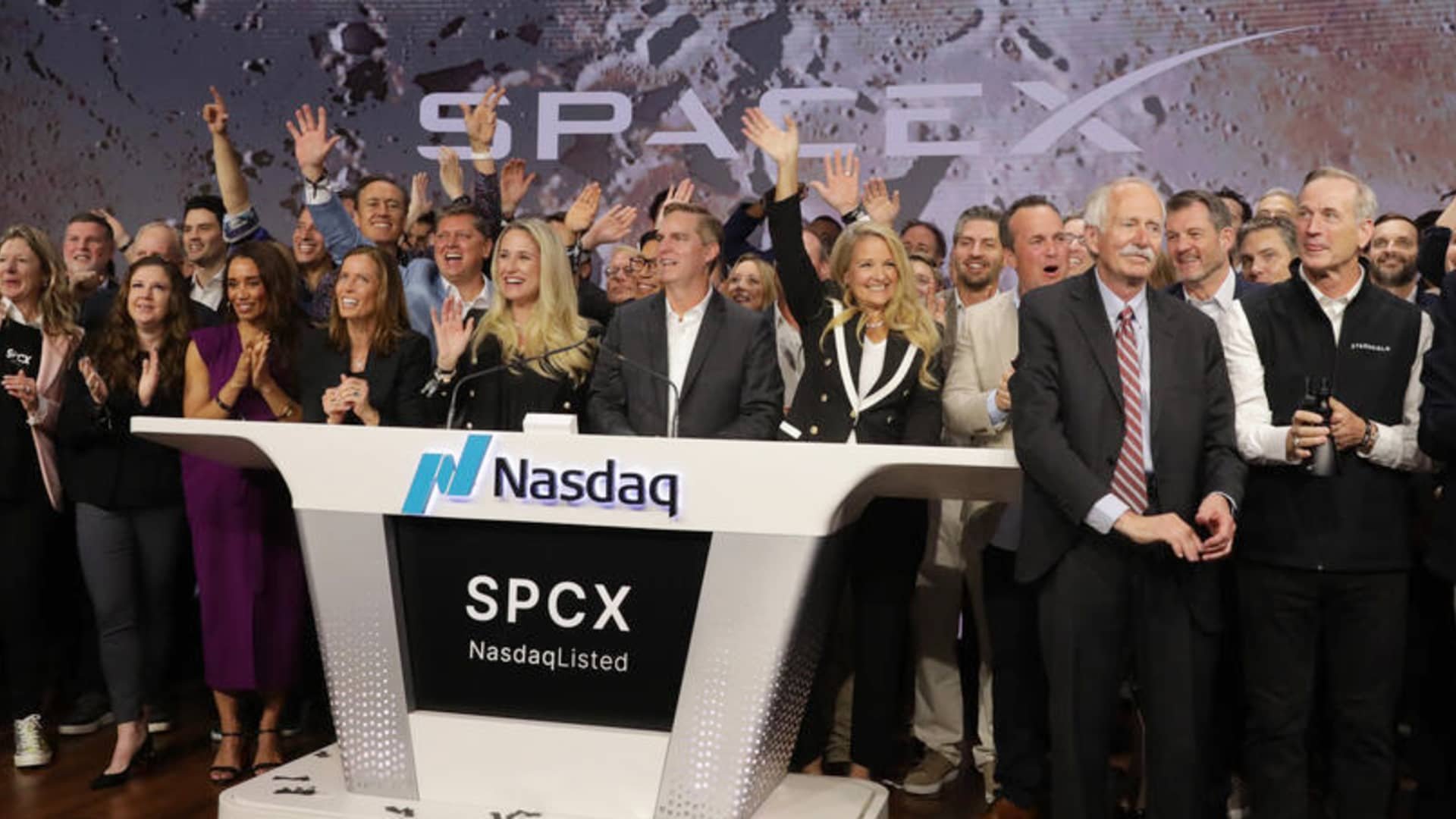
Investors pushed SpaceX shares 4% higher Tuesday, lifting the company past Amazon in market value after a debut that has turned Elon Musk’s rocket builder into one of Wall Street’s largest technology bets.
SpaceX finished the session at a $2.65 trillion valuation, above Amazon at about $2.64 trillion and below Microsoft after touching $2.94 trillion during morning trading. The intraday move put SpaceX above Microsoft’s $2.93 trillion value for a short stretch before traders pulled the stock back.
The stock has gained 62% from its $135 IPO price. Investors lifted shares 20% Monday, the company’s first full trading day, after Friday’s listing gave public-market buyers rare direct exposure to reusable rockets, Starlink satellite broadband, defense contracts, and Musk’s merged AI ambitions.
SpaceX now sits behind Apple, which carries a market value near $4.4 trillion. That gap gives bulls room to argue for more upside, but it also raises the test for Musk: Public investors now expect revenue growth that can support one of the richest valuations in U.S. markets.
SpaceX reported $18.7 billion in 2025 revenue and a $4.9 billion net loss. The company also lost $4.28 billion in the first quarter of this year. Musk told followers on X that SpaceX might reach about $1 trillion in revenue in 2030, a target that would require a surge across launch services, Starlink, government work, AI infrastructure, and new lines of business.
The company added another catalyst Tuesday by announcing a $60 billion deal for Anysphere, the maker of Cursor, an AI coding tool used by software developers. SpaceX expects the deal to close in the third quarter.
The purchase would give SpaceX a major developer-tool business and a stronger base for its AI work. Musk merged SpaceX with xAI in February after combining xAI with X in 2025, and the Cursor acquisition would add a product that competes in the same developer workflow as tools from OpenAI, Anthropic, Google, and Microsoft’s GitHub.
Cursor gives SpaceX more than a coding editor. Anysphere built a fast-growing business around AI-assisted software work, codebase search, agentic edits, and developer subscriptions. That matters because AI coding tools sit close to enterprise software budgets. Companies that adopt them often run pilots across engineering teams, then expand seats if the tools cut review time or help developers ship more code.
SpaceX can also use Cursor inside its own engineering operation. Rocket systems, satellite networks, ground software, AI training pipelines, and consumer internet products all require large software teams. Better code tools could reduce cycle times across teams that already operate under tight launch and deployment schedules.
The market’s reaction shows how investors now view SpaceX as more than an aerospace company. Buyers have priced the company as a combined space, broadband, defense, and AI platform. That framing helps explain why traders compare SpaceX with Amazon and Microsoft rather than with Boeing or Lockheed Martin.
Amazon gives investors one useful comparison. The company built its market value through e-commerce scale, cloud infrastructure, advertising, logistics, and subscriptions. SpaceX offers a different mix: launch dominance, Starlink cash flow, government demand, and AI assets. Investors appear to be paying for the chance that those businesses reinforce one another.
Microsoft gives another comparison. The company earns durable profits from cloud computing, enterprise software, Windows, LinkedIn, gaming, and AI partnerships. SpaceX has the growth story, but Microsoft has operating income and a mature customer base. SpaceX’s valuation asks investors to accept losses now in exchange for a belief that Starlink, launch, and AI can produce Microsoft-scale economics later.
That assumption carries risk. SpaceX needs heavy capital spending for rockets, satellites, launch facilities, spectrum, chips, and compute. Starlink faces competition from terrestrial broadband, wireless carriers, and satellite rivals. Government contracts can shift with budgets and policy. AI coding tools also face price pressure as OpenAI, Anthropic, Google, and Microsoft improve their own products.
CFRA gave investors one warning sign Friday by starting SpaceX coverage with a sell rating and a $115 12-month price target. The firm cited SpaceX’s aggressive growth plan, high valuation expectations, and capital needs. That target sits far below the stock’s post-IPO trading levels.
Bullish analysts see a longer time frame. They argue that SpaceX controls scarce assets: reusable launch capacity, a global satellite internet network, engineering talent, and a founder who can direct capital across space and AI. If SpaceX turns Starlink into a large cash generator and folds AI tools into its product stack, the company could justify a premium that older industrial firms cannot command.
The next few quarters will matter. Investors will watch Starlink subscriber growth, launch cadence, defense revenue, AI spending, Cursor integration, and loss trends. SpaceX’s S-1 projections helped sell the IPO. Public shareholders will now grade Musk against those numbers.
Tuesday’s trading gave SpaceX a symbolic win over Amazon and a moment above Microsoft. The harder work starts with earnings reports, integration milestones, and proof that a $2.65 trillion company can grow into the valuation investors assigned it.
Comments
Please log in or register to join the discussion