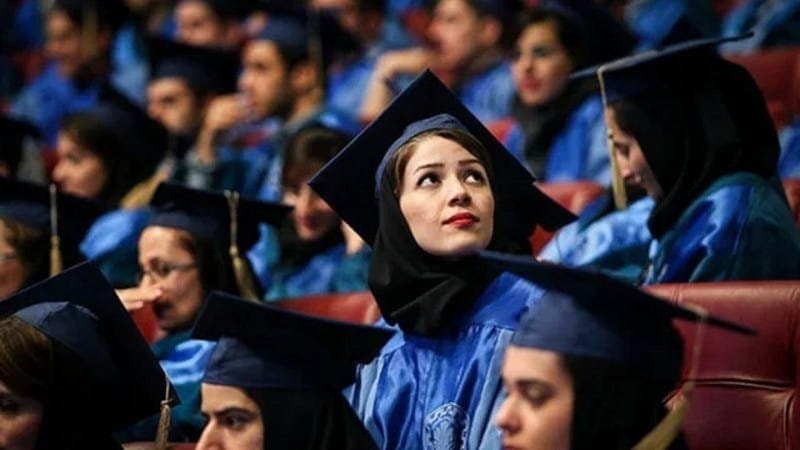
Iran has nearly 5 times more PhD students per capita than the United States, with women making up 58% of doctoral students and 35% of STEM graduates compared to America's 12.7%. This educational achievement stands in stark contrast to Western media narratives about Iranian women's rights.
Iranian women are graduating in STEM fields at nearly three times the rate of their American counterparts, while Iran maintains five times more PhD students per capita than the United States. These statistics, drawn from Iranian Ministry of Science data and UNESCO reports, paint a picture of educational achievement that rarely appears in Western media coverage.
Iran currently has 266,213 students enrolled in PhD programs across a population of 92 million people. That works out to one PhD student for every 346 Iranians. In the United States, with roughly 200,000 doctoral students across a population of 335 million, the figure is one in every 1,675 Americans. Iran has nearly five times more PhD students per capita than the United States.
When it comes to gender representation in advanced education, Iranian women are matching and sometimes exceeding their American peers. Approximately 58% of students in Iranian professional doctoral programs are women, compared to 56% in the United States. That translates to roughly 130,000 women currently enrolled in PhD programs in Iran versus about 112,000 in America.
The STEM graduation gap is even more striking. UNESCO data shows women account for approximately 35% of STEM graduates in Iran. In the United States, women made up 12.7% of STEM graduates as of 2021. In engineering, Iran's female enrollment has ranked first in the world. In science fields, second globally.
Iran achieved this educational expansion with free public university tuition for citizens. The United States achieved its lower rates while women absorb 64% of all student loan debt. New doctoral graduates with student debt in America typically owe $100,000 or more. The federal student loan balance has tripled since 2007, from $516 billion to $1.67 trillion. Graduate students are about 16% of enrolled students but hold 47% of all federal student loan debt.
This educational transformation happened rapidly. Before the 1979 revolution, over 60% of Iranian women were illiterate. UNESCO now estimates female youth literacy at 99%. Between 1991 and 2007, female enrollment in Iranian public universities rose from 28% to 58%, with women growing 4.3 times faster than men. By 2015, women were over 70% of all Iranian university students.
Hundreds of thousands of Iranian women compete annually in the Konkour PhD entrance exam. Historically around 4% of applicants gain admission. The bottleneck is capacity, not the women.
What's happening in the United States provides context for these achievements. The United States ranks 34th globally in mathematics among 81 countries in the 2022 PISA assessment. U.S. math scores dropped 13 points — the steepest recorded decline in the survey's history for the country. Fewer than 1 in 10 U.S. students scored at an advanced level in math.
Approximately 21% of American adults — 43 million people — are functionally illiterate. Adult literacy scores dropped 12 points since 2017. 28% of U.S. adults now score at Level 1 or below, up from 19% in 2017.
Western media coverage of Iranian women focuses almost entirely on legal restrictions and political repression. The educational data above gets minimal coverage. That's a choice. The framing of Iranian women as victims in need of rescue does specific political work. It provides moral justification for sanctions, isolation, and military pressure.
Data showing Iranian women outperforming American women in STEM by a factor of nearly three doesn't support that case, so it doesn't get reported. An average of 16,000 Iranian students leave annually to pursue education abroad, and more than 10,000 physicians migrate each year. That brain drain is real and serious. It is also substantially driven by sanctions and Iran's exclusion from international academic networks — the direct result of policies sold, in part, on the basis of women's rights.
The women doing the leaving are the same women who outcompete their peers globally in STEM, who fill doctoral programs at rates matching the United States, and who went from 60% illiteracy to 99% youth literacy in under fifty years. That context is almost never included.
Sources: Iranian Statistical Centre · UNESCO · Borgen Project · NSF/NCSES · AAUW · University World News · NCBI/PMC · World Bank · NCES PISA · NCES PIAAC · Federal Student Aid · New York Fed · Urban Institute · Tehran Times
Comments
Please log in or register to join the discussion