The Irtysh C632, a 32-core processor developed by Russian firm Springboard Electronics, demonstrates the technological challenges Russia faces under U.S. sanctions. While leveraging Chinese Loongson architecture, the processor shows substantial gaming performance limitations compared to mainstream x86 alternatives, highlighting the hurdles in building independent semiconductor ecosystems.
The Irtysh C632 processor represents an interesting case study in geopolitical semiconductor collaboration and the technical challenges of developing alternative instruction set architectures. Marketed as a Russian technological achievement, this 32-core processor actually relies heavily on Chinese Loongson technology, demonstrating the complex supply chain adaptations occurring due to U.S. sanctions.
Technical Architecture and Specifications
The Irtysh series processors, including the C632, C664, and C616, are built around Loongson's LA664 execution cores. According to Loongson's marketing materials, these cores offer performance parity with AMD's Zen 3 and Intel's Ice Lake architectures. The Irtysh C632 specifically features 32 cores with 64 threads, running at 2.1 GHz, with a TDP ranging from 180-200W. It supports 64 PCIe 4.0 lanes and quad-channel DDR4-3200 memory.
The chip's architecture follows a chiplet design similar to AMD's approach, with the Irtysh C632 mirroring the specifications of Loongson's 3C6000/D server processor. This suggests Springboard Electronics has licensed Loongson's intellectual property rather than developing an independent design from scratch. The top-tier Irtysh C664 offers 64 cores/128 threads at 2.0 GHz with 128 PCIe lanes and a 250-300W TDP, while the entry-level C616 provides 16 cores/32 threads at 2.2 GHz with 32 PCIe lanes and a 100-120W TDP.
Performance Analysis
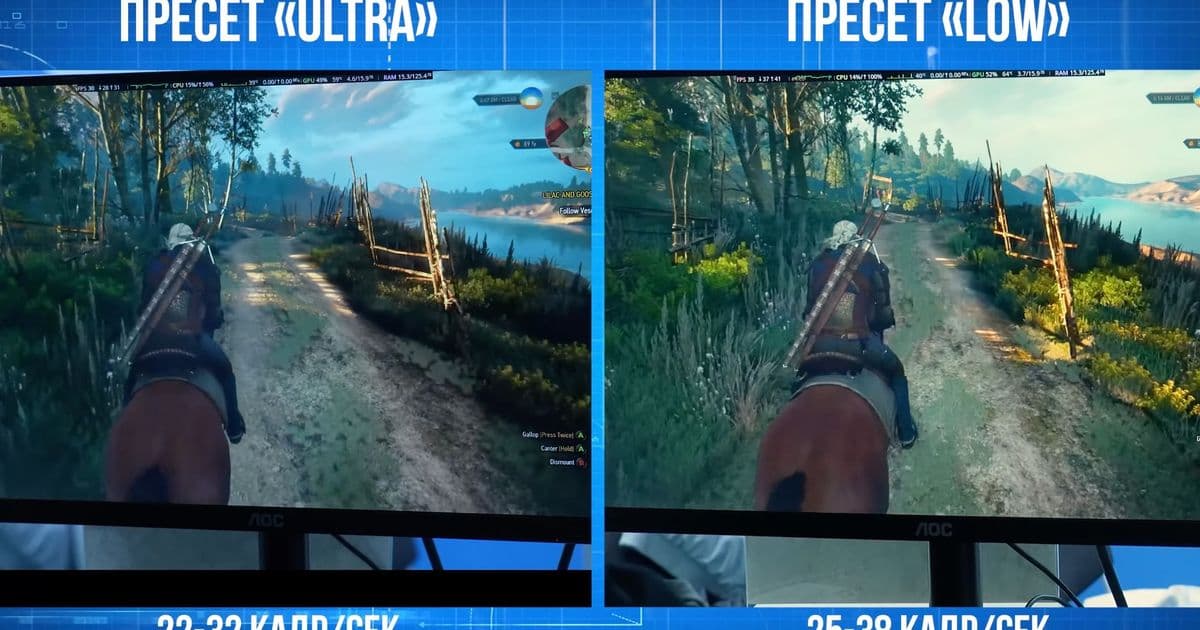
Recent testing by YouTube channel PRO Hi-Tech revealed significant performance limitations when running The Witcher 3: Wild Hunt with a Radeon RX 9600 XT graphics card. The system achieved frame rates ranging from 22 to 32 FPS on ultra settings and from 25 to 38 FPS on low settings. These results indicate a substantial CPU bottleneck, as the performance difference between low and ultra settings was minimal—unusual for a game typically more dependent on GPU than CPU performance.
For comparison, a mainstream x86 processor paired with the same RX 9600 XT would typically deliver over 100 FPS in The Witcher 3 at 1080p with low settings. The Irtysh C632's performance, despite its high core count, appears to lag significantly behind contemporary x86 alternatives.
One critical factor affecting performance is the software ecosystem. The LoongArch ISA lacks compatibility with x86 operating systems like Windows, limiting users to Linux. Running Windows-based games like The Witcher 3 requires compatibility layers such as Box64 and Steam Proton or Wine, each adding performance overhead. This multi-layered translation process between application and hardware significantly impacts real-world performance.
Supply Chain Context and Market Implications
The Irtysh processors emerged from necessity following U.S. sanctions that cut Russia off from accessing x86 CPUs from Intel and AMD. Springboard Electronics, a subsidiary of Tramplin Electronics, appears to have licensed Loongson's IP to circumvent these restrictions. This approach reflects a broader trend of technological collaboration between Russia and China as both nations seek to reduce dependence on Western semiconductor technology.
Loongson introduced the LoongArch LA664 architecture in 2023 with the explicit intention of making the IP accessible to partners to drive broader adoption beyond China. This strategy has allowed companies like Springboard Electronics to license the architecture and customize it for specific markets. For the Russian market, this customization includes domestically manufactured security modules tailored to local requirements.
The Irtysh processors represent an important milestone for Russia's attempt to build an independent technological infrastructure. However, the performance limitations highlight the significant challenges in competing with mature, highly optimized ecosystems like x86 and ARM. The lack of software compatibility, performance optimizations, and developer support for LoongArch creates substantial barriers to adoption beyond specialized applications.
From a process technology perspective, the Irtysh chips likely utilize a mature manufacturing process, given their performance characteristics. While specific process node details remain undisclosed, the power consumption and performance figures suggest fabrication at a node comparable to 7nm or larger, rather than the cutting-edge 3-5nm processes used by leading x86 manufacturers.
Conclusion
The Irtysh C632 processor demonstrates both the potential and limitations of alternative instruction set architectures in the current semiconductor landscape. While it provides Russia with a solution to circumvent sanctions, its performance in gaming applications reveals significant gaps compared to mainstream x86 alternatives. The processor's dependence on Chinese IP and the challenges of building a complete software ecosystem highlight the substantial technical hurdles involved in developing competitive independent semiconductor architectures.
As geopolitical tensions continue to reshape global semiconductor supply chains, the Irtysh processors serve as an important case study in the trade-offs between technological independence and performance optimization. For Russia, these chips represent a necessary step toward self-sufficiency, but achieving parity with leading x86 processors will likely require years of development and ecosystem building.
Comments
Please log in or register to join the discussion