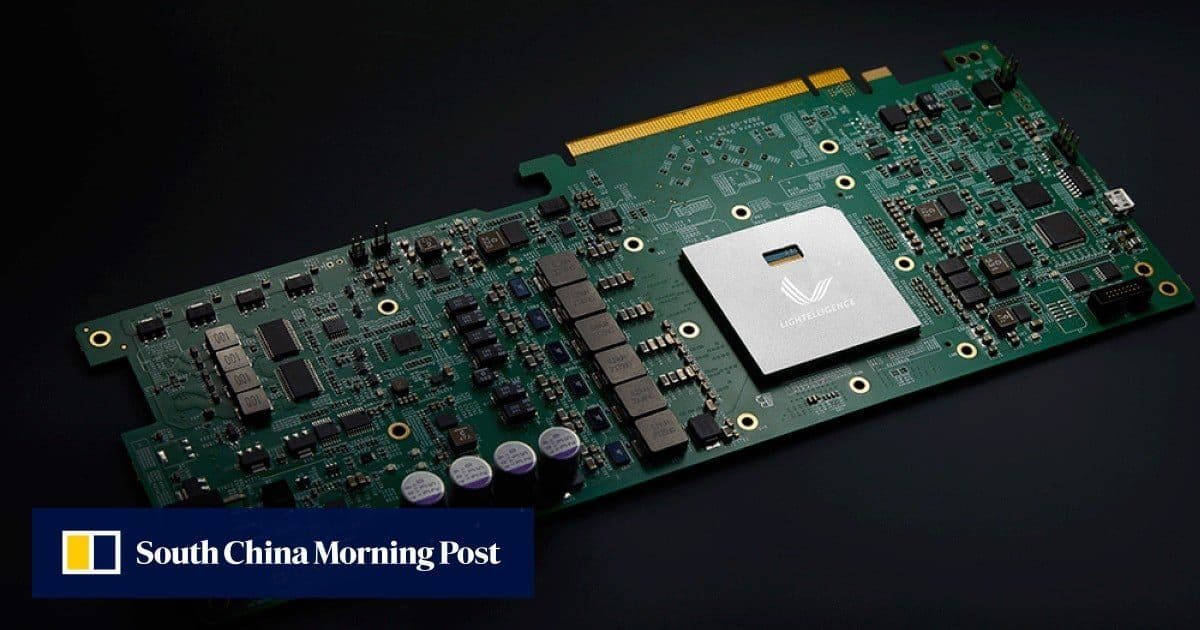
Shanghai-based photonics chip company Lightelligence sees nearly 400% stock surge in Hong Kong debut, raising $310M amid growing demand for AI hardware alternatives.
Lightelligence, a Shanghai-based developer of photonics chips for artificial intelligence applications, experienced a remarkable surge in its Hong Kong trading debut, with shares jumping by nearly 400% after the company raised approximately $310 million in its initial public offering. The dramatic debut reflects growing investor interest in alternative computing hardware solutions as traditional silicon approaches physical limitations.
Founded in 2017, Lightelligence has positioned itself at the intersection of photonics and AI acceleration, developing chips that use light rather than electricity to process information. The company's technology aims to address the growing power consumption and heat generation challenges in AI computing, particularly for large language models and other computationally intensive applications.
Unlike traditional electronic chips that rely on electrons moving through circuits, photonics chips use photons (light particles) to perform computations. This approach offers potential advantages in energy efficiency and speed for certain types of calculations, particularly matrix operations that are fundamental to AI workloads.
"The performance of Lightelligence's IPO suggests that investors are looking beyond conventional silicon solutions," said Dr. Evelyn Reed, a hardware analyst specializing in AI accelerators. "There's growing recognition that as AI models continue to scale, we'll need fundamentally different approaches to hardware to maintain progress."
The $310 million raised will likely fund further development of Lightelligence's photonics platform and expansion of its manufacturing capabilities. The company joins a growing field of AI hardware startups, including those developing neuromorphic chips, specialized AI processors, and quantum computing systems.
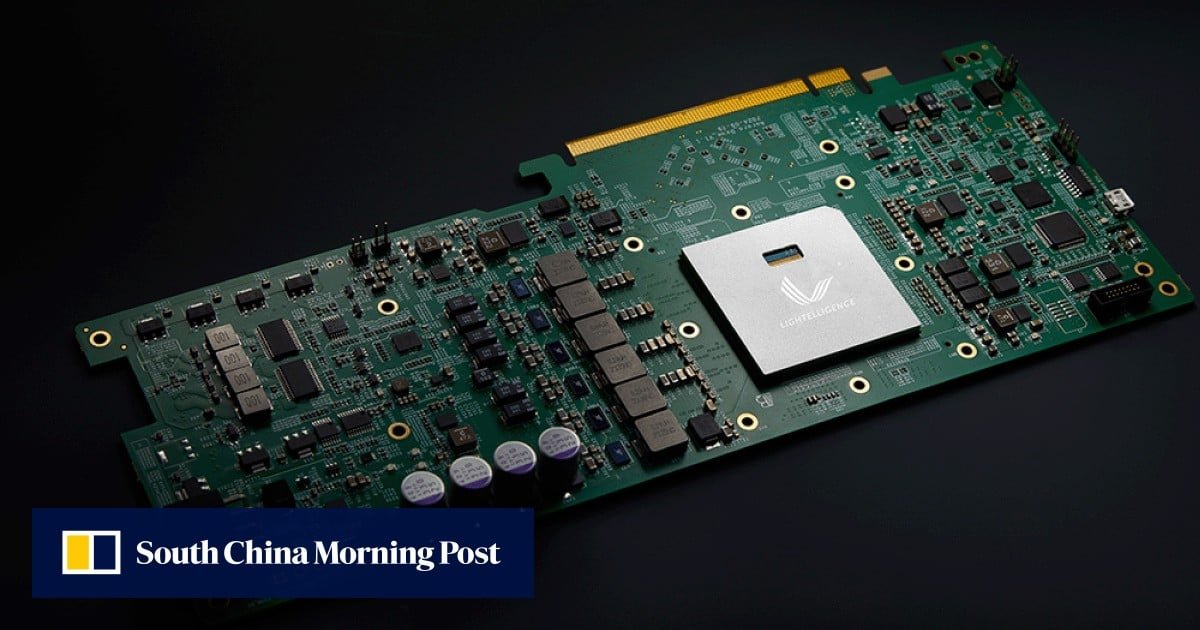
However, the photonics chip space faces significant challenges. Manufacturing photonic components remains more complex and expensive than traditional silicon fabrication. Additionally, photonics systems often require conversion between optical and electronic signals, which can offset some of the theoretical advantages in certain applications.
"Lightelligence has demonstrated promising results in specific benchmarks, but real-world adoption will depend on their ability to integrate photonics seamlessly into existing AI infrastructure," noted Professor Michael Chen, a computer architect at Tsinghua University. "The technology shows promise, but it's not a universal replacement for electronic processors."
The company's strong debut comes amid increased competition in AI hardware, with major players like NVIDIA, Google, and AMD developing increasingly sophisticated AI accelerators. It also reflects China's growing ambitions in semiconductor technology, particularly as geopolitical tensions have restricted access to advanced manufacturing equipment.
Lightelligence's technology builds on research in photonic computing that has gained traction in recent years as AI workloads have grown more demanding. The company has published papers demonstrating its approach to implementing neural network operations using optical components, though commercial deployment at scale remains a significant technical challenge.
For investors, the dramatic stock increase presents both opportunity and risk. While the underlying technology addresses real challenges in AI computing, the path to widespread commercialization is uncertain. Many hardware startups have struggled to deliver on early promises, and the photonics field has seen several companies fail to achieve commercial viability.
The Hong Kong market has become an increasingly important venue for Chinese tech companies seeking capital, offering a bridge between mainland China's technology ecosystem and international investors. Lightelligence's performance may encourage other specialized AI hardware companies to consider Hong Kong for their listings.
As AI continues to drive demand for computing power, innovations like Lightelligence's photonics chips will play an increasingly important role in the technology landscape. Whether the company can translate its promising early results into sustainable business success remains an open question, but its IPO debut certainly signals strong market interest in alternative approaches to AI hardware.
Comments
Please log in or register to join the discussion