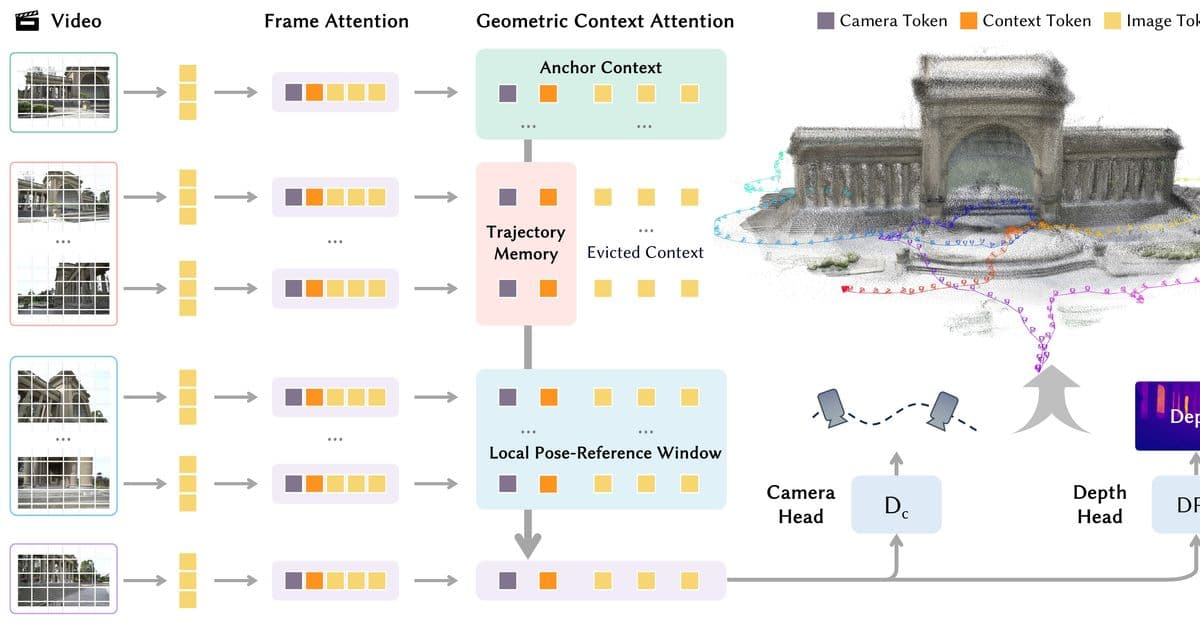
Robbyant introduces Lingbo-Map, a breakthrough streaming 3D reconstruction system that maintains consistent performance across 10,000+ frames by using Geometric Context Attention to efficiently manage memory and computational resources.
When it comes to 3D reconstruction from video streams, the fundamental challenge has always been memory management—what information to retain, and in what form. Robbyant, a technology company focused on advanced computer vision solutions, has addressed this challenge head-on with Lingbo-Map, a streaming 3D reconstruction system that leverages Geometric Context Attention (GCA) to maintain consistent performance across extremely long sequences.
The core innovation behind Lingbo-Map is its approach to memory management. Traditional 3D reconstruction systems typically struggle with accumulating data over time, leading to increased computational requirements and degraded performance as sequences grow longer. Lingbo-Map solves this by maintaining a small but structured streaming state that is learned end-to-end through GCA.
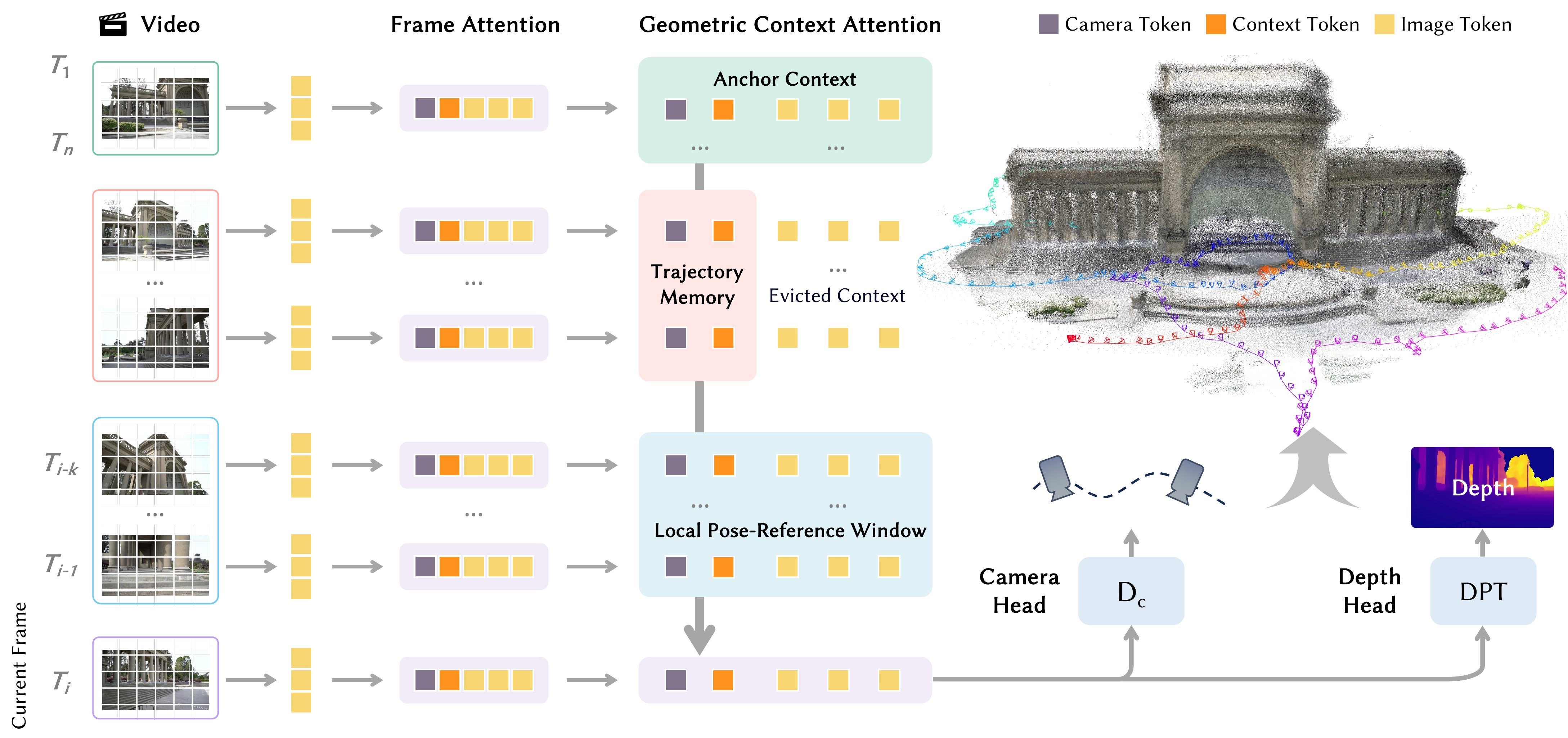
GCA maintains three complementary contexts that work together to provide comprehensive spatial information:
- Anchor Context: Provides coordinate and scale grounding, ensuring the reconstruction maintains proper spatial relationships
- Local Pose-Reference Window: Captures dense local geometry for immediate surroundings
- Trajectory Memory: Compresses the full history into compact per-frame tokens, enabling the system to reference past information without storing excessive data
This three-pronged approach allows Lingbo-Map to keep memory and compute per frame nearly constant, even across sequences of 10,000+ frames at approximately 20 FPS—performance levels that would be impossible with traditional approaches.
[ ]
]
The technical pipeline of Lingbo-Map is elegant in its efficiency. It begins with a DINO (self-DIstillation with NO labels) backbone that extracts image features from each frame. These features are then refined through alternating layers of Frame Attention and GCA. Within the GCA mechanism, the current view intelligently aggregates information from all three contexts mentioned above. Finally, task-specific heads predict camera pose and depth maps to construct the 3D representation.
The practical applications of this technology are extensive. Lingbo-Map can be used for:
- Large-scale mapping: Creating detailed 3D maps of buildings, campuses, or even cities
- Autonomous navigation: Providing environmental understanding for robots and self-driving vehicles
- Virtual reality: Generating real-time 3D environments for immersive experiences
- Architectural documentation: Creating accurate as-built models of structures
- Film production: Generating 3D assets from video footage
Robbyant has demonstrated Lingbo-Map's capabilities through several impressive demos. The system handles diverse environments effectively, from multi-room indoor spaces to aerial scenes and even specialized cases like lightweight cartoon and realistic rendering scenarios. The camera trajectory estimation shows particularly strong performance across various benchmarks including Tanks & Temples, Barn, Oxford Spires, Keble College, and Observatory Quarter.
What makes Lingbo-Map particularly significant is its efficiency. By maintaining constant computational requirements regardless of sequence length, it removes a major barrier to practical deployment of streaming 3D reconstruction systems. This could enable applications that were previously impractical due to computational constraints.
The technology has been released with accompanying code and technical documentation, making it accessible to researchers and developers who want to build upon this foundation. Robbyant has made the system available through both Hugging Face and ModelScope platforms, indicating a commitment to open research and practical adoption.
As 3D reconstruction becomes increasingly important across industries, technologies like Lingbo-Map that can efficiently handle large-scale streaming data will become essential. Robbyant's approach represents not just an incremental improvement but a fundamental rethinking of how we manage memory in 3D reconstruction systems.
The combination of elegant design, practical performance, and open accessibility suggests that Lingbo-Map could become a foundational technology in the field of real-time 3D reconstruction, enabling new applications that were previously impossible due to computational limitations.
Comments
Please log in or register to join the discussion