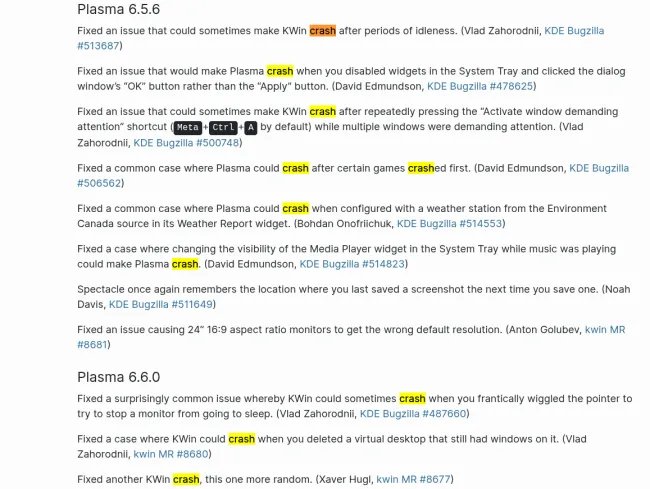
KDE's development team has merged at least nine distinct crash fixes into Plasma 6.6 this week, targeting edge cases ranging from KWin failures during idle periods to system instability when games crash first. The fixes arrive as Plasma 6.6 feature development winds down and work on the next 6.7 release begins, with a new Windows printer sharing UI already in the pipeline.
KDE's development cadence is a constant push-and-pull between stabilizing the current release and building the next one. This week's "This Week in Plasma" report highlights that dynamic perfectly, with the team landing at least nine distinct crash fixes into the stable Plasma 6.6 branch while simultaneously seeding new features into the upcoming 6.7 release.
The stability push is particularly focused on edge cases that can frustrate users in real-world scenarios. Among the fixes are:
- KWin crashes after periods of idleness: A classic issue where the compositor would fail after the system sat idle, potentially disrupting workflow upon return.
- Plasma crashes triggered by other applications: A specific fix addresses situations where Plasma itself would crash after a game or other application had already crashed, a cascading failure that can be difficult to diagnose.
- KWin crashes from frantic user input: An almost poetic fix for a scenario where a user "frantically wiggled the pointer to try to stop a monitor from going to sleep." This points to a race condition or resource conflict in the display power management logic.
These fixes are critical for the "homelab builder" mentality that values reliability above all else. A desktop environment that crashes under idle conditions or when peripheral hardware behaves unexpectedly is a non-starter for a headless server management station or a primary workstation. The fact that these are being backported to the stable 6.6 branch means users don't have to wait for the next major release to benefit from increased stability.
The 6.6/6.7 Development Split
The report underscores KDE's parallel development tracks. While the 6.6 branch is now in a feature freeze, focused on bug squashing and polishing, the 6.7 branch is where new functionality is being born. One notable addition already in 6.7 is a dedicated setup UI for configuring shared printers on Windows networks.
This is a significant quality-of-life improvement for multi-OS environments. Previously, setting up printers from a Windows server often required manual CUPS configuration or command-line tools. A dedicated GUI streamlines the process, making KDE Plasma more accessible for users in mixed Windows/Linux households or small offices. It's a practical feature that reduces friction for adoption.
Another subtle but important change in the stable 6.6 branch is the standardization of keyboard shortcuts. The Meta key (Super/Windows key) is now consistently used for desktop switching and the "present windows" overview. This reduces cognitive load for users who switch between different desktop environments or even different Linux distributions, creating a more predictable experience.
Under the Hood: OpenBSD and System Monitoring
For the niche but dedicated user base running KDE on OpenBSD, there's good news. The system monitoring code within Plasma has received more fixes to enhance OpenBSD support. While Linux dominates the desktop space, KDE's commitment to broader UNIX-like systems is a testament to its portability. For homelab builders who might use OpenBSD for specific security-focused services, having a functional desktop environment is a bonus.
What This Means for Users and Builders
For the average user, these crash fixes translate directly to a more reliable desktop. Fewer unexpected restarts, fewer lost work sessions, and a generally more stable platform. For the enthusiast or homelab builder who measures everything, this is a data point in KDE's ongoing maturity.
The stability work on 6.6 ensures that the current release line is becoming a rock-solid foundation. The feature work on 6.7 promises to address practical, real-world needs like printer configuration. This dual-track approach is healthy for a project of KDE's scale.
If you're running KDE Plasma 6.6, these fixes should be arriving via your distribution's regular updates. For those who want to see the raw data and follow the development in detail, the full "This Week in Plasma" report is available on the KDE Community blog.
Relevant Links:
- This Week in Plasma - 24 January 2026 - The original report with full changelogs.
- KDE Plasma Desktop - Official project page.
- KWin (KDE Window Manager) - Information on the compositor receiving many of the fixes.
- CUPS Printing System - The underlying printing system that the new Windows printer UI will interface with.
Comments
Please log in or register to join the discussion