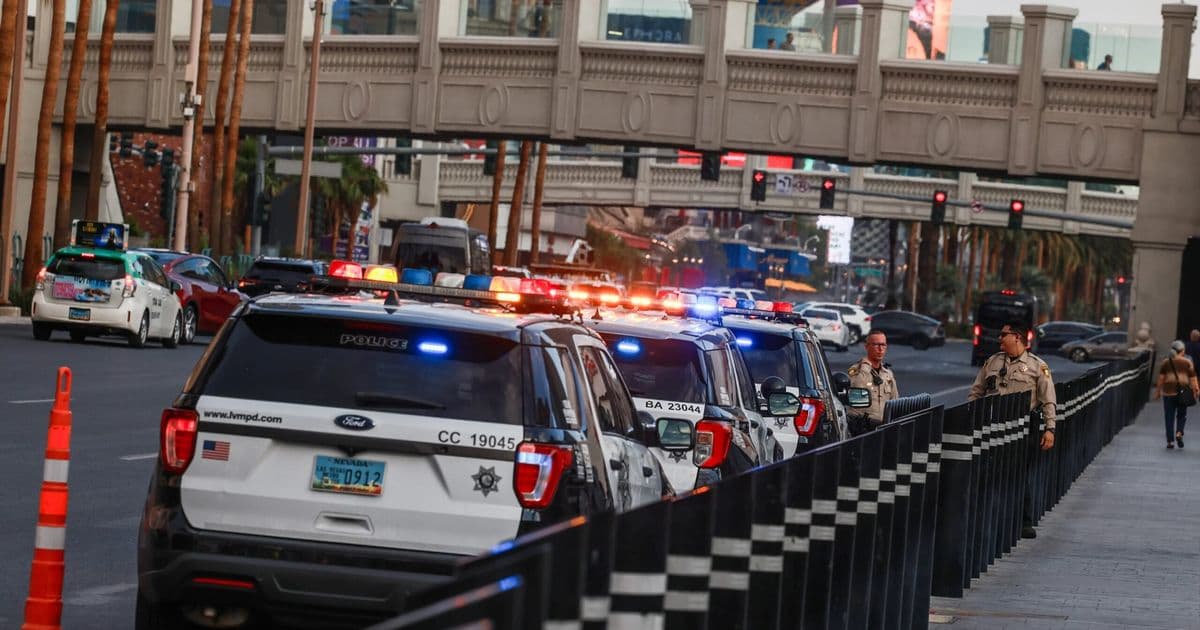
Las Vegas police have built a massive license plate reader network using private foundation money, allowing them to bypass public input and democratic oversight on controversial surveillance technology.
Las Vegas police have quietly built one of the nation's most extensive automated license plate reader networks, funded entirely by private donations that allow them to sidestep public oversight and democratic debate over the controversial surveillance technology.
Unlike police departments across the country that must seek public approval and funding for surveillance tools, the Las Vegas Metropolitan Police Department has constructed its network using money from the Horowitz Family Foundation, a philanthropy group connected to venture capitalist Ben Horowitz of Andreessen Horowitz.
This arrangement has enabled Metro to avoid the public meetings, city council debates, and community input that typically accompany the deployment of such surveillance technology. "It's a short circuit of the democratic process," said Jay Stanley, a lawyer with the American Civil Liberties Union who specializes in technology and civil liberties.
How the Technology Works
The AI-powered cameras scan license plates and vehicle details including make, model, and color, feeding this information into a national database that police can search to track vehicles across jurisdictions. Flock Security operates over 80,000 of these cameras nationwide, with Metro alone operating approximately 200 on city or county infrastructure.
Since late 2023, Las Vegas police have conducted more than 23,000 searches of vehicles using this system, according to data compiled by Have I Been Flocked, a website that tracks public audit logs of Flock data.
Privacy Concerns and Potential for Abuse
Privacy advocates warn the technology could be used to track undocumented immigrants, political protesters, and people seeking abortions across state lines. In one Texas case, police used Flock technology to conduct a nationwide search for a woman who self-induced an abortion.
"This could be ripe for abuse by ICE, but it could also be ripe for abuse by other government entities," said Athar Haseebullah, executive director of the ACLU of Nevada.
The technology has already been misused elsewhere. A Kansas police chief tracked his ex-girlfriend 228 times in four months using Flock data. An officer in South Carolina monitored his wife whom he suspected of infidelity.
The Private Funding Advantage
Most of Metro's cameras were purchased with money from the Horowitz Family Foundation, which donated nearly $1.9 million for license plate readers and another $2.47 million for supporting software as recently as October 2025. Because these donations flow through a private foundation rather than directly to the police department, they're not subject to Nevada's open meeting laws.
This means Metro doesn't have to hold public meetings to discuss the technology or its use, unlike other cities where Flock deployments are regularly debated in city council meetings. The Clark County Commission never discussed the Horowitz donations or the technology's use in 2025 meeting minutes.
Transparency Gaps
While some municipalities in Clark County maintain public dashboards showing Flock activity—Las Vegas reports about 185,000 license plates picked up monthly with 22 cameras in use—Metro's policy is not publicly available online. The department's agreement with Flock allows the company to retain all rights to recordings and data and use them "for any purpose" at its discretion.
Metro policy states that data won't be retained based on citizenship, social views, race, or other protected classifications, and misuse can result in termination. However, a former Metro officer who spoke anonymously expressed concern about the lack of transparency: "If you look around the country where license plate readers are being used, there's some kind of public meeting, there's some kind of public process. What's happening here is on a very large scale — they're putting out surveillance technology — and there's no public disclosure."
Broader Implications
The Horowitz Family Foundation has also donated drones and Tesla Cybertrucks to Metro police. Felicia Horowitz, who leads the foundation, has said she's focused on "creating the best community in America" in Las Vegas and combating crime to keep citizens safe.
Critics suggest the donations represent a strategy called "penetration pricing," where companies provide free or reduced products to hook consumers before charging them. "There's no question that there's a financial interest in them proving that the Flock technology works in Las Vegas so that they can sell it to other places," said Andrew Ferguson, a law professor researching tech and police surveillance.
The former officer expressed concern about what happens when private funding runs out: "Once you start relying on a certain type of policing, it's going to be hard to switch over, and then who will foot the bill?"
The surveillance network raises fundamental questions about democratic oversight in an era when private money can fund public policing tools without public input. As Ferguson noted about Las Vegas's party culture: "Things are happening in Vegas that are not going to stay in Vegas. They're going to be broadcast through Flock."
Comments
Please log in or register to join the discussion