AWS's latest AI model optimizations, agent ecosystem enhancements, and specialized infrastructure offerings create new strategic considerations for enterprise cloud architecture and multi-cloud planning.
Recent AWS announcements present significant developments in cloud infrastructure and AI capabilities that warrant strategic evaluation against competing platforms. These updates influence cost structures, migration pathways, and architectural decisions for enterprises operating in multi-cloud environments.
Frontier AI Models at Reduced Costs
The introduction of Claude Sonnet 4.6 in Amazon Bedrock delivers performance approaching Anthropic's premium Opus 4.6 model at approximately 40% lower cost. This positions AWS favorably against Azure's OpenAI Service pricing tiers and Google Cloud's Gemini Pro models for high-volume coding and knowledge work. Enterprises handling large-scale document processing or automated code generation can achieve near-frontier results without Opus-tier expenses. Unlike Google's Gemini 1.5 Pro which emphasizes long-context windows, Claude Sonnet 4.6 prioritizes rapid task completion—a trade-off developers should evaluate against workload requirements.
Specialized Infrastructure for Performance-Sensitive Workloads
The EC2 Hpc8a instances featuring 5th Gen AMD EPYC processors and 300 Gbps networking demonstrate AWS's focus on compute-intensive scenarios. Compared to Azure's HX-series and Google Cloud's A3 VMs, Hpc8a offers 40% higher performance for engineering simulations and tightly coupled HPC workloads. However, organizations running fluid dynamics or financial modeling applications should benchmark against Azure's NVIDIA GPU-accelerated options where parallel processing provides alternative advantages. The new nested virtualization capability further enables specialized use cases like automotive hardware simulation—filling a gap in Azure's nested virtualization support which currently focuses primarily on development/test scenarios.
AI Agent Ecosystem Maturity
Kiro's expansion into AWS GovCloud (US) Regions addresses a critical gap in regulated industries where competing agent frameworks like Microsoft Copilot and Google Duet AI lack equivalent FedRAMP High environments. The open-source Agent Plugins for AWS enable infrastructure-as-code generation directly from coding agents, contrasting with Azure's closed-system approach. AWS DevOps Agent's reported 86% root cause identification rate for production incidents suggests competitive advantage in operational AI—though enterprises should verify these claims against their incident management workflows.
Security and Cost Optimization Shifts
Amazon Aurora's new server-side encryption by default using AWS-owned keys provides transparent security comparable to Azure SQL Database's Always Encrypted feature. While eliminating configuration overhead, organizations requiring customer-managed keys must still implement manual settings. SageMaker Inference now allows granular configuration for custom Nova models—enabling cost/performance optimization that rivals Google Vertex AI's model deployment controls. This is particularly valuable for AI workloads where instance selection directly impacts operational expenses.
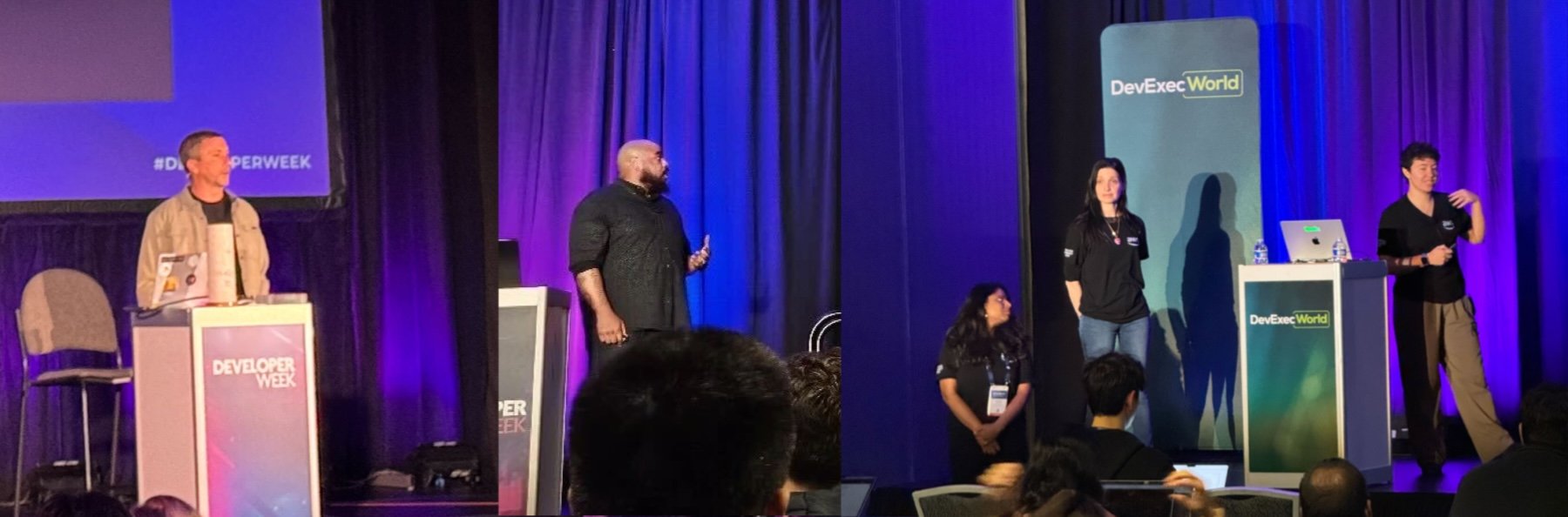 AWS developer events showcase growing agent development ecosystem
Strategic Implications
- Cost Arbitrage Opportunities: Claude Sonnet 4.6 enables shifting high-volume AI workloads from premium models, potentially reducing annual inference costs by 25-30% for qualifying use cases
- Regulatory Alignment: Kiro in GovCloud provides public sector organizations a migration path from less compliant AI agent platforms
- HPC Workload Placement: EC2 Hpc8a instances warrant reevaluation of where tightly coupled workloads reside in multi-cloud architectures
- Agent Development: AWS's plugin approach offers more extensibility than closed alternatives, but requires deeper technical investment
As AWS accelerates AI and infrastructure specialization, enterprises should:
- Conduct comparative benchmarking of Claude Sonnet against Azure/GCP models for specific workload profiles
- Evaluate HPC workload placement against competing platforms every 6 months
- Audit encryption and compliance requirements before migrating regulated workloads to Kiro
- Develop skill sets around AWS's agent frameworks to leverage their open ecosystem advantage
The evolving landscape underscores that cloud strategy must continuously adapt to shifting technical capabilities and cost structures across providers.
Comments
Please log in or register to join the discussion