A study finds that standard LED lighting, with its limited spectrum from 350-650nm, suppresses mitochondrial function and reduces color contrast sensitivity. Supplementing this environment with incandescent light (400-1500nm+) for two weeks led to a 25% improvement in visual performance, with benefits lasting for at least six months after the supplemental light was removed.
Life evolved under the full spectrum of sunlight, from ultraviolet to infrared (300–2500 nm). This balanced light shaped our physiology and metabolism. Yet, the modern built environment is increasingly dominated by a narrow slice of that spectrum: the 350–650 nm output of light-emitting diodes (LEDs). A new study in Scientific Reports suggests this shift is not benign, directly undermining human visual performance by disrupting mitochondrial function, but also points to a simple, economic fix.
The core issue is mitochondrial sensitivity to light. Mitochondria, the cellular power plants that regulate metabolism, aging, and disease, are light-sensitive. The dominant blue wavelengths in LEDs (420–450 nm) have been shown in animal models to suppress mitochondrial respiration, reducing ATP production. This short-wavelength dominance is linked to increased body weight and reduced lifespan in fruit flies. Conversely, longer wavelengths in the deep red and infrared spectrum (670–900 nm), which are absent from standard LEDs but present in sunlight and incandescent bulbs, increase mitochondrial respiration and ATP production, particularly in aging or diseased systems.
The retina, with its exceptionally high metabolic rate and mitochondrial concentration, is a critical frontline for this effect. The study's authors, Edward M. Barrett and Glen Jeffery, hypothesized that the restricted spectrum of LED lighting undermines retinal mitochondrial function, impairing vision. To test this, they moved from the lab to a real-world office environment.
The experiment was conducted in a deep, windowless section of a University College London building. The space was illuminated exclusively by overhead LED arrays (4000K, 1000 lux) with no access to daylight. The building's windows were even fitted with an infrared-blocking film, creating a controlled environment devoid of the longer wavelengths found in nature.
For two weeks, one group of subjects had their workspace supplemented with standard 60W incandescent desk lamps. These lamps provided the missing spectral component, extending from 350 nm to over 1700 nm, with a significant infrared output. A control group continued working under LED-only lighting.
The researchers measured color contrast sensitivity using a test called ChromaTest, which determines the threshold at which subjects can identify letters against a noisy background in both red (protan) and blue (tritan) visual axes. This metric is a direct indicator of visual processing efficiency.
The results were clear. After two weeks of exposure to the broader-spectrum incandescent light, all experimental subjects showed a significant improvement in color contrast sensitivity—approximately 25%—across both visual axes. This balanced improvement is notable; previous studies using only a specific 670 nm red light showed improvements biased toward the tritan (blue) axis.
Most strikingly, the benefits were durable. When the incandescent lamps were removed, the visual improvements persisted, showing no significant decline at retesting points four and six weeks later. In contrast, the control group, working under LED-only light, showed no change in visual performance over the same period. This suggests that the broader spectrum of incandescent light induces a more profound and lasting physiological change than a single wavelength, possibly by upregulating mitochondrial protein synthesis rather than just temporarily increasing enzyme activity.
The implications extend beyond visual acuity. The study notes that mitochondrial changes are systemic. Light exposure in one area can trigger shifts in serum cytokine expression and impact metabolism elsewhere in the body. For instance, prior research has shown that 670 nm light exposure can lower blood glucose levels in humans. The absence of these longer wavelengths in standard LED lighting, therefore, may have wider negative health impacts, particularly for the elderly or clinically debilitated populations in environments dominated by such lighting.
The study presents a paradox for sustainable design. Incandescent bulbs are being phased out globally for their energy inefficiency, yet they provide the full-spectrum light our physiology evolved under. The authors suggest that simply adding multiple, closely-spaced infrared LEDs to current fixtures may not replicate the smooth, continuous spectrum of incandescent light or sunlight, and could negate energy savings. A more practical interim solution might be the use of halogen bulbs (a type of incandescent) run at lower voltages, which improves longevity and shifts the spectral peak toward longer wavelengths while saving some energy.
The research underscores that lighting design has focused almost exclusively on the visible spectrum for human perception and energy efficiency, ignoring the physiological impact of the missing infrared wavelengths. As the built environment transitions entirely to LEDs, this study argues for a re-evaluation, suggesting that the most economical route to improved public health in offices, hospitals, and care homes might be as simple as changing the light bulbs.
Relevant Links:
- Full Study: LED lighting (350-650nm) undermines human visual performance unless supplemented by wider spectra (400-1500nm+) like daylight
- Related Research: Weeklong improved colour contrasts sensitivity after single 670 nm exposures
- Background: Mitochondrial decline in the ageing old world primate retina
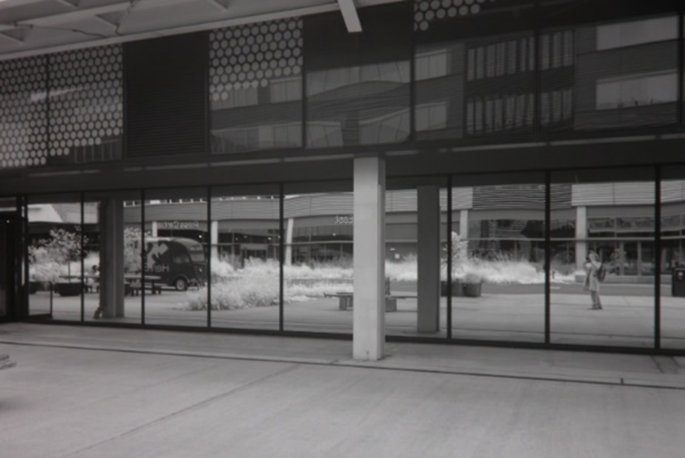 Fig. 1: Infrared photograph of the front of the Here East building. The glazing reflects infrared light away, resulting in the mirror-like appearance of the windows.
 Fig. 2: Infrared photograph taken from inside the Here East building, showing infrared light only entering when the front doors are opened. The interior space appears otherwise completely dark as infrared light is not passed by the glazing.
{{IMAGE:3}} Fig. 3: The work environment in Here East where the LED lighting was supplemented with incandescent units. There was no natural light, and all lighting was in the form of overhead LEDs.
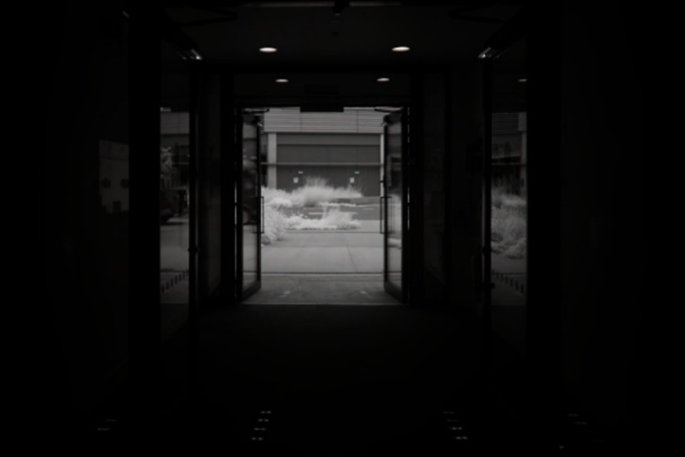 Fig. 4: Spectral profiles of lighting. The light generated by the LEDs (blue) runs from approximately 350 nm to 720 nm. The incandescent lamp (black and red) extends from approximately 350 nm to > 1700 nm.
 Fig. 5: Horizontal illuminance was measured at nine locations in the workshop area, showing consistent spectral distribution throughout the space.
Comments
Please log in or register to join the discussion