
Google's AI coding tool faces criticism as unclear quotas and higher costs frustrate users
Google's Antigravity agentic AI coding tool is facing significant backlash from developers following recent pricing changes that have left many users frustrated with unclear quotas and unexpectedly high costs.
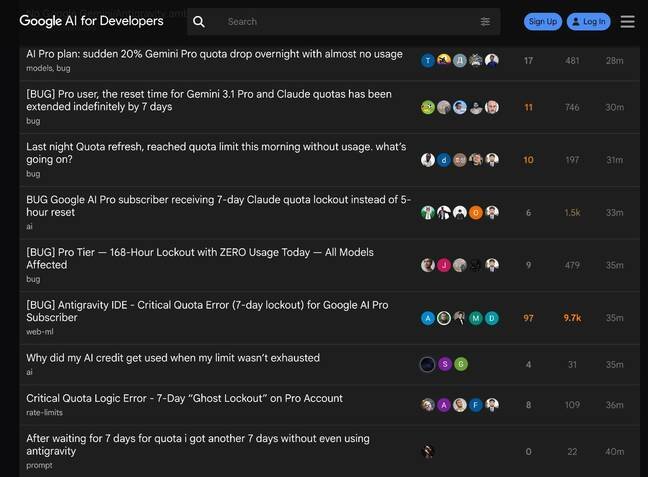
Developers in Google's AI forum have only one thing on their mind: quotas
The controversy centers on Google's recent announcement that it's "evolving" its AI plans to give developers more control over what they can build. The company introduced a new credit system where AI credits can now be used for Antigravity, with subscriptions providing some built-in credits while additional credits are available for purchase at $25 for 2,500 credits.
However, the lack of transparency about what a credit is worth when used with Antigravity has left developers confused and angry. Many users with AI Pro ($20.00 per month) subscriptions report that their previously "high, generous quota, refreshed every five hours" has effectively disappeared, with weekly waits between refreshes instead.
A developer tracking their token usage on Reddit posted that before January they could use over 300 million input / 1-2 million output tokens per week for Gemini Pro models, but this week hit weekly rate limits at less than 9 million input / 200 thousand output tokens.
Antigravity supports five large language models: Gemini 3.1 Pro (with High and Low options), Gemini 3 Flash, Anthropic Claude Sonnet 4.6 or Claude Opus 4.6, and OpenAI's GPT-OSS 120B. Google now positions the Pro plan for "hobbyists, students and developers who live in the IDE" while pointing professional developers toward the AI Ultra plan at $249.99 per month for "consistent, high-volume access to our most complex models."
The pricing confusion isn't entirely new. When Antigravity launched in preview in November 2025, pricing wasn't announced initially. Google soon directed users to its Google AI Pro and Ultra subscriptions using vague terms like "high," "generous," and "meaningful" to describe quota limits, making it difficult for users to understand actual limits and how they might change.
One developer complained last month about "ghost-drains" on their limits, demanding "a transparent explanation of how these Antigravity quotas are calculated and an immediate fix for these ghost-drains on our limits."
The pricing challenges reflect broader difficulties in the AI industry. AI processing makes intensive use of compute resources, and the amount of resources used by any one prompt is unpredictable, making pricing a complex problem for both users and providers. There's also uncertainty about how much providers are willing to subsidize users while building market share.
We've reached out to Google for clarification on what has changed and what an AI credit buys when used with Antigravity, but the company has not yet responded. The situation highlights the ongoing challenges in the AI industry as companies navigate the difficult balance between providing useful tools and maintaining sustainable business models.
Comments
Please log in or register to join the discussion