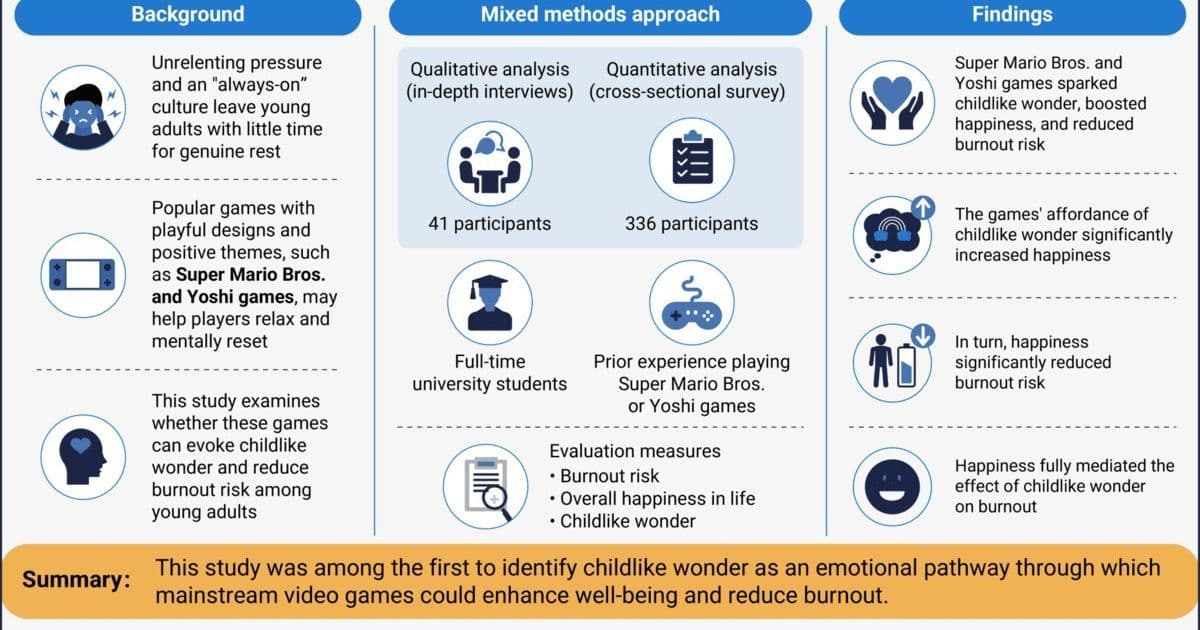
A mixed‑methods study shows that playing Super Mario Bros. and Yoshi can rekindle childlike wonder, boost overall happiness, and cut burnout risk among university students. The research uncovers a novel emotional pathway—childlike wonder—that links everyday gameplay to improved mental well‑being.
Leveling Up Burnout: How Nintendo’s Classic Games Restore Youthful Wonder and Reduce Stress
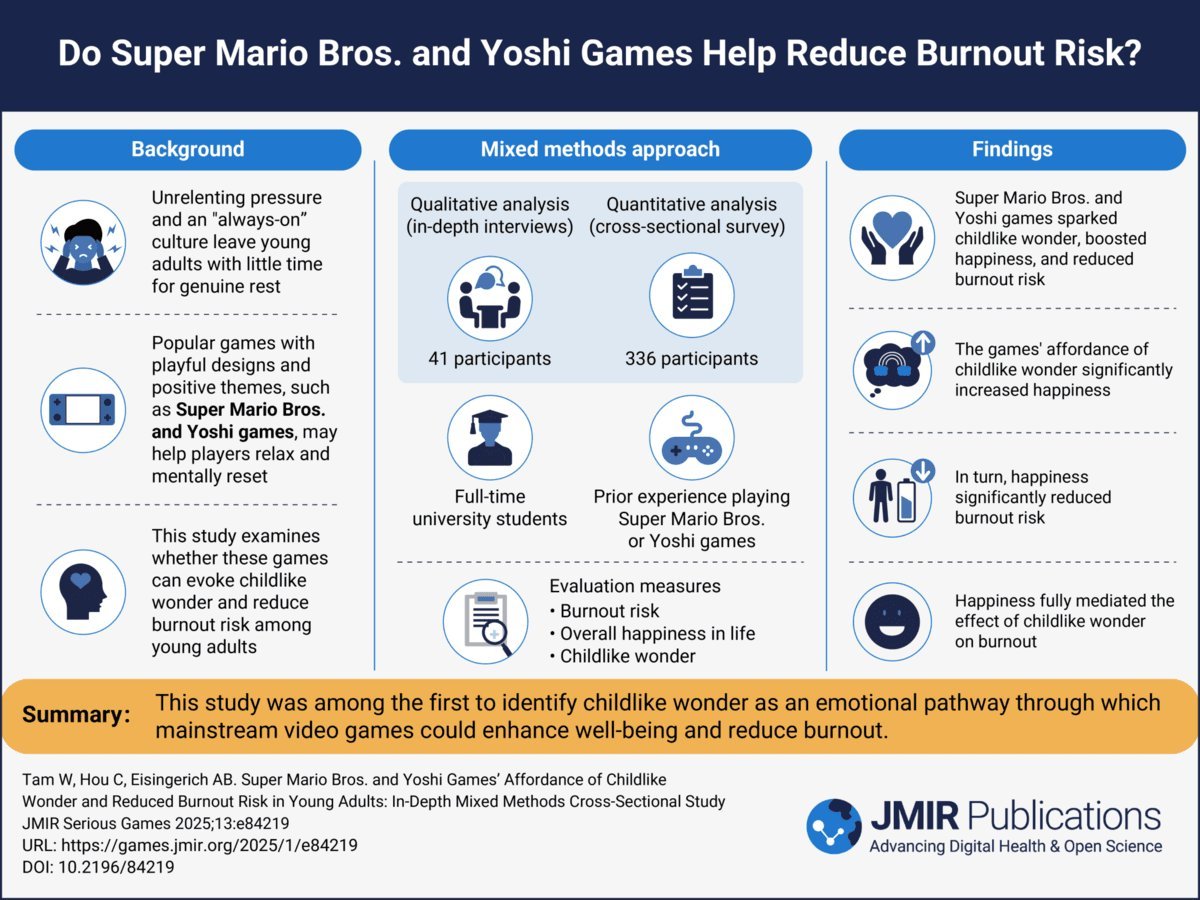
In an era where the “always‑on” culture leaves little room for genuine rest, a new study published in JMIR Serious Games turns to one of the most beloved video‑game franchises to explore a counterintuitive antidote to burnout. Researchers from Imperial College London and Kyushu Sangyo University conducted a mixed‑methods investigation (Winze Tam et al., 2025) that combined in‑depth interviews with 41 university students and a cross‑sectional survey of 336 players. The focus was on two iconic titles—Super Mario Bros. and Yoshi—and their capacity to foster childlike wonder, a state of curiosity and delight that may serve as a psychological buffer against exhaustion and cynicism.
Theoretical backdrop
While prior work has linked video‑game play to mood regulation and stress relief (e.g., Hu et al., 2025; Kowal et al., 2021), little research has examined how mainstream entertainment games might act as restorative micro‑environments. The authors frame childlike wonder as distinct from nostalgia or escapism, arguing that it engages players’ sense of discovery and playfulness in a low‑pressure setting. This aligns with Self‑Determination Theory’s emphasis on autonomy, competence, and relatedness, but extends it by positioning wonder as a conduit to sustained happiness and reduced burnout.
Methodology at a glance
| Study | Sample | Design | Key Measures |
|---|---|---|---|
| Qualitative | 41 full‑time students (mean age 22.5 y) | 25‑40 min semi‑structured interviews | Childlike wonder, happiness, burnout risk |
| Quantitative | 336 full‑time students | Cross‑sectional survey | Childlike wonder, happiness, burnout risk (validated scales) |
The survey employed a 7‑point Likert scale and confirmed robust psychometric properties (α ≥ 0.83, CR ≥ 0.88). Mediation analysis (PROCESS model 4) revealed that childlike wonder positively predicted happiness (b = 0.30, p < 0.001), which in turn significantly lowered burnout risk (b = –0.48, p < 0.001). The direct effect of wonder on burnout became non‑significant, indicating full mediation.
“Playing Yoshi transports me back in time… I see myself as this kid again, wondering about the possibilities and beauty of this world.” – Respondent 8
Visualizing the experience
The games’ design elements—bright color palettes, upbeat music, and predictable, non‑violent mechanics—create an environment that feels “safe, warm, and inviting” (Figure 3). The authors illustrate how these aesthetics serve as a digital vacation for the mind.
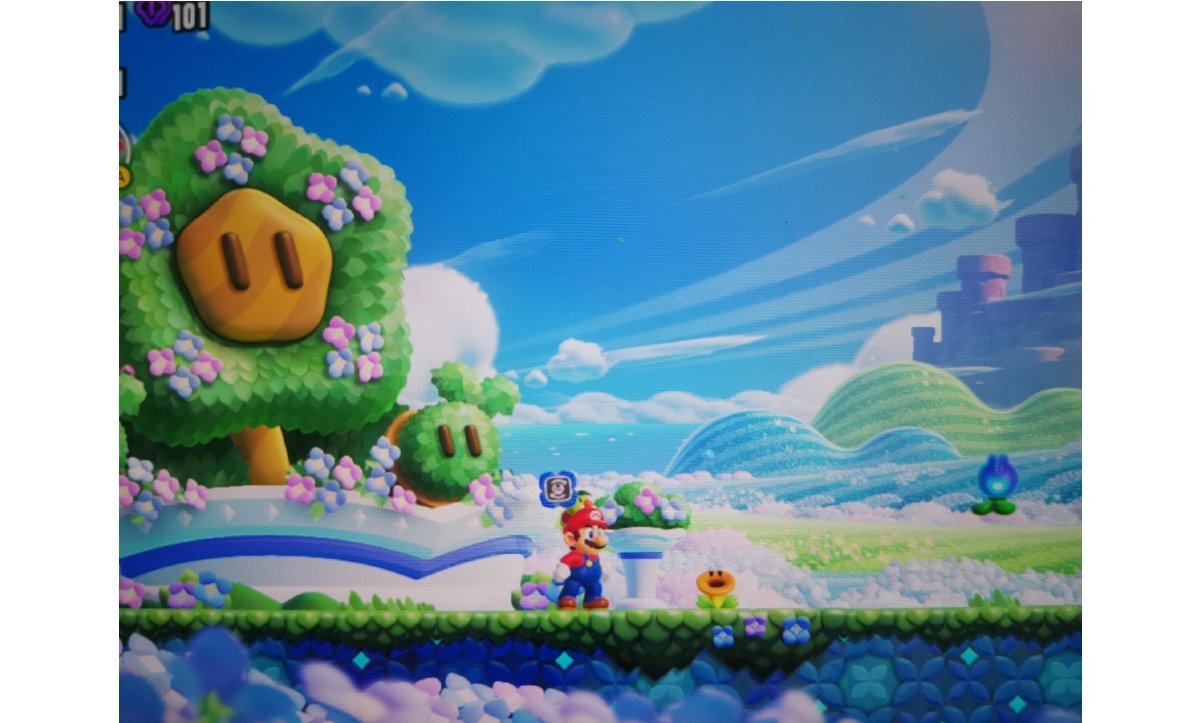
In Super Mario Bros. Wonder, the cheerful landscape (Figure 1) and the playful interaction with enemies (Figure 2) reinforce the sense of joy and curiosity.

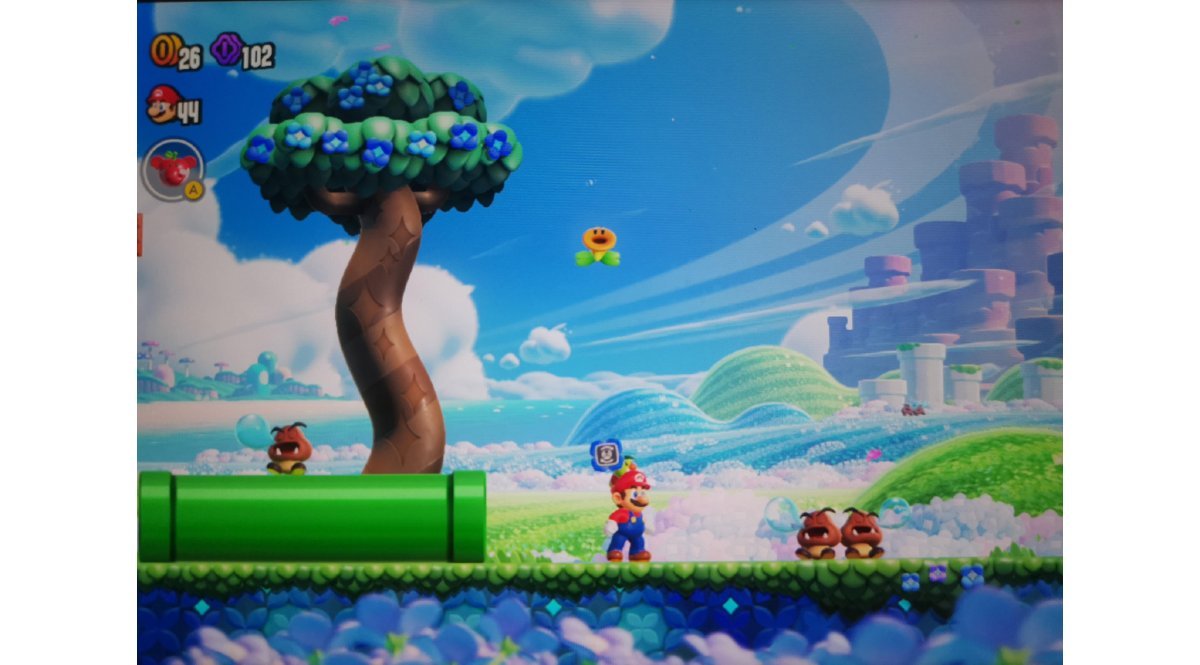
These visuals are not merely decorative; they embody the study’s assertion that aesthetic design can directly influence affective states.
Implications for practice
- Game designers: Incorporate low‑pressure mechanics and positive feedback loops to cultivate wonder, thereby enhancing players’ well‑being.
- Educators: Use short, restorative gameplay sessions to counteract academic burnout, especially during high‑stress periods.
- Mental‑health professionals: Consider everyday play as a complementary tool for resilience building, acknowledging that moderate, voluntary engagement can mitigate burnout symptoms.
The study cautions that gameplay should not replace systemic interventions addressing workload or organizational culture. Instead, it offers a personal, accessible buffer that can be integrated into daily routines.
Future research directions
- Longitudinal studies to assess whether sustained gameplay leads to measurable reductions in clinically diagnosed burnout.
- Comparative analyses across age groups and cultural contexts to evaluate the generalizability of the childlike wonder pathway.
- Experimental designs that manipulate specific game elements (e.g., difficulty, narrative clarity) to isolate causal mechanisms.
Closing thoughts
Winze Tam et al. (2025) illuminate a fresh angle on the intersection of gaming and mental health: that a well‑crafted, low‑stakes platformer can reignite curiosity, elevate happiness, and dampen burnout. In a world where digital overload is the norm, these findings suggest that stepping into a pixelated kingdom may be a surprisingly effective way to reset the mind.
“Nintendo’s Super Mario Bros. and Yoshi… are more than entertainment; they are restorative digital spaces that rekindle wonder and foster resilience.” – Study authors
Source: Winze Tam, Congcong Hou, Andreas Benedikt Eisingerich (2025). The influence of childlike wonder in popular video games on burnout risk among young adults. JMIR Serious Games, 13:e84219. https://games.jmir.org/2025/1/e84219/
Images:
- – Main article image
- – Coins of joy illustration
- – Cheerful landscape in Super Mario Bros. Wonder
- – Super Mario facing sleeping enemies
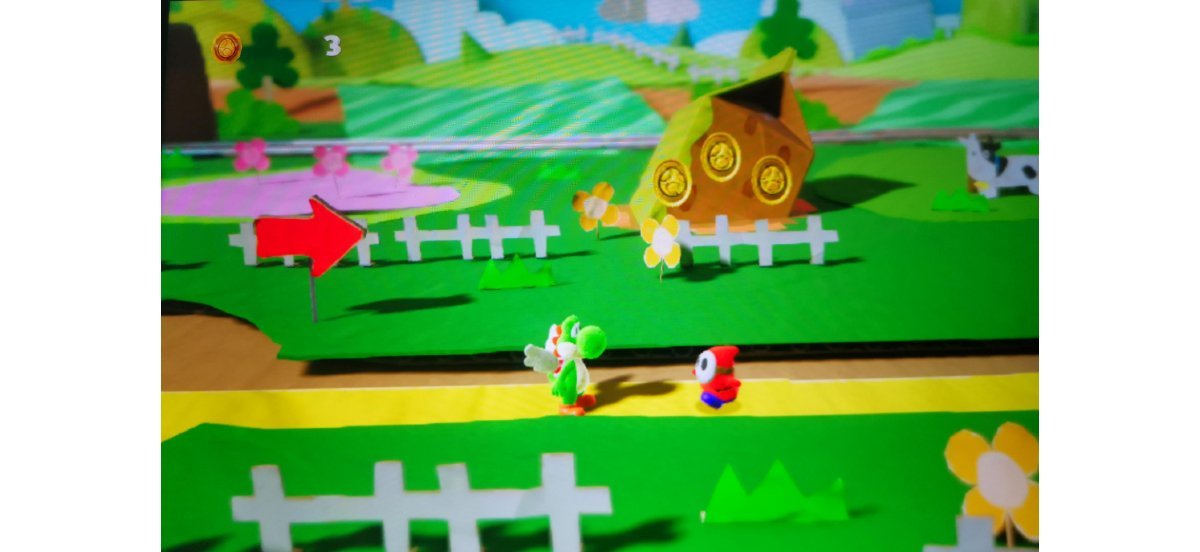 – Bright environment of Yoshi’s Crafted World
Comments
Please log in or register to join the discussion