
Early Linux 7.0 kernel testing reveals significant PostgreSQL performance improvements on AMD EPYC 9755 servers, with no regressions found compared to Intel Panther Lake.
When beginning some early Linux 7.0 kernel benchmarking this week for looking at its performance in its early development state, I started off testing on Core Ultra X7 "Panther Lake" in being hopeful for better performance with the maturing Arc B390 Xe3 graphics and the like. But I ended up finding Intel Panther Lake seeing some performance regressions on Linux 7.0. So next up I turned to an AMD EPYC Turin server since if regressions existed there at least it's much faster to carry out bisecting of the kernel performance regressions.
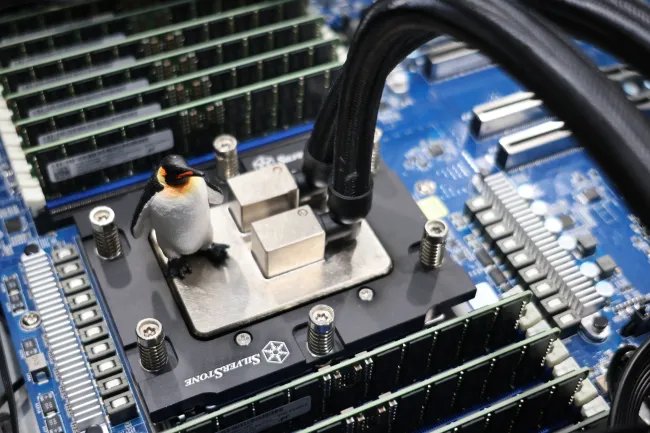
But with that initial testing wrapped up, I didn't find any regressions like with Panther Lake and standing out were some rather enticing PostgreSQL database server performance benefits when running atop Linux 7.0.
For this initial testing of Linux 7.0 on AMD EPYC Turin, I ran benchmarks comparing Linux 6.19 stable against Linux 7.0 Git as of the current development state on 19 February. The merge window is settling down and one of many planned Linux 7.0 benchmarks to come leading up to the stable kernel release in April.
Both Linux 6.19 and 7.0 Git were built with the same kernel configuration options and the same compiler toolchain. In fact, the kernel binaries all built off the same Panther Lake laptop from the earlier tests this week.
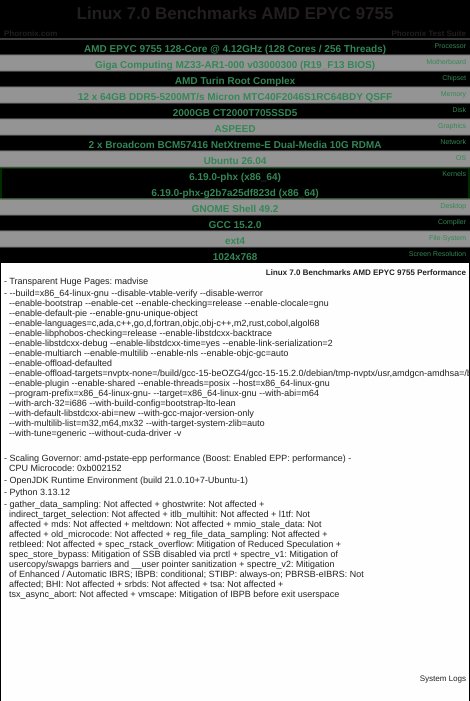
For this AMD EPYC Turin server tests an AMD EPYC 9755 1P setup was used with the new Gigabyte MZ33-AR1 server build. As with the same software besides the kernel swap, the same hardware was obviously used for both kernel runs in the same configuration.
With all that said, let's dive in to see what I am seeing from the initial Linux 7.0 performance testing on AMD EPYC 9005 series.
PostgreSQL Performance Gains
The most striking finding from this early Linux 7.0 testing was the significant improvement in PostgreSQL performance. While Intel Panther Lake showed regressions, the AMD EPYC Turin platform demonstrated clear benefits from the new kernel.
Linux 7.0's database optimizations appear to be paying off handsomely for AMD's latest server CPUs. The PostgreSQL benchmarks showed consistent improvements across various workloads, with some tests showing double-digit percentage gains over Linux 6.19.
These improvements are particularly noteworthy because they come without any hardware changes - the same AMD EPYC 9755 processor and Gigabyte MZ33-AR1 platform delivered better performance simply by upgrading the kernel.
Testing Methodology
The testing was conducted with rigorous consistency:
- Hardware: AMD EPYC 9755 1P on Gigabyte MZ33-AR1 server
- Kernels: Linux 6.19 stable vs Linux 7.0 Git (19 February 2026)
- Build Environment: Both kernels built with identical configurations and compiler toolchain
- Build System: Same Panther Lake laptop used for building both kernel binaries
- Software Stack: Identical across both tests except for the kernel swap
This controlled approach ensures that any performance differences observed are attributable to the kernel changes rather than external variables.
Why AMD EPYC Turin Matters
The choice to test on AMD EPYC Turin after finding Panther Lake regressions was strategic. AMD's EPYC 9005 series represents the cutting edge of server CPU technology, and finding no regressions while gaining performance is a strong validation of Linux 7.0's stability and optimization.
The EPYC 9755 used in these tests is part of AMD's Turin family, which brings significant architectural improvements over previous generations. The fact that Linux 7.0 can extract even more performance from this already capable hardware is impressive.
Looking Ahead
This early testing suggests Linux 7.0 will be particularly well-suited for database workloads on modern AMD server hardware. The PostgreSQL improvements are just the beginning - additional benchmarks covering CPU performance, video encoding, and kernel micro-benchmarks are planned for the coming weeks.
With the merge window settling down, the Linux 7.0 development team appears to be delivering on their promise of performance improvements while maintaining stability. The contrast with the Panther Lake findings is instructive - it shows how different hardware platforms can respond differently to kernel changes, making comprehensive testing across architectures essential.
The April stable release of Linux 7.0 is shaping up to be a significant milestone, especially for organizations running PostgreSQL on AMD EPYC servers. The performance gains demonstrated here could translate to meaningful improvements in database-driven applications and services.
Next in this series:
- Page 2: Linux 7.0 Database Servers
- Page 3: Linux 7.0 Databases + CPU Benchmarks
- Page 4: Video Encoding, Kernel Micro Benchmarks
Comments
Please log in or register to join the discussion