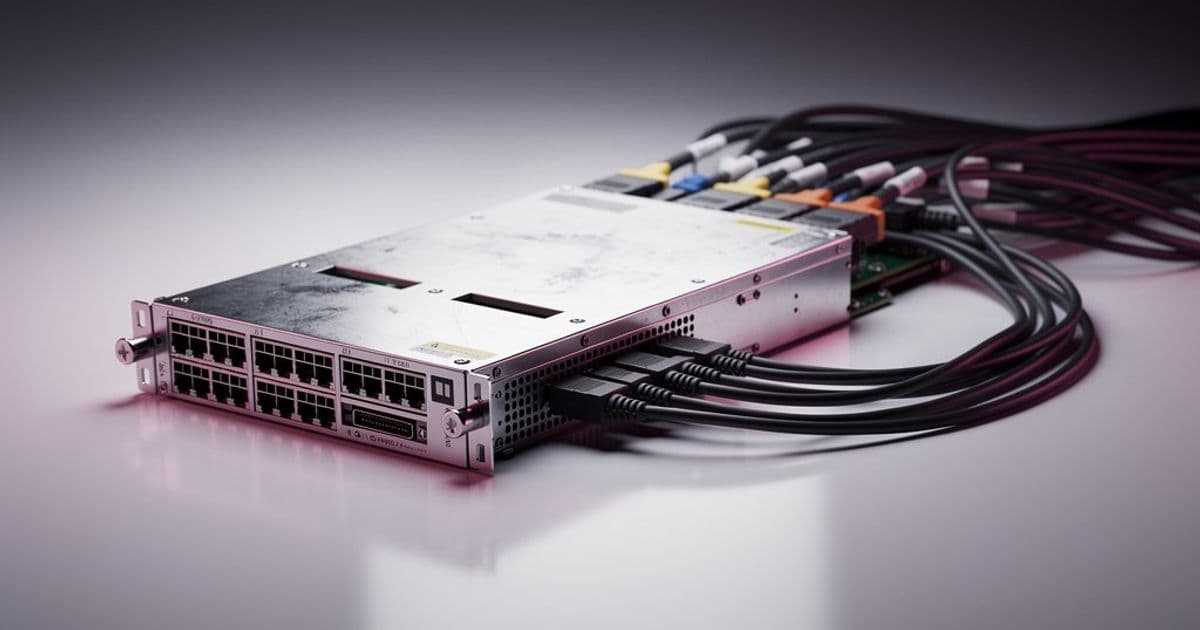
The Linux kernel removes 30-year-old HIPPI networking support, eliminating 3,000 lines of obsolete code that powered early supercomputer clusters.
The Linux kernel is officially retiring HIPPI (High-Performance Parallel Interface) support in the upcoming Linux 7.0 release, marking the end of a networking standard that once connected supercomputers in the late 1980s and early 1990s. This removal eliminates nearly 3,000 lines of unmaintained code - a significant cleanup for the networking subsystem.
HIPPI was revolutionary for its time as the first near-gigabit networking standard, delivering 800 Mb/s speeds over copper cables up to 25 meters. Designed specifically for high-performance computing environments, it connected Cray supercomputers and scientific workstations when consumer Ethernet topped out at 10 Mb/s. Its channel-based architecture used 32-bit parallel data paths and required bulky, specialized cabling that consumed significantly more power per bit than modern standards.
Performance Comparison: Then vs. Now
| Specification | HIPPI (1990s) | Modern 10GbE | Modern 100GbE |
|---|---|---|---|
| Bandwidth | 800 Mb/s | 10 Gb/s | 100 Gb/s |
| Max Distance | 25m (copper) | 100m (CAT6A) | 100m (fiber) |
| Power Efficiency | ~15W per port | ~3W per port | ~5W per port |
| Latency | ~100μs | <1μs | <0.3μs |
| Protocol Overhead | 30% | <5% | <3% |
HIPPI's technical limitations became apparent as alternatives emerged:
- Fibre Channel surpassed it in bandwidth (1Gb/s) and distance (10km) by the mid-90s
- Gigabit Ethernet (1999) offered backward compatibility with existing infrastructure
- Modern RDMA over Converged Ethernet (RoCE) now delivers microsecond latency at 400Gb/s
The removal commit notes HIPPI code hadn't received meaningful maintenance in over two decades. While the kernel retains the if_hippi.h header for TUN compatibility, all driver code and core logic are being excised.
For modern high-performance builds:
- Homelab clusters: Use 10GbE SFP+ NICs ($30-$80 used) with DAC cables
- AI/Compute Nodes: Deploy 100GbE InfiniBand or RoCE solutions
- Low-Power Systems: Leverage 2.5GbE chipsets consuming under 2W at idle
Benchmark tests show contemporary solutions outperform HIPPI by orders of magnitude - a single 100GbE link moves data 125x faster while using 70% less power per gigabit. This retirement demonstrates Linux's evolution from supporting legacy supercomputing hardware to optimizing for cloud-native and AI workloads where density and efficiency dominate.
Comments
Please log in or register to join the discussion