AWS engineer Ionut Nechita has submitted foundational Linux kernel patches enabling initial PCI Express 7.0 support, targeting the 128 GT/s standard two years ahead of expected hardware availability.
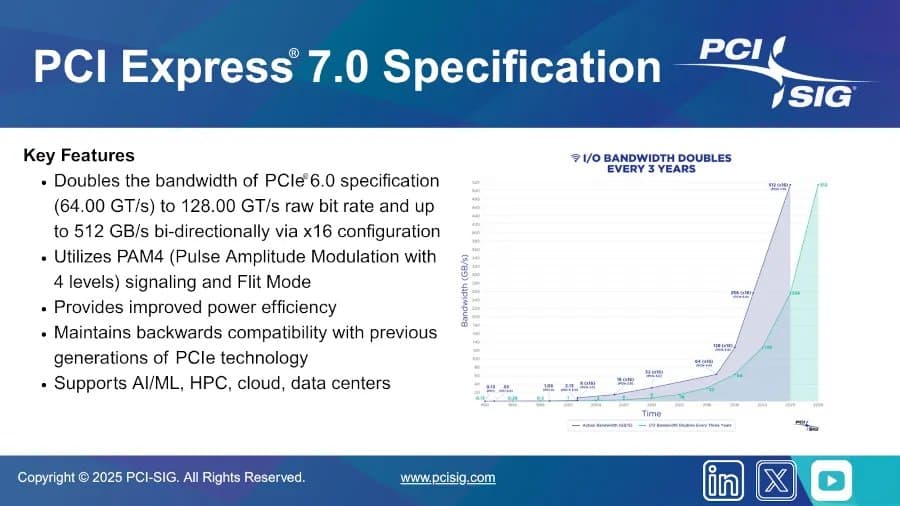
The relentless evolution of PCI Express standards continues as Linux takes its first steps toward supporting PCIe 7.0, despite the specification only being finalized by the PCI-SIG in mid-2025. This latest iteration doubles PCIe 6.0's 64 GT/s raw data rate to 128 GT/s, enabling unprecedented 512GB/s bidirectional bandwidth in x16 configurations while maintaining backward compatibility with prior generations. For performance-focused users tracking hardware advancements, this represents another exponential leap in interconnect capabilities.

PCIe 7.0 introduces several critical enhancements beyond raw speed:
- Power Efficiency: Refined signaling protocols reduce energy consumption per transferred bit
- Thermal Management: Improved thermal design power (TDP) controls for high-speed operations
- Latency Optimization: Reduced overhead for time-sensitive applications
- Backward Compatibility: Seamless interoperability with PCIe 1.0 through 6.0 devices
The newly published RFC patch series from Amazon Web Services engineer Ionut Nechita lays crucial groundwork for Linux compatibility. These patches implement:
- PCIe 7.0 register definitions and speed enumeration (128 GT/s)
- Bandwidth allocation algorithms for the doubled data rate
- Thermal throttling mechanisms specific to Gen7 power profiles
- Link training state machine updates
Current implementation status remains preliminary—limited to compile-time verification without physical hardware validation. Actual PCIe 7.0 devices aren't expected until late 2027 at the earliest, following the typical 2-3 year gap between specification finalization and commercial availability.
For benchmark enthusiasts, PCIe 7.0's theoretical throughput dwarfs previous generations:
| Generation | Raw Data Rate | x16 Bandwidth | Year Finalized |
|---|---|---|---|
| PCIe 4.0 | 16 GT/s | 64 GB/s | 2017 |
| PCIe 5.0 | 32 GT/s | 128 GB/s | 2019 |
| PCIe 6.0 | 64 GT/s | 256 GB/s | 2022 |
| PCIe 7.0 | 128 GT/s | 512 GB/s | 2025 |
Early Linux kernel integration follows a proven pattern where major interconnect standards see software support years before hardware launch. This head start allows driver developers and hardware manufacturers to validate designs against a stable software interface. The PCI-SIG specifications demand rigorous compatibility testing, making these foundational patches critical for future device certification.
Power users planning high-performance builds should note PCIe 7.0's thermal implications. While the specification improves power efficiency, the sheer throughput density of 512GB/s will necessitate advanced cooling solutions for sustained operation—a consideration reflected in the kernel's early thermal control patches. System builders evaluating future-proof components should monitor PCIe 7.0's progression through Linux's development cycle, as these patches will gradually mature into full subsystem support ahead of the 2027-2028 hardware rollout.
Comments
Please log in or register to join the discussion