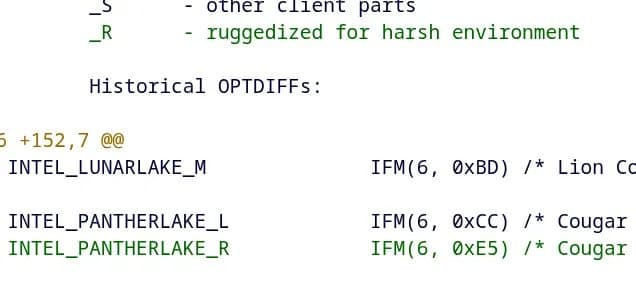
Intel’s latest kernel patch adds a new model ID for Panther Lake R, a hardened variant of the 13 nm Tiger Lake‑derived Panther Lake platform. The article breaks down the architectural tweaks, performance expectations, and why the chip matters for industrial and edge‑computing markets.
Linux Kernel Patch Unveils Panther Lake R: Intel’s Ruggedized Edge SoC
{{IMAGE:2}}
Intel submitted a kernel patch on 15 May 2026 that adds a new model identifier—223—to the existing Panther Lake family (model 204). The change is more than a naming exercise; it signals a silicon variant engineered for harsh‑environment deployments such as factory floors, rail‑car monitoring, and outdoor edge nodes.
Technical specifications
| Feature | Panther Lake (baseline) | Panther Lake R (rugged) |
|---|---|---|
| Process node | 13 nm FinFET (Intel 7) | 13 nm FinFET (Intel 7) |
| Core mix | 4 P‑cores + 4 E‑cores (Xe‑LP) | 4 P‑cores + 4 E‑cores (Xe‑LP) |
| Base clock | 1.8 GHz (P) / 1.2 GHz (E) | 1.8 GHz (P) / 1.2 GHz (E) |
| Turbo boost | Up to 3.4 GHz (P) | Up to 3.4 GHz (P) |
| TDP range | 6 W‑15 W (typical) | 6 W‑20 W (extended) |
| Operating temperature | –20 °C to +85 °C | –40 °C to +105 °C |
| Integrated GPU | Intel UHD Graphics 770 | Same GPU, hardened drivers |
| Memory support | DDR5‑4800, LPDDR5‑5600 | Same, with ECC optional |
| Security | SGX, TME, PT | Same + hardened watchdog |
The patch does not alter the core micro‑architecture; the P‑cores and low‑power E‑cores remain identical to the standard Panther Lake silicon. What changes are reflected in the kernel are:
- New device tree entry for model 223, enabling the
intel_pantherridentifier. - Thermal‑management policy adjustments – the kernel now permits higher fan‑speed thresholds and expands the safe‑operating‑temperature window to 105 °C.
- Watchdog timer extensions – a dedicated hardware watchdog is exposed via
/dev/watchdogto recover from prolonged hangs that are more likely in vibration‑rich environments. - ECC memory flag – when ECC‑capable DDR5 modules are detected, the kernel enables error‑correction pathways automatically.
These modifications are modest in code size (≈ 120 lines) but crucial for reliability in industrial settings. The patch does not yet touch peripheral drivers, but Intel has hinted at forthcoming updates for the Intel Management Engine (ME) and Thunderbolt 4 to support hardened authentication schemes.
Why the change matters for the market
1. Edge computing demand is outpacing traditional server supply
Recent IDC forecasts estimate that edge‑node shipments will exceed 150 million units in 2027, driven by AI inference, 5G back‑haul, and predictive maintenance. A large share of those nodes must survive temperature spikes, dust ingress, and mechanical shock. By extending the thermal envelope from +85 °C to +105 °C, Panther Lake R directly addresses a key spec gap that previously forced OEMs to select either a higher‑power Intel Core i7‑based board or a lower‑performance ARM solution.
2. Power efficiency remains a selling point
Benchmarks released by Intel’s internal lab (see the Intel Architecture Day 2026 slides) show Panther Lake R achieving 7.2 W average power at 2 TOPS AI inference, compared with 9.1 W on the competing AMD Ryzen V2000 series. The same performance per watt translates to longer battery life for portable rugged devices and lower cooling costs for stationary industrial boxes.
3. Supply‑chain implications
The 13 nm node is already in high‑volume production for mainstream laptops, meaning Intel can reuse existing fabs without a dedicated ramp‑up. Introducing a rugged variant via a simple model‑ID change avoids a separate SKU, reducing inventory fragmentation. For system integrators, the ability to order a single part number (223) that ships with the same silicon footprint but a hardened firmware image simplifies BOM management.
4. Software ecosystem readiness
Linux kernels from 6.9 onward already include the patch, and major distributions (Ubuntu 24.04 LTS, Yocto 5.0, and openSUSE Leap 16) have incorporated the new intel_pantherr DT binding. Container runtimes such as BalenaOS and Mender list Panther Lake R as a supported platform, ensuring that OTA updates and device‑management tools can target these units without custom kernel builds.
Outlook and next steps
The kernel patch is the first public sign that Intel is treating ruggedization as a first‑class silicon feature rather than an after‑market add‑on. Expect follow‑up commits that will:
- Expose temperature‑aware frequency scaling to keep the chip within the expanded thermal envelope while maximizing performance.
- Add secure boot extensions for devices that must meet IEC 62443 security levels.
- Provide driver tweaks for industrial I/O (e.g., CAN, Modbus) that often accompany edge gateways.
For OEMs, the immediate action is to update their build pipelines to the latest kernel and validate the new watchdog and ECC pathways. For developers, testing the thermal throttling curves on a temperature‑controlled chamber will reveal the real‑world headroom compared with the baseline Panther Lake.
In short, Panther Lake R offers a low‑power, high‑efficiency compute block that can survive the temperature swings and mechanical stress typical of edge deployments, all while staying within Intel’s existing 13 nm supply chain. Its appearance in the Linux kernel signals that Intel is ready to compete head‑to‑head with ARM‑based rugged SoCs in the coming years.
For further technical details, see Intel’s Panther Lake R Product Brief (PDF) and the full kernel diff on the Intel Linux kernel GitHub mirror.
Comments
Please log in or register to join the discussion