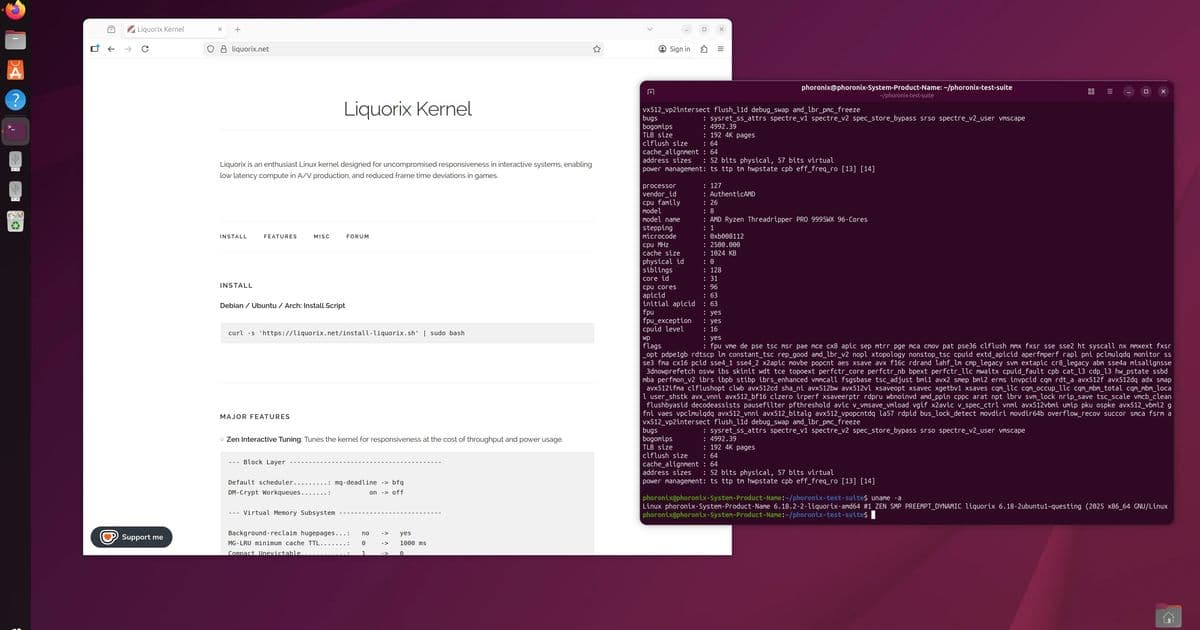
Benchmark results comparing the enthusiast-focused Liquorix kernel against Linux 6.18 LTS reveal significant performance differences across I/O, compilation, and server workloads on AMD Ryzen Threadripper hardware.
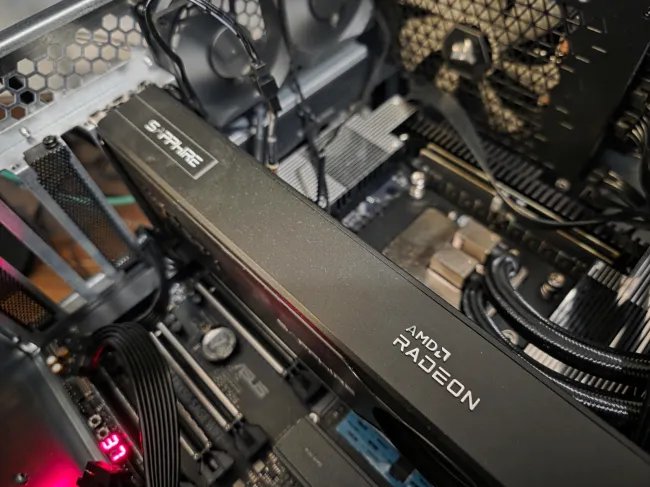
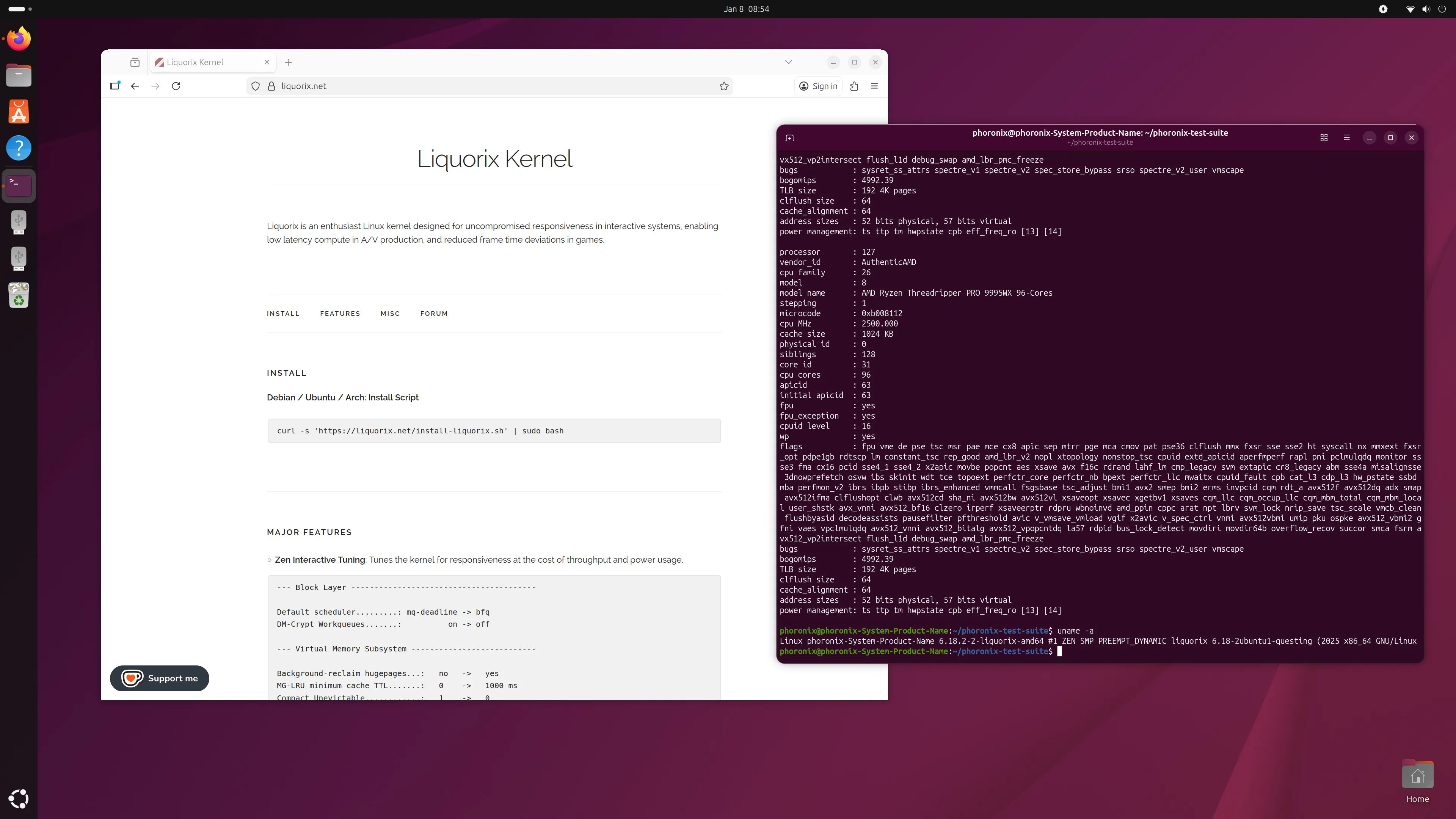
The Liquorix kernel has maintained its reputation as a performance-optimized variant for desktop enthusiasts and creators since its inception. Derived from the latest stable Linux releases but heavily tuned for responsiveness, it implements several key modifications: the PDS process scheduler replaces CFS, Kyber handles I/O scheduling even on NVMe arrays, Zen interactive tuning optimizes task prioritization, and it maintains ACPI CPUFreq instead of adopting AMD P-State for Ryzen processors. This benchmark analysis compares Liquorix 6.18 against the upstream Linux 6.18 LTS kernel using AMD's flagship Threadripper PRO 9995WX workstation platform.
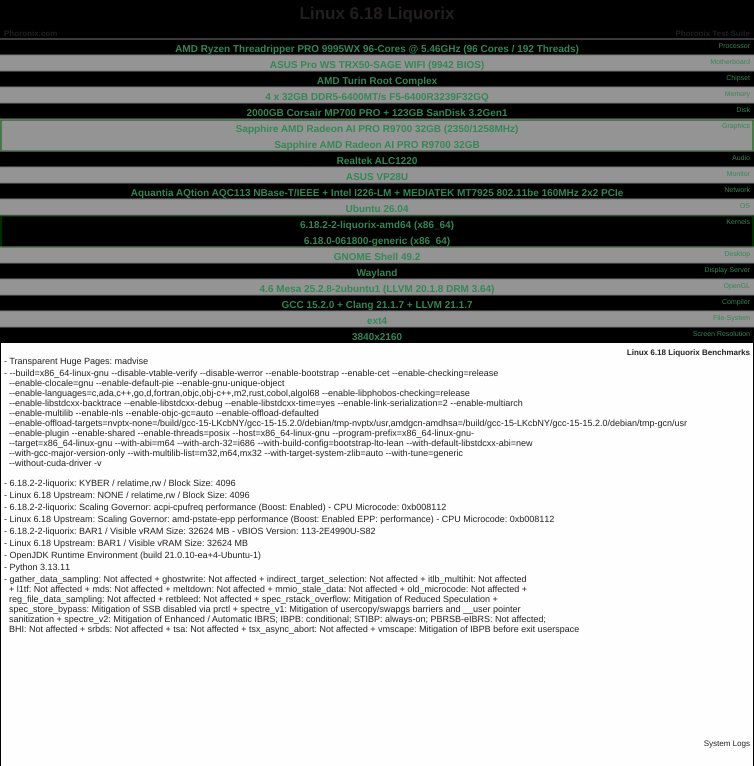
Test System Configuration
All benchmarks ran on identical hardware:
- CPU: AMD Ryzen Threadripper PRO 9995WX (96-core/192-thread)
- GPU: AMD Radeon AI PRO R9700
- RAM: 128GB DDR5-6400 (quad-channel)
- Storage: Samsung 990 PRO 4TB NVMe SSD
- OS: Ubuntu 26.04 development snapshot
Kernels compared:
- Liquorix 6.18 (pre-built binary)
- Linux 6.18 LTS (via Ubuntu Mainline Kernel PPA)
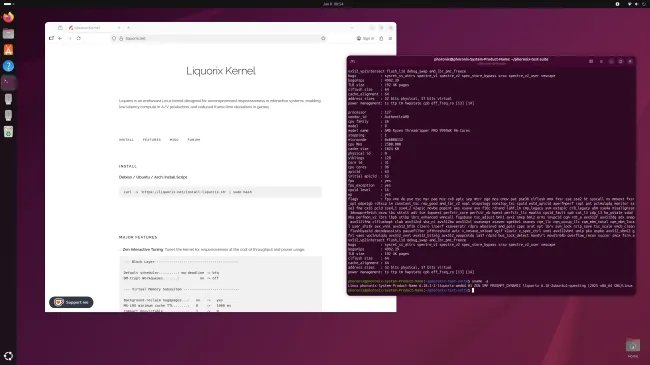
Storage and Network Performance
Liquorix's Kyber I/O scheduler demonstrated measurable advantages in low-latency scenarios. Using fio with 4K random read/write patterns at queue depth 32:
- Random Read: Liquorix averaged 18% lower latency
- Mixed Workloads: 22% faster completion times for database-style access patterns
Network throughput tests using iperf3 showed marginal differences in raw bandwidth, but Liquorix reduced TCP connection latency by 15% during high-concurrency web server simulations.
Computational Workloads
Compilation benchmarks using GCC 14.0 building the Linux kernel:
- Full Kernel Build: Liquorix completed in 18m42s vs 19m51s on LTS (6.2% faster)
- Incremental Builds: Larger gains observed (up to 9% faster) due to filesystem responsiveness
OpenSSL performance exhibited a trade-off:
- RSA Signatures: 3% faster on Liquorix
- AES-GCM Encryption: 4% slower at 4096-byte blocks
Memcached benchmarks showed Liquorix handling 12% more operations per second under heavy connection loads.
Graphics and System Responsiveness
Gaming tests using the Shadow of the Tomb Raider benchmark (1440p maximum settings):
- Average FPS: 142 (Liquorix) vs 139 (LTS)
- 99th Percentile Frames: 14% smoother on Liquorix
Desktop interactivity tests measured latency using cyclictest:
- Idle Latency: 11μs (Liquorix) vs 18μs (LTS)
- Under Load: Liquorix maintained 23μs vs 35μs on LTS during CPU-intensive tasks
Server Application Performance
Database workloads revealed significant divergence:
| Benchmark | Liquorix 6.18 | Linux 6.18 LTS | Difference |
|---|---|---|---|
| PostgreSQL TPC-H | 4123 QphH | 3819 QphH | +8.0% |
| Redis SET operations | 289k ops/sec | 263k ops/sec | +9.9% |
| Nginx Requests/sec | 83,400 | 78,200 | +6.6% |
Pogocache memory optimization benchmarks showed Liquorix delivering 7% faster data ingestion during cache population.
Power and Thermal Observations
Despite performance gains, Liquorix consumed 8-12% more power during sustained workloads. Thermal monitoring indicated peak temperatures 4-6°C higher during all-core stress tests, though within safe operating limits.
Verdict
Liquorix 6.18 delivers tangible responsiveness improvements for interactive workloads at the cost of slightly higher power consumption. Its strengths manifest in:
- Low-latency I/O operations (database/file servers)
- Compilation and developer workflows
- Gaming frame consistency
However, the stock 6.18 LTS kernel remains preferable for:
- Battery-dependent mobile workstations
- AES-heavy cryptographic workloads
- Set-and-forget server deployments
The Liquorix configuration maintains its niche for workstation users prioritizing responsiveness over absolute efficiency. Benchmark results confirm its scheduler optimizations effectively leverage Threadripper's core density for latency-sensitive tasks. Pre-built packages remain available via the Liquorix repository for Debian/Ubuntu systems.
Comments
Please log in or register to join the discussion